
Entrance Exams for BBA in Business Analytics 2026
Getting into a good BBA in Business Analytics program depends largely on your target institute's admission approach. Here's what to expect in 2026.
Merit-based admission (common at many institutes)
Several colleges offering this specialisation admit students purely based on 12th-grade academic performance, without requiring a separate entrance exam, particularly at state and regional institutes.
CUET (Common University Entrance Test)
Increasingly the standard entrance route for central universities and many state universities, CUET scores are now widely accepted for BBA admissions, including Business Analytics specialisations.
Institute-specific entrance exams
Several private universities conduct their own entrance tests, typically assessing:
- Quantitative aptitude and numerical reasoning
- Logical reasoning and analytical thinking
- English language proficiency
- Basic data interpretation skills
State-level entrance exams
Various state governments conduct their own common entrance tests (CETs) for BBA admissions, applicable depending on your target university's location.
Group Discussion and Personal Interview rounds
Some institutes, particularly more selective ones, conduct GD-PI rounds specifically evaluating communication skills, logical thinking, and genuine interest in analytics and business strategy.
Our advice:
Since this specialisation values analytical thinking, even institutes with merit-based admission alone tend to favour candidates with stronger performance in Mathematics or quantitative subjects during 12th grade — so if entrance exams are required, dedicate extra preparation time to quantitative aptitude and data interpretation sections for 2026.
BBA in Business Analytics Course Cutoffs 2026
Wondering what academic score you need to secure admission? Here's the honest picture for 2026.
General cutoff trends
BBA in Business Analytics cutoffs are generally moderate, with most institutes requiring 55-65% aggregate marks in 12th grade for merit-based admission — slightly higher than general BBA programs given thespecialisation'ss growing popularity.
What affects cutoffs?
- Institute reputation and industry partnerships, particularly with analytics-focused companies
- Number of available seats for this specific specialisation
- Category (General, OBC, SC, ST) with standard reservation-based relaxations
- Whether admission is merit-based or entrance-exam-based
- Overall applicant demand, which has been rising given growing interest in analytics careers
Top-tier private institutes
Well-established institutes with strong industry tie-ups and modern analytics labs may set higher cutoffs, typically around 65-75%, given increased demand for their stronger placement records.
Mid-tier and emerging institutes
Many colleges maintain relatively accessible cutoffs around 55-60%, making this specialisation genuinely reachable for students with decent academic performance.
CUET-based admissions
For universities using CUET, specific cutoff percentiles vary by institute and change annually based on applicant volume and the difficulty level of that year's exam.
Reserved category relaxations
SC, ST, and OBC candidates typically benefit from standard cutoff relaxations of 5%, consistent with broader government reservation policies.
Our advice:
Since this specialisation's popularity has been rising steadily, don't assume cutoffs will remain static year-over-year — check the most recent admission cycle's actual cutoff trends directly from your target institutes rather than relying on older data for your 2026 application strategy.
BBA in Business Analytics Syllabus 2026
Understanding the curriculum structure helps you know exactly what to expect from this specialisation in 2026.
Year 1: Foundation subjects
- Principles of Management
- Financial Accounting
- Business Statistics and Probability
- Business Communication
- Introduction to Data Analytics
- Basic Computer Applications and Excel
- Microeconomics
Year 2: Core business and analytics subjects
- Marketing Management
- Human Resource Management
- Data Analysis and Interpretation
- Introduction to Programming (Python/R basics)
- Database Management and SQL Fundamentals
- Financial Management
- Business Research Methods
Year 3: Specialised and applied subjects
- Data Visualisation (Power BI/Tableau)
- Marketing Analytics
- Financial Analytics
- Business Intelligence Fundamentals
- Strategic Management
- Predictive Analytics Basics
- Industry Internship and Capstone Project
Practical components:
- Hands-on training with real business datasets
- Live industry projects with analytics-focused companies
- Case study competitions applying data insights to business scenarios
- Summer internship, typically after Year 2
- Final year capstone project addressing a genuine business analytics problem
Elective specialisations (vary by institute):
- Marketing Analytics Track
- Financial Analytics Track
- Operations Analytics Track
- HR Analytics Track
Assessment methods:
Programs typically combine written examinations, practical lab work, project presentations, and continuous evaluation through assignments and case studies.
Our advice:
When comparing programs, check the balance between theoretical business coursework and genuine hands-on analytics training with real datasets, since practical exposure to tools like SQL and Power BI significantly impacts your job readiness upon graduation in 2026.
Top BBA in Business Analytics Colleges in India
Choosing the right college significantly impacts your practical training quality and placement outcomes. Here are India's leading institutes offering BBA in Business Analytics for 2026.
Christ University, Bangalore
Known for its strong academic reputation and growing analytics-focused curriculum, backed by solid industry connections and consistent placement performance.
Symbiosis Centre for Management Studies (SCMS)
Offers a well-regarded BBA with analytics specialisation, known for practical, industry-aligned coursework and strong alumni networks.
NMIMS Mumbai (School of Business Management)
Recognised for its comprehensive business analytics curriculum at the undergraduate level, backed by strong corporate connections.
Amity University (Multiple Campuses)
Offers a dedicated BBA in Business Analytics program with modern infrastructure and growing industry partnerships across major campuses.
Christ University and St. Xavier's affiliated colleges
Known for rigorous academic standards combined with growing emphasis on practical analytics training.
Woxsen University, Hyderabad
Offers a specialised, modern curriculum with strong emphasis on technology integration and industry-relevant analytics training.
Chandigarh University
Provides BBA in Business Analytics with practical training components and reasonable fee structures, popular among North Indian students.
Manipal University
Known for quality infrastructure and strong industry connections, offering solid analytics-focused business education.
Our advice:
When shortlisting colleges, prioritise institutes with dedicated analytics labs, industry certifications embedded in the curriculum (like Power BI or Google Analytics), and placement records specifically for the Business Analytics specialisation rather than general BBA placement statistics alone.
Best Government BBA in Business Analytics Colleges
For students seeking quality education at more affordable fees, government and public institutes offering this specialisation remain solid choices for 2026.
Delhi University Affiliated Colleges
Several DU colleges have begun incorporating business analytics electives within their BBA programs, offering government-subsidised fees combined with strong academic reputation.
Central Universities offering BBA (via CUET)
Various central universities across India now offer BBA programs with analytics-focused electives, accessible through CUET scores at significantly lower fees than private institutes.
State University Business Schools
Many state universities have started introducing business analytics specialisations within their BBA programs, offering affordable, government-subsidised education with decent regional industry connections.
Jamia Millia Islamia, Delhi
Offers BBA programs with growing analytics-focused coursework at significantly lower fees compared to private institutes.
Punjab University, Chandigarh
Provides BBA programs with analytics electives, backed by government-subsidised fee structures and solid regional recognition.
Why choose government institutes?
Beyond lower fees, government institutes often benefit from strong academic rigour, established reputation, and increasingly modernised curriculum incorporating analytics coursework, even if their programs aren't always explicitly branded as "Business Analytics" specialisations.
Our advice:
Since dedicated BBA in Business Analytics programs remain more common at private institutes, government institute applicants should specifically verify whether analytics coursework and practical tool training are genuinely embedded in the curriculum, rather than assuming standard BBA programs automatically include this specialisation for 2026 admissions.
Best Private BBA in Business Analytics Colleges
Looking specifically at private institutes for your BBA in Business Analytics? Here are the top options offering strong programs in 2026.
Christ University, Bangalore
Widely recognised for its strong academic reputation combined with a growing analytics-focused curriculum and solid industry connections.
NMIMS Mumbai
A leading private institute known for its comprehensive business analytics curriculum, backed by strong corporate connections and consistent placement performance.
Symbiosis Centre for Management Studies (SCMS), Pune
Offers a well-structured analytics specialisation within its BBA program, known for industry-aligned coursework and strong alumni network.
Woxsen University, Hyderabad
Known for its modern, technology-integrated curriculum with strong emphasis on practical analytics training and industry certifications.
Amity University (Multiple Campuses)
Offers accessible, well-structured BBA in Business Analytics programs with decent industry connections and placement support across various campus locations.
Chandigarh University
Known for practical, industry-relevant analytics coursework combined with reasonable fee structures, particularly popular among North Indian students.
Manipal University
Recognised for quality infrastructure and strong industry connections, offering solid analytics-focused business education.
Jaipuria Institute of Management
Known for practical, industry-relevant coursework across multiple campus locations, with growing emphasis on analytics specialisations.
What to prioritise:
When choosing between private institutes, focus on placement records specific to analytics-related roles, faculty industry experience, and availability of hands-on training with real business datasets rather than institute reputation alone.
Our advice:
Since private institute fees can vary significantly, always request placement reports specifically for the Business Analytics specialisation (not just overall BBA placements) to get an accurate picture of career outcomes before committing to a 2026 admission.
Top Job Profiles After BBA in Business Analytics
BBA in Business Analytics Colleges Comparison
Comparing your options side by side makes decision-making easier. Here's how top institutes stack up across key factors for 2026.
Industry partnerships and analytics infrastructure
- NMIMS Mumbai and Christ University lead with strong, established corporate analytics partnerships and dedicated analytics labs
- Woxsen University stands out for technology integration, with modern infrastructure specifically built around analytics training.
- Symbiosis SCMS and Amity University offer solid mid-tier industry connections with growing analytics-focused partnerships.
Placement strength
- NMIMS Mumbai and Christ University typically report the strongest placement records with analytics and consulting-focused recruiters
- Symbiosis SCMS and Woxsen offer consistent, solid placements though slightly below top-tier packages.s
- Chandigarh University and Amity (regional campuses) generally show moderate placement outcomes, often stronger for entry-level analytics support roles
Fee affordability
- Government/central university options and DU-affiliated colleges offer the most budget-friendly fee structures.
- Chandigarh University and Amity (non-flagship campuses) provide relatively accessible private fee structures.s
- NMIMS, Christ University, and Woxsen charge premium fees reflecting stronger infrastructure and placement outcomes
Curriculum depth and specialization options
- Woxsen and NMIMS offer the most technology-forward curriculum with embedded industry certifications.
- Christ University and Symbiosis provide strong balance between business fundamentals and analytics training.
- Government institutes often provide more standardised coursework, requiring students to verify genuine analytics depth before enrolling.
Our advice:
If strong industry connections and premium analytics infrastructure matter most, prioritise NMIMS or Christ University. If affordability matters more while still wanting decent analytics exposure, government/central university options or Chandigarh University offer solid alternatives for 2026 admissions.
BBA in Business Analytics Fees 2026
Planning your budget for this specialisation? Here's a realistic breakdown of costs for 2026.
Premium private institutes:
- NMIMS Mumbai: Approximately ₹8-12 Lakhs for the complete three-year program
- Christ University: Approximately ₹6-9 Lakhs for the complete program
- Woxsen University: Approximately ₹9-13 Lakhs for the complete program
Mid-tier private institutes:
- Symbiosis SCMS: Approximately ₹6-8 Lakhs for the complete program
- Amity University: Approximately ₹5-7 Lakhs for the complete program
- Chandigarh University: Approximately ₹3-5 Lakhs for the complete program
- Manipal University: Approximately ₹5-7 Lakhs for the complete program
Government/affordable options:
- DU-affiliated colleges: Approximately ₹50,000-1.5 Lakhs for the complete program
- Central universities (via CUET): Approximately ₹1-2.5 Lakhs for the complete program
- State university business schools: Generally range between ₹1-3 Lakhs
Additional costs to consider:
- Application fees (₹500-2,500 per institute)
- Hostel/accommodation fees, if applicable (₹80,000-1.5 Lakhs annually)
- Software licensing and analytics tool certification costs (if not included in tuition)
- Laptop/computer requirements, given the program's hands-on technical component
Our advice:
Since analytics-focused programs often require genuine software access and lab infrastructure, verify whether tool certifications (Power BI, Google Analytics, etc.) are included in tuition or charged separately — this can meaningfully affect your total cost comparison across institutes for 2026.
BBA in Business Analytics Placements
Placement outcomes are a major deciding factor when choosing your program. Here's what to expect in 2026.
Overall placement trends
Given the strong industry demand for data-literate business graduates, BBA in Business Analytics programs at reputed institutes generally report solid placement percentages, often stronger than general BBA placement rates.
Who's hiring?
- Consulting firms: Deloitte, EY, KPMG, Accenture (analyst-level roles)
- E-commerce companies: Amazon, Flipkart, Myntra
- Banking and financial services: HDFC Bank, ICICI Bank, American Express
- FMCG companies: Hindustan Unilever, Nestlé
- IT and technology companies: TCS, Infosys, Wipro (business analyst tracks)
- Analytics-focused firms: Mu Sigma, Fractal Analytics, LatentView Analytics
Common job roles offered
- Junior Business Analyst
- Data Analyst (Entry-level)
- Marketing Analytics Associate
- Operations Analyst
- Business Intelligence Associate
- Management Trainee (Analytics track)
Factors affecting placement quality
- Institute-specific industry partnerships and analytics infrastructure
- Internship performance during the program
- Individual proficiency in tools like Excel, SQL, and Power BI
- Communication skills and case study problem-solving ability during interviews
Placement support systems
Top institutes typically offer dedicated placement cells, mock case study interviews, resume-building workshops specific to analytics roles, and strong corporate relationships built through live projects.
Our advice:
Before finalising your college choice, always check historical placement reports specifically for the Business Analytics specialisation, average starting packages, and the specific companies that recruited from previous batches to gauge realistic 2026 outcomes.
BBA in Business Analytics Salary in India
Here's a realistic breakdown of what you can expect to earn after completing a BBA in Business Analytics in India for 2026.
Average starting salary
Fresh graduates typically earn between ₹4-7 LPA, meaningfully higher than general BBA starting salaries, reflecting the specialised, in-demand skill set this program builds.
Salary by institute tier
- Top-tier institutes (NMIMS, Christ University): ₹6-9 LPA
- Mid-tier private institutes (Symbiosis, Woxsen, Amity): ₹4-7 LPA
- Government/affordable institutes: ₹3-5 LPA
Salary by job role
- Junior Business Analyst: ₹4-6 LPA
- Data Analyst (Entry-level): ₹4-7 LPA
- Marketing Analytics Associate: ₹4-6 LPA
- Business Intelligence Associate: ₹4.5-7 LPA
- Management Trainee (Analytics track): ₹5-8 LPA
What influences your salary?
- Institute reputation and placement track record
- Technical proficiency in tools like SQL, Python basics, and Power BI
- Internship experience and quality of case study projects completed
- Specific industry and company size
- Location (metro cities typically offer higher packages)
Career growth potential
With 3-5 years of experience, professionals often see salaries rise to ₹10-15 LPA, particularly if they pursue an MBA in Business Analytics or gain specialised certifications along the way.
The bigger picture:
Given the consistent, growing demand for data-literate business professionals across industries, BBA in Business Analytics offers genuinely stronger early-career salary outcomes compared to general BBA programs, with strong long-term growth potential well into 2026 and beyond.
Career Scope After BBA in Business Analytics
Let's talk about long-term career prospects — what does your professional journey actually look like after this degree?
Immediate career scope
With businesses across every sector increasingly relying on data for strategic decisions, BBA in Business Analytics graduates enter a job market with genuinely strong, growing demand at the entry level in 2026.
Industries actively hiring:
- Consulting: Analyst roles supporting data-driven client recommendations
- E-commerce and Retail: Customer analytics, inventory optimisation, and pricing analysis roles
- Banking and Financial Services: Risk analysis, fraud detection support, and customer analytics
- FMCG: Marketing analytics and consumer behaviour analysis
- IT Services: Business analyst tracks supporting technology implementation projects
Career progression path:
- 0-3 years: Junior Business Analyst, Data Analyst, Marketing Analytics Associate
- 3-6 years: Senior Analyst, Analytics Team Lead, Business Intelligence Manager
- 6-10 years: Analytics Manager, Senior Consultant, Head of Business Intelligence
- 10+ years: Director of Analytics, VP of Business Intelligence, Chief Data Officer
Pathway to further specialization
Many graduates pursue an MBA in Business Analytics or Data Science after gaining initial work experience, significantly accelerating their career trajectory into leadership analytics roles.
Entrepreneurial opportunities
Some graduates leverage their combined business and analytics knowledge to start data-consulting services or analytics-focused startups, particularly given the growing market demand for accessible analytics solutions for small and mid-sized businesses.
Global career prospects
Business analytics skills remain valuable internationally, opening doors to career opportunities beyond domestic markets, particularly for graduates who supplement their BBA with additional certifications or a master's degree abroad.
The bigger picture:
As AI and automation continue transforming how businesses operate, professionals who understand both data and business strategy — exactly what this program builds — remain essential, ensuring strong long-term career relevance well beyond 2026.
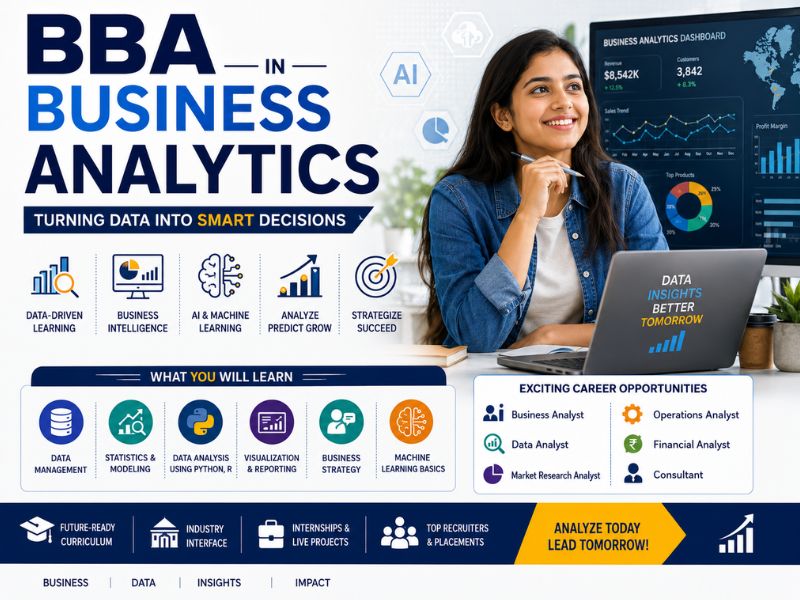
Top Job Profiles After BBA in Business Analytics
Here's a detailed look at the specific job roles available to BBA in Business Analytics graduates in 2026.
1. Junior Business Analyst
Supports senior analysts in examining business processes and data to identify improvement opportunities, working closely with management teams on data-driven recommendations.
2. Data Analyst (Entry-Level)
Focuses on collecting, cleaning, and analysing business data to generate reports and insights supporting day-to-day decision-making.
3. Marketing Analytics Associate
Analyses customer data and campaign performance metrics to support marketing strategy optimisation and improve ROI on marketing spend.
4. Business Intelligence Associate
Assists in maintaining BI dashboards and reports, ensuring stakeholders have access to accurate, real-time business performance data.
5. Financial Analyst (Analytics-focused)
Uses basic data modelling and statistical analysis to support financial reporting, budgeting, and preliminary investment analysis.
6. Operations Analyst
Focuses on analysing operational data to identify efficiency improvements in supply chain, production, or service delivery processes.
7. Management Trainee (Analytics Track)
Many large corporations offer structured management trainee programs specifically for analytics-focused BBA graduates, providing rotational exposure across departments before specialisation.
8. Product Analyst (Entry-Level)
Common in e-commerce and technology companies, analysing user behaviour and product performance data to support product development decisions.
9. Consulting Analyst
Entry-level roles at consulting firms supporting client engagements with data analysis, market research, and business case development.
10. Customer Insights Associate
Focuses on analysing customer behaviour and feedback data to support customer experience and retention strategies.
Our advice:
Your specific specialisation track (marketing, financial, or operations analytics) and internship experience during your BBA program often determine which job profile aligns best with your skills — use your internship strategically to explore roles that genuinely interest you before final placements in 2026.
Top Recruiters for BBA in Business Analytics Graduates
Curious which companies actively hire BBA in Business Analytics graduates? Here's a look at major recruiters across sectors in 2026.
Consulting firms:
- Deloitte
- EY (Ernst & Young)
- KPMG
- Accenture
- PwC
E-commerce and retail:
- Amazon
- Flipkart
- Myntra
- Reliance Retail
Banking and financial services:
- HDFC Bank
- ICICI Bank
- American Express
- Axis Bank
FMCG companies:
- Hindustan Unilever
- Nestlé
- ITC Limited
IT and technology services:
- TCS (Tata Consultancy Services)
- Infosys
- Wipro
- Accenture (technology analytics divisions)
Specialised analytics firms:
- Mu Sigma
- Fractal Analytics
- LatentView Analytics
- Tredence Analytics
Telecommunications:
- Airtel
- Reliance Jio
Our advice:
These recruiters typically prioritise candidates with strong technical fundamentals (Excel, SQL, basic Python), relevant internship experience, and solid case study problem-solving abilities demonstrated during interviews. Building a portfolio of analytics projects during your BBA significantly improves your chances of landing roles with these top employers in 2026.
Skills Required for BBA in Business Analytics
Wondering what skills actually matter for success in this field? Here's a comprehensive breakdown for 2026.
Technical and analytical skills
- Advanced Excel proficiency: Essential foundational skill for data manipulation, pivot tables, and basic analysis across nearly every business function
- SQL fundamentals: Ability to query and extract data from databases, a core requirement for most entry-level analytics roles
- Basic programming (Python/R): While not requiring deep expertise, foundational familiarity significantly strengthens your analytical capabilities
- Data visualisation tools: Working knowledge of Power BI or Tableau for presenting insights clearly to stakeholders
- Statistical fundamentals: Understanding of basic statistical concepts like averages, correlations, and trend analysis
Business and strategic skills
- Business acumen: Understanding of core business functions (marketing, finance, operations) to contextualise data insights meaningfully
- Critical thinking: Ability to identify relevant business problems that data can genuinely help solve
- Data interpretation: Translating raw numbers into clear, actionable business insights rather than just presenting statistics
Communication and soft skills
- Presentation skills: Ability to explain data findings clearly to non-technical stakeholders and management
- Written communication: Creating clear reports and summaries that effectively communicate analytical findings
- Collaboration: Working effectively with cross-functional teams including marketing, finance, and IT departments
Problem-solving and adaptability
- Analytical problem-solving: Approaching business challenges systematically using data-driven frameworks
- Adaptability: Comfort with learning new tools and adapting to evolving analytics technologies
Emerging skills for 2026
- AI tool familiarity: Basic comfort using AI-powered analytics and productivity tools is becoming a genuine differentiator
- Cloud platform basics: Growing relevance as businesses increasingly store and process data on cloud platforms like AWS or Google Cloud
Our advice:
While your BBA coursework builds foundational knowledge, actively practising with real datasets through online platforms (like Kaggle) and pursuing basic certifications in Excel, SQL, or Power BI during your degree will significantly strengthen your employability in 2026's competitive job market.
Higher Studies After BBA in Business Analytics
Considering further education after your BBA in Business Analytics? Here are the most valuable pathways for 2026.
1. MBA in Business Analytics
The most popular and directly relevant choice, offering advanced management education combined with deeper analytics specialisation, ideally pursued after 2-3 years of work experience for stronger admission chances and richer application.
2. MS in Business Analytics or Data Science
For students wanting deeper technical specialisation, master's programs focused specifically on analytics or data science (domestic or abroad) offer more intensive technical training beyond the business-focused BBA foundation.
3. MBA in General Management
For students wanting broader business exposure beyond analytics specifically, a general MBA with relevant electives can open doors to leadership roles across various functions.
4. PGDM in Business Analytics
Offered by specialised institutes, Post Graduate Diploma programs provide similar depth to an MBA, often with a more flexible, industry-aligned curriculum specifically focused on analytics applications.
5. Professional Certifications
Certifications like Google Data Analytics, Microsoft Power BI, or SQL certifications can supplement your degree without requiring a full additional postgraduate program.
6. Study Abroad Options
Countries like the US, UK, and Canada offer specialised master's programs in Business Analytics or Data Science, providing international exposure and potentially stronger global career opportunities.
7. PhD/Doctoral Studies
For those interested in analytics research or academia, pursuing a PhD in Business Analytics or a related field after gaining relevant experience offers a long-term academic career path.
Our advice:
If you're considering an MBA or MS in Business Analytics, gaining 2-3 years of relevant work experience first often leads to better admission chances at top programs and allows you to apply classroom learning more meaningfully to real workplace challenges.
BBA in Business Analytics vs BBA in Data Science
Trying to decide between these two closely related specialisations? Here's an honest comparison for 2026.
Core focus difference
BBA in Business Analytics emphasises applying data insights to business strategy, marketing, finance, and operations decisions, maintaining a strong management focus throughout. BBA in Data Science leans more technical, focusing deeper on programming, machine learning fundamentals, and algorithmic thinking, sometimes at the expense of broader business coursework.
Curriculum comparison
Business Analytics programs balance technical skills (SQL, basic Python, visualisation tools) with substantial core business subjects like Marketing, Finance, and Strategy. Data Science programs typically include more intensive coding, statistical modelling, and machine learning coursework, with comparatively less emphasis on traditional business management subjects.
Career path differences
Business Analytics graduates often move into roles like Business Analyst, Marketing Analytics Associate, or Management Trainee, where business context matters as much as technical skill. Data Science graduates typically pursue more technical roles like Junior Data Scientist or Data Engineer, requiring stronger programming foundations.
Who should choose which?
- Choose Business Analytics if you want to blend business management knowledge with practical data skills, keeping career options open across business functions.s
- Choose Data Science if you're drawn toward deeper technical work and want to build stronger programming and machine learning foundations from the undergraduate level
Prerequisite comfort level
Business Analytics is generally more accessible for students without strong prior technical or programming backgrounds, while Data Science typically expects greater comfort with mathematics and logical/programming thinking from the start.
Salary comparison
Both specialisations offer competitive entry-level salaries, though Data Science roles sometimes command slightly higher starting packages in pure tech companies, while Business Analytics offers more balanced opportunities across business functions and industries.
Our advice: If you enjoy business strategy as much as data work and want to keep management career paths open, Business Analytics offers better versatility. If you're specifically drawn to the technical, programming-heavy side of data work, Data Science provides deeper foundational preparation for 2026 and beyond.
Future Scope of BBA in Business Analytics
Wondering if this specialisation holds long-term value? Here's why the outlook remains genuinely strong for 2026 and beyond.
1. Accelerating data-driven business practices
As companies across every industry continue prioritising data-informed decision-making, the demand for business graduates who understand analytics remains on a consistent upward trajectory.
2. Growing AI and automation integration
Rather than replacing analytics-literate business professionals, AI and automation are increasingly creating demand for people who can interpret AI-generated insights and apply them strategically — exactly the skill set this program builds.
3. Cross-industry applicability
Unlike narrower technical specialisations, business analytics skills remain relevant across virtually every industry — finance, retail, healthcare, technology — providing genuine long-term career flexibility.
4. Strong foundation for evolving career paths
As new analytics-adjacent roles continue emerging (like AI product management or data storytelling), graduates with this blended business-analytics foundation are well-positioned to adapt to evolving job titles and responsibilities.
5. Increasing corporate investment in analytics infrastructure
Companies continue to invest heavily in analytics teams and data infrastructure, ensuring sustained demand for professionals who can bridge business strategy and data interpretation.
6. Global relevance
Business analytics skills remain valuable internationally, offering graduates potential pathways to global career opportunities, particularly when combined with further studies or certifications.
7. Entrepreneurial potential
Growing demand for accessible, affordable analytics solutions among small and mid-sized businesses creates entrepreneurial opportunities for graduates who understand both business needs and analytical solutions.
The bigger picture:
While specific tools and technologies will continue evolving, the fundamental need for professionals who can bridge business strategy and data interpretation remains a durable, growing career foundation — ensuring BBA in Business Analytics holds genuine long-term relevance well into 2026 and beyond.
Frequently Asked Questions (FAQs)
1. What is the eligibility for BBA in Business Analytics?
Candidates need to complete 12th grade (any stream) with a minimum of 50-60% aggregate marks from a recognised board, with a Mathematics background being advantageous though not always mandatory.
2. Do I need programming knowledge before joining this course?
No, prior programming knowledge isn't required. The curriculum introduces basic programming (Python/R) and analytics tools from the ground up, making it accessible even for students without a technical background.
3. What is the average salary after BBA in Business Analytics?
Fresh graduates typically earn between ₹4-7 LPA, meaningfully higher than general BBA starting salaries, with top-tier institute graduates earning ₹6-9 LPA.
4. Is BBA in Business Analytics better than a regular BBA?
It depends on your career goals. If you want a competitive edge with in-demand analytical skills, this specialisation offers stronger placement outcomes and salary potential. A regular BBA offers broader flexibility if you're unsure about pursuing an analytics-focused career.
5. Which entrance exams are accepted for this specialisation?
CUET is increasingly the standard route for many universities, alongside institute-specific entrance exams and state-level CETs, though several colleges also admit based on merit (12th-grade marks) alone.
6. Should I pursue an MBA after BBA in Business Analytics?
Many experts recommend gaining 2-3 years of work experience first, as this typically leads to better MBA admission chances and allows you to apply classroom learning more meaningfully to real workplace challenges.
7. Which companies hire BBA in Business Analytics graduates?
Major recruiters include Deloitte, EY, Amazon, HDFC Bank, TCS, and specialised analytics firms like Fractal Analytics and Mu Sigma.
8. What's the difference between BBA in Business Analytics and BBA in Data Science?
Business Analytics maintains a stronger business management focus with practical analytics skills, while Data Science leans more technical with deeper programming and machine learning coursework.
Conclusion
BBA in Business Analytics offers Indian students a genuinely smart, future-focused pathway into the business world in 2026, combining core management fundamentals with increasingly essential data literacy skills. As companies across every industry continue prioritising data-driven decision-making, graduates with this blended skill set enjoy meaningful early-career advantages over general BBA graduates.
From accessible eligibility criteria and diverse specialisation options to strong placement outcomes and clear pathways toward further specialisation through an MBA or professional certifications, this degree provides a well-rounded, practically valuable foundation. While the coursework demands genuine engagement with quantitative and analytical thinking, the payoff — stronger salaries, broader career flexibility, and long-term relevance in an increasingly data-driven business world — makes it a compelling choice for students genuinely interested in where business and data intersect.