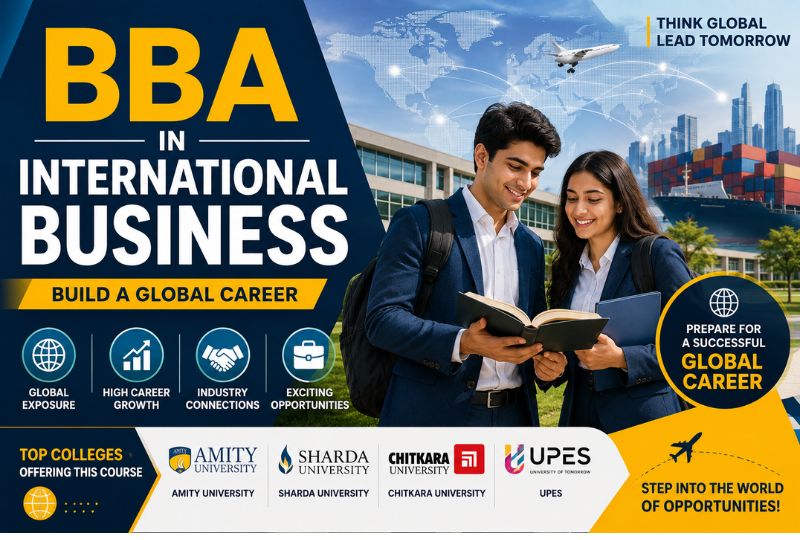
Let's cut to the chase.
BBA in International Business puts you at the centre of how money and goods actually move across borders.
This three-year undergraduate program isn't just business theory. It's a direct pipeline into global trade, export-import operations, and multinational business strategy.
Why does it matter right now?
Indian companies are going global. MNCs are deepening their India footprint. And someone needs to manage the trade regulations, foreign exchange, and cross-border logistics that come with it.
Here's what you'll actually study:
But it's not all classroom theory. You'll get hands-on exposure through:
Here's the interesting part: 2026 is seeing rising demand specifically in global supply chain management and trade compliance — driven by shifting tariffs, evolving trade agreements, and genuine geopolitical uncertainty.
The payoff? Career variety, real global exposure, and long-term relevance in an economy that's only getting more interconnected.
Bottom line: if you want a business degree that doesn't box you into one country or one industry, this is it.
Simple version: it's the business degree built for a world without borders.
While a general BBA teaches you how business works, this one teaches you how business works across countries — different currencies, different laws, different cultures, same deadline pressure.
Core coursework covers:
Layered on top of the usual BBA staples — Accounting, HR, Communication, Organisational Behaviour.
Here's what makes it different from a regular BBA:
You learn the actual mechanics of cross-border commerce — trade documentation, customs procedures, currency risk, global supply chains, cross-cultural negotiation. Not theory. Mechanics.
And you don't just read about geopolitics and trade policy — the curriculum forces you to understand how these factors directly shape whether a shipment clears customs or a deal falls apart.
The practical side matters too:
Case study competitions. Internships with export-import firms and MNCs. Simulation-based learning on real trade scenarios.
By the end, you understand global commerce as a system — not just a buzzword on your resume.
That's exactly why export houses, MNCs, logistics companies, and trade consultancies specifically look for this degree in 2026.
Still deciding? Here's why this move makes sense.
1. India is going global — and staying global.
As Indian companies expand overseas and multinationals deepen their India presence, someone needs to manage that cross-border complexity. That's you.
2. You're not limited to India.
Most business degrees keep you domestic. This one doesn't. Your skills transfer to MNCs, international trade bodies, and global logistics firms — anywhere, not just here.
3. Four functions, one degree.
Export-import operations. International marketing. Supply chain. Trade compliance. Pick your lane later — right now, you get exposure to all of it.
4. It's genuinely interesting.
If geopolitics, global economics, and cross-cultural dynamics interest you, this beats sitting through another domestic marketing case study.
5. E-commerce just made this bigger.
Cross-border digital trade is exploding. That's a whole new career lane that didn't exist a decade ago.
6. It sets up your next move.
Want an MBA in International Business later? Or a master's abroad? This degree is built as the natural stepping stone.
The bottom line: If you want global exposure, intellectual variety, and options beyond the Indian job market, this specialisation delivers all three in 2026.
Here's what you actually walk away with.
1. Knowledge general BBA grads don't have
Trade regulations. Forex dynamics. Cross-border operations. This isn't generic business knowledge — it's specialised, and it shows.
2. Skills that travel
Unlike domestic-onlyspecialisationss, this knowledge works the same whether you're in Mumbai, Dubai, or Singapore.
3. Cross-cultural fluency
You'll naturally build negotiation and communication skills for working across cultures — useful for international roles, but honestly useful for any team with diverse stakeholders.
4. Works across every industry
Manufacturing, tech, textiles, pharma, agriculture — anyone trading across borders needs this skill set. That's most industries.
5. A real launchpad for further study
MBA in International Business? Master's abroad? This degree is practically designed to feed into both.
6. You're future-proofed against trade shifts
As supply chains diversify and trade agreements continue to evolve, people who understand this complexity become more valuable, not less.
7. Built-in entrepreneurship value
Thinking about starting an export-import business or trade consultancy someday? This is literally the knowledge base for that.
8. More intellectually broad than typical business degrees
You're touching international economics, geopolitics, and cultural studies — not just spreadsheets.
The takeaway: This degree gives you globally transferable skills in an economy that keeps getting more connected, not less. That's the whole bet — and in 2026, it's a good one.
Educational qualification:
Subject preference (where applicable):
Age requirement:
English proficiency:
Entrance exam requirements (varies by institute):
Step 1: Research and shortlist colleges
Begin by researching institutes offering BBA in International Business, checking curriculum structure, global business partnerships, and placement records.
Step 2: Check entrance exam requirements
Verify whether your target institutes require CUET, an institute-specific entrance exam, or admit based on merit (12th-grade marks) alone.
Step 3: Submit your application
Complete the online or offline application form with your academic transcripts, photographs, and required documents within specified deadlines.
Step 4: Appear for entrance exam (if applicable)
Where required, appear for the institute's specific entrance test or CUET, typically assessing general aptitude, reasoning, and basic English proficiency.
Step 5: Attend Group Discussion/Personal Interview
Many institutes conduct GD-PI rounds specifically evaluating communication skills, awareness of global economic and trade issues, and genuine interest in international business.
Step 6: Receive admission offer
Based on your merit score, entrance exam performance, and interview evaluation, institutes release admission offers, often through a merit list.
Step 7: Complete document verification and fee payment
Confirm your seat by completing document verification and paying the required admission fee within specified deadlines.
Step 8: Attend orientation and begin coursework
Once enrolled, most institutes conduct an orientation program introducing you to the international business curriculum and any global exposure opportunities.
Our advice: Since GD-PI rounds for this specialisation often probe genuine awareness of global trade and current affairs, stay updated on major international business news and trade developments before your interview for 2026 admissions.
Merit-based admission (common at many institutes)
Several colleges offering this specialisation admit students purely based on 12th-grade academic performance, without requiring a separate entrance exam.
CUET (Common University Entrance Test)
Increasingly the standard entrance route for central universities and many state universities, CUET scores are widely accepted for BBA admissions, including International Business specialisations.
Institute-specific entrance exams
Several private universities conduct their own entrance tests, typically assessing general aptitude and reasoning, English language proficiency, basic quantitative ability, and general awareness of global economics and current affairs.
State-level entrance exams
Various state governments conduct their own common entrance tests (CETs) applicable for BBA admissions, depending on your target university's location.
Group Discussion and Personal Interview rounds
Many institutes, particularly more selective ones, conduct GD-PI rounds specifically evaluating communication skills, global awareness, and genuine interest in international trade and business.
Our advice: Since this specialisation values global awareness alongside standard business aptitude, regularly follow international business news and major trade developments to strengthen your performance in interviews and group discussions for 2026 admissions.
General cutoff trends
BBA in International Business cutoffs are generally moderate, with most institutes requiring 55-65% aggregate marks in 12th grade for merit-based admission.
What affects cutoffs?
Top-tier private institutes
Well-established institutes with strong international business partnerships and study-abroad exchange programs may set higher cutoffs, typically around 65-75%, given stronger placement and global exposure records.
Mid-tier and emerging institutes
Many colleges maintain relatively accessible cutoffs around 55-60%, making this specialisation genuinely reachable for students with decent academic performance.
Reserved category relaxations
SC, ST, and OBC candidates typically benefit from standard cutoff relaxations of 5%, consistent with broader government reservation policies.
Our advice: Rather than fixating on a specific cutoff number, prioritise researching each institute's actual global business partnerships, exchange program opportunities, and specific International Business placement records for 2026 admissions.
Semester 1: Principles of Management, Financial Accounting, Business Communication, Business Economics, Introduction to International Business, Basic Computer Applications
Semester 2: Business Statistics, Organisational Behaviour, Business Environment, International Trade Theories, Business Mathematics, Environmental Studies
Semester 3: Marketing Management, Human Resource Management, International Economics, Export-Import Procedures and Documentation, Business Law
Semester 4: Financial Management, International Marketing, Foreign Exchange Management, International Business Law, Cross-Cultural Management
Semester 5: International Logistics and Supply Chain Management, Global Strategic Management, WTO and Trade Policy, International Human Resource Management, Elective I
Semester 6: International Business Environment and Emerging Markets, Trade Finance and Risk Management, Global E-Commerce, Industry Internship and Capstone Project, Elective II
Practical components: International business case study competitions and simulations, internships with export-import houses, MNCs, or logistics companies, industry visits to trade fairs, ports, or export processing zones, and a final year capstone project addressing a real global business challenge.
Our advice: When comparing programs, check whether your target institute offers genuine international exposure — student exchange programs, global business simulations, or internships with export-import companies — since practical global business experience significantly strengthens your employability in 2026.
Indian Institute of Foreign Trade (IIFT), Delhi/Kolkata — India's premier institute specifically for international trade education, with growing undergraduate-level offerings.
Amity University (Multiple Campuses) — Offers a dedicated BBA in International Business program with strong emphasis on global exposure, exchange programs, and multinational industry partnerships.
Symbiosis Centre for Management Studies (SCMS) — Known for its international business-focused curriculum backed by strong industry connections and study-abroad opportunities.
Christ University, Bangalore — Offers a well-regarded BBA program with international business specialisation, known for strong academic rigour and global exposure initiatives.
Chandigarh University — Provides BBA in International Business with practical training components and reasonable fee structures.
Manipal University — Known for quality infrastructure and international collaborations, offering solid international business-focused education.
Jaipuria Institute of Management — Known for practical, industry-relevant coursework with growing emphasis on international business specialisations.
Galgotias University, Greater Noida — Offers BBA in International Business with modern facilities and growing partnerships with export-import and logistics companies.
Our advice: When shortlisting colleges, prioritise institutes with genuine international exchange programs, MNC industry partnerships, and export-import company internship placements, since practical global business exposure significantly outweighs general university rankings for this specific specialisation.
Delhi University Affiliated Colleges
Several DU colleges offer BBA (with International Business electives) or the specialised BMS (International Business) stream, backed by government-subsidised fees and strong academic reputation.
Indian Institute of Foreign Trade (IIFT), Delhi/Kolkata
While primarily renowned for postgraduate programs, IIFT's association with international trade education gives it strong credibility, and its growing undergraduate offerings provide government-institute-level quality specifically focused on global trade.
Central Universities offering BBA (via CUET)
Various central universities across India now offer BBA programs with international business-focused electives, accessible through CUET scores at significantly lower fees than private institutes.
State University Business Schools
Many state universities have begun introducing international business specialisations within their BBA programs, offering affordable, government-subsidised education with growing industry relevance.
Jamia Millia Islamia, Delhi
Offers BBA programs with international business coursework at significantly lower fees compared to private institutes.
Punjab University, Chandigarh
Provides BBA programs with international business electives, backed by government-subsidised fee structures and solid regional recognition.
Our advice: Since dedicated BBA in International Business programs remain more clearly branded at private institutes, government institute applicants should specifically verify whether trade, export-import, and global business coursework are genuinely embedded in the curriculum for 2026 admissions.
Amity University (Multiple Campuses) — Widely recognised for its dedicated International Business program, offering strong emphasis on global exposure, exchange opportunities, and multinational industry partnerships.
Symbiosis Centre for Management Studies (SCMS), Pune — Known for its international business-focused curriculum, backed by strong industry connections and genuine study-abroad opportunities.
Christ University, Bangalore — Offers a well-regarded specialisation known for strong academic rigour combined with global exposure initiatives and international faculty collaborations.
Manipal University —Recognised for quality infrastructure and international collaborations, offering solid international business-focused education with strong global partnerships.
Chandigarh University — Known for practical training components combined with reasonable fee structures, particularly popular among North Indian students.
Jaipuria Institute of Management — Known for practical, industry-relevant coursework across multiple campus locations.
Galgotias University, Greater Noida — Offers modern facilities and growing partnerships with export-import and logistics companies for internships and placements.
Woxsen University, Hyderabad — Known for its modern, globally-oriented curriculum with strong emphasis on international exposure and industry certifications.
Our advice: When choosing between private institutes, focus on genuine international exchange program availability, MNC and export-import company placement records, and faculty with real cross-border business experience rather than institute reputation alone.
Premium private institutes:
Mid-tier private institutes:
Budget-friendly options:
Additional costs to consider: Application fees (₹500-2,500 per institute), hostel/accommodation fees (₹80,000-1.5 Lakhs annually), exchange program or study-abroad semester costs, and industry certification costs, if pursued separately.
Our advice: If your target institute offers a genuine exchange or study-abroad component, factor in these additional costs separately when comparing overall program value for 2026.
Overall placement trends
Given India's expanding global trade footprint and consistent MNC presence, BBA in International Business programs at reputed institutes generally report solid placement percentages.
Who's hiring?
Common job roles offered
Export-Import Executive/Coordinator, International Marketing Associate, Global Supply Chain Coordinator, Trade Compliance Executive, Foreign Exchange/Trade Finance Associate, and International Business Development Executive.
Factors affecting placement quality
Our advice: Before finalising your college choice, always check historical placement reports specifically for the International Business specialisation, average starting packages, and whether any graduates secured roles with genuine international exposure to gauge realistic 2026 outcomes.
Career scope in a nutshell
With India's growing global trade footprint and consistent multinational corporation presence, graduates enter a job market offering genuine variety across both domestic and internationally-oriented roles.
Common job profiles:
Top recruiters: Export-Import houses, MNC India offices, logistics companies (DHL, FedEx, Maersk), banks with trade finance divisions, international consulting firms, and cross-border e-commerce companies.
Salary expectations:
Career progression path:
Further specialisation option
Many graduates pursue an MBA in International Business or specialised global trade certifications to accelerate their progression into senior leadership roles with genuine global mobility.
Our advice: While entry-level salaries may not always outpace certain domestic-focused specialisations initially, the genuine global career mobility and diverse industry applicability this specialisation offers make it a compelling long-term investment for 2026 and beyond.
Export-Import and Trading Companies
Businesses engaged in textiles, pharmaceuticals, agriculture, and manufactured goods trade consistently recruit for documentation, compliance, and logistics roles.
Multinational Corporations (MNCs)
MNC India offices across FMCG, technology, automotive, and pharmaceutical sectors actively hire graduates who understand both local and global business practices — think Unilever, P&G, Samsung, and similar companies with India operations.
Logistics and Freight Forwarding
Banking and Financial Services
Trade finance divisions, foreign exchange desks, and international banking departments at major banks like HDFC Bank, ICICI Bank, and Axis Bank.
Consulting Firms
International business strategy and market-entry consulting practices at firms like Deloitte, EY, and KPMG.
E-commerce and Cross-Border Digital Trade
Growing global e-commerce platforms like Amazon and Flipkart, particularly for roles managing international marketplace operations and cross-border logistics.
Government and Trade Promotion Bodies
Export promotion councils and trade facilitation bodies supporting India's broader trade policy and export growth initiatives.
Our advice: These recruiters typically prioritise candidates with genuine internship experience in trade documentation or cross-border operations, strong communication skills, and demonstrated awareness of global business trends. Building a track record through internships significantly improves your chances of landing roles with these employers in 2026.
1. Export-Import Management
Focuses specifically on trade documentation, customs procedures, and the operational aspects of importing and exporting goods across borders.
2. International Marketing
Concentrates on global branding strategy, cross-cultural consumer behaviour, and market-entry strategies for international expansion.
3. Foreign Exchange and Trade Finance: Specialises in currency risk management, international banking instruments, and financial aspects of cross-border transactions.
4. Global Supply Chain and Logistics
Focuses on international freight management, customs compliance, and cross-border inventory and distribution coordination.
5. International Trade Policy and Law
Concentrates on WTO regulations, trade agreements, and the legal and regulatory frameworks governing global commerce.
6. Cross-Border E-Commerce
A newer, increasingly relevant specialisation focusing on international digital marketplace operations and global online consumer engagement.
7. International Human Resource Management
Focuses on managing diverse, multicultural teams and navigating HR practices across different countries and labour regulations.
8. Global Strategic Management
Concentrates on developing and executing business strategies for multinational expansion and international market positioning.
Our advice: Select a specialisation based on your personal strengths and interests — analytically-minded students might thrive in trade finance or logistics, while communication-focused students might find international marketing or cross-cultural HR more fulfilling for their 2026 career journey.
Technical and functional skills
Business and analytical skills
Communication and cultural skills
Digital and emerging skills
Our advice: While your BBA coursework builds foundational knowledge, actively following global trade news, participating in international business case competitions, and seeking internships with export-import companies or MNCs will significantly strengthen your employability in 2026's competitive job market.
1. MBA in International Business
The most popular and directly relevant choice, offering advanced management education specifically focused on global strategy, international finance, and cross-border business leadership.
2. MBA in General Management
For students wanting broader business exposure, a general MBA with relevant electives can open doors to leadership roles across various functions.
3. Master's in International Trade/Global Business (Abroad)
Countries like the US, UK, Germany, and Singapore offer specialised master's programs in international trade or global business management, providing genuine international exposure.
4. PGDM in International Business
Offered by specialised institutes like IIFT, Post Graduate Diploma programs provide similar depth to an MBA, often with an industry-aligned, globally focused curriculum.
5. Professional Certifications
Certifications in international trade compliance, export documentation (like Certified International Trade Professional), or global supply chain management can supplement your degree.
6. Master's in Trade and Diplomacy
For students interested in the policy and governmental side of international business, this specialised path combines trade knowledge with diplomatic expertise.
7. MS in Supply Chain Management
Particularly relevant for students drawn to the logistics and operations side of international business.
8. PhD/Doctoral Studies
For those interested in international economics research or academia, pursuing a PhD in International Business offers a long-term academic career path.
Our advice: If you're considering an MBA or master's program abroad, gaining 2-3 years of relevant international business work experience first often leads to better admission chances and allows you to apply your international exposure more meaningfully to advanced coursework.
1. India's continued global trade expansion
As Indian companies increasingly pursue international markets and the country strengthens trade relationships worldwide, demand for professionals who understand cross-border business dynamics continues growing steadily.
2. Sustained multinational corporation presence
With numerous MNCs maintaining and expanding India operations, opportunities remain strong for graduates who understand both local and global business contexts.
3. Growing complexity of global trade requires specialised talent
As companies navigate evolving tariffs, trade agreements, and shifting geopolitical dynamics, the need for professionals skilled in trade compliance and international risk management continues rising.
4. Expanding cross-border e-commerce
The continued growth of global digital commerce creates new career opportunities specifically around international online marketplace operations and cross-border logistics.
5. India's growing manufacturing and export ambitions
Government initiatives promoting domestic manufacturing and export growth (like Production Linked Incentive schemes) directly support sustained hiring demand for trade and export-focused professionals.
6. Genuine global career transferability
Unlike many domestically-focused specialisations, international business skills remain relevant and valuable across countries, offering long-term career flexibility beyond just the Indian job market.
7. Diversifying global supply chains
As companies increasingly diversify supply chains beyond single-country dependence, professionals who understand multi-country trade coordination become increasingly valuable.
The bigger picture: While specific tools, trade agreements, and market dynamics will continue evolving, the fundamental need for professionals who understand cross-border business complexities remains a durable, growing career foundation — ensuring BBA in International Business holds genuine long-term relevance well into 2026 and beyond.
1. What is the eligibility for BBA in International Business?
Candidates need to complete 12th grade (any stream) with a minimum of 50% aggregate marks from a recognised board, along with meeting standard age requirements.
2. Is BBA in International Business a good career choice?
Yes, given India's expanding global trade footprint and consistent multinational corporation presence, it offers genuinely diverse career prospects with meaningful global mobility potential.
3. What is the average salary after BBA in International Business?
Fresh graduates typically earn between ₹3-5 LPA in entry-level roles, with salaries rising to ₹8-14 LPA with 3-5 years of experience in managerial positions.
4. Do I need to know a foreign language for this specialisation?
Not mandatory, but proficiency in an additional foreign language can meaningfully strengthen your candidacy for roles involving specific regional markets.
5. What are the top job roles after BBA in International Business?
Common roles include Export-Import Executive, International Marketing Associate, Global Supply Chain Coordinator, Trade Compliance Executive, and Foreign Exchange Associate.
6. Can I pursue an MBA after BBA in International Business?
Yes, an MBA in International Business is a popular and highly relevant choice, ideally pursued after gaining 2-3 years of industry experience for better admission chances and practical application.
7. Which companies hire BBA in International Business graduates?
Major recruiters include export-import houses, MNCs across various sectors, logistics companies like DHL and FedEx, and banking institutions with trade finance divisions.
8. Is CUET mandatory for admission to this specialisation?
No, it depends on the institute — many colleges accept CUET scores, others conduct their own entrance exams, and several offer direct merit-based admission using Class 12 marks alone.
BBA in International Business offers Indian students a genuinely globally-oriented pathway into the business world in 2026, combining core management fundamentals with specialised cross-border trade and commerce expertise. As India continues to strengthen its position in global trade and multinational corporations maintain a strong domestic presence, graduates with this specialised skill set enjoy meaningful career diversity and genuine global mobility potential.