
- Conclusion

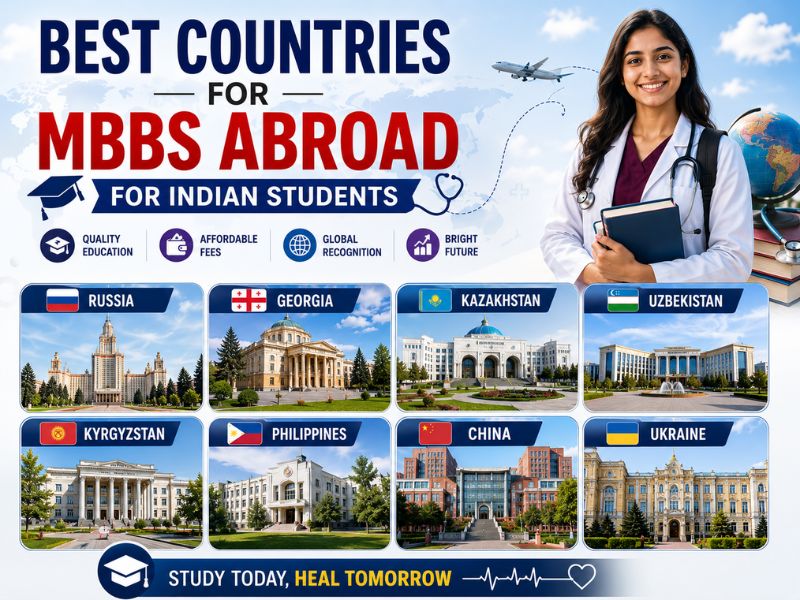
Choosing the right country for your MBBS abroad journey is one of the most consequential decisions in your medical career, directly affecting your education quality, budget, and future licensing prospects in India. In 2026, several countries continue to stand out as genuinely strong options for Indian medical aspirants.
Countries like Georgia, Russia, the Philippines, Uzbekistan, and Kyrgyzstan remain popular choices, each offering distinct advantages — affordable tuition, English-medium instruction, WHO/NMC-recognized universities, and relatively straightforward admission processes based on academic merit rather than competitive entrance exams.
That said, "best" shouldn't be judged purely on cost. The right country for you depends on multiple factors: university recognition status, clinical training quality, cultural adaptability, safety, proximity to India, and — critically — the track record of graduates successfully clearing India's FMGE/NExT licensing exam after returning.
A crucial 2026 development worth understanding is the NMC's tightened enforcement around program duration (54 months academic plus 12 months internship) and stricter scrutiny of online coursework, meaning students must now verify these compliance factors more carefully than in previous years before selecting their destination.
Ultimately, the best country for you balances affordability, education quality, and — most importantly — a clear, verified pathway back to practising medicine in India, provided you've qualified NEET before enrolling.
Choosing your MBBS destination carefully genuinely matters — here's why getting this decision right is so important in 2026.
1. Directly impacts your recognition and licensing outcome
Not all countries or universities offer the same FMGE/NExT pass rates. Choosing a country with a strong track record of clinical training quality significantly improves your chances of successfully practising in India after graduation.
2. Significant cost variation across countries
Total program costs can vary by ₹10-20 Lakhs or more between destinations, making country selection a major financial decision, not just an academic one.
3. Clinical exposure quality differs substantially
Some countries offer robust hospital access and diverse patient case studies, while others provide more limited practical exposure — this directly affects how prepared you'll be for both FMGE/NExT and actual medical practice.
4. Safety and living conditions matter for a 5.5-year commitment
Given the lengthy program duration, your chosen country's safety, healthcare infrastructure, and overall living conditions significantly impact your day-to-day wellbeing throughout your studies.
5. Visa and immigration policies vary
Some countries offer smoother, more transparent visa processes for Indian students, while others involve more bureaucratic complexity — worth researching before committing.
6. Cultural and language adaptability
Countries with established Indian student communities often provide easier cultural transitions, better support networks, and more familiar food options.
The bottom line: Since you're committing 5.5+ years and a significant financial investment, choosing the right country deserves the same careful research you'd apply to choosing a career path itself.
Making the right country choice delivers benefits that compound throughout your medical career. Here's what's genuinely at stake in 2026.
1. Stronger clinical training foundation
Countries with well-established medical education systems and strong hospital partnerships provide genuinely better hands-on clinical exposure, directly improving your real-world medical competency.
2. Better FMGE/NExT preparation and pass rates
Universities and countries with strong curriculum alignment to Indian medical standards tend to produce graduates who perform better on India's licensing exams.
3. More manageable financial planning
Choosing a country with transparent, predictable fee structures (rather than hidden costs that emerge later) makes budgeting for your entire 5.5-year journey significantly easier.
4. Stronger peer and alumni networks
Popular destinations with larger Indian student communities often provide better peer support, established alumni networks, and easier access to mentorship from previous graduates who've successfully navigated the FMGE/NExT process.
5. Smoother visa renewal and stay processes
Countries with established, transparent student visa systems reduce administrative stress throughout your program duration.
6. Better long-term career flexibility
Some countries offer genuine dual pathways — the option to practice locally if you choose, alongside the standard route back to India — providing valuable career flexibility.
7. Cultural and logistical convenience
Geographically closer countries (like Nepal or Bangladesh) offer easier, more affordable travel home during breaks, an underrated but meaningful quality-of-life factor over several years.
The takeaway: The right country choice isn't just about saving money upfront — it's about setting yourself up for genuine success in both your education and your eventual medical career in India.
Regardless of which country you choose, certain eligibility requirements remain consistent for Indian students in 2026 — and one of them is non-negotiable if you want to practice in India.
NEET-UG qualification (mandatory for Indian recognition)
Academic qualification
Age requirement
University compliance requirements (for the country you choose)
Additional documentation
Our advice: Regardless of which country ultimately fits your budget and preferences, ensure you've qualified NEET before making any admission commitment — this single requirement determines whether your entire investment translates into a usable medical career in India.
Understanding exactly which exams matter — and when — helps you plan your MBBS abroad journey correctly in 2026.
1. NEET-UG (the foundational, non-negotiable exam)
This remains the single most important exam for Indian students, regardless of which country or university you choose. While your host university might not require it for admission, NEET qualification is mandatory for future Indian medical registration and practice.
2. University-specific entrance tests (where applicable)
Some universities, particularly in Russia and certain European countries, may conduct their own basic academic assessment or interview, though these are generally less rigorous than India's competitive entrance landscape.
3. English proficiency tests (for non-native English speakers)
While most Indian students are already comfortable with English, some universities may still request basic English proficiency verification, particularly if your 12th-grade education wasn't conducted in English.
4. FMGE/NExT (post-graduation, not pre-admission)
This isn't required before you go abroad, but it's essential to understand as part of your overall exam journey — this is the licensing exam you'll need to clear after completing your MBBS abroad to practice in India. From 2027 onwards, NExT will replace FMGE for this purpose.
What's notably NOT required by most foreign universities
Unlike Indian medical colleges, most MBBS abroad universities don't require additional standardised entrance exams like separate aptitude tests — admission is typically based on your 12th-grade academic performance and NEET qualification status (even if not formally required for admission, having it strengthens your application and protects your future).
Our advice: Treat NEET-UG as your primary and most important exam in this entire journey — everything else (university-specific tests, English proficiency checks) is secondary in comparison, since NEET alone determines your long-term ability to legally practice medicine in India after completing your MBBS abroad.
Here's the step-by-step process to follow for a smooth, recognition-safe MBBS abroad journey in 2026.
Step 1: Qualify NEET-UG first
Before researching universities, appear for and clear the NEET-UG qualifying cutoff. Since your score stays valid for 3 years, this gives you flexibility without pressuring your timeline.
Step 2: Shortlist WHO/NMC-recognized universities
Research and shortlist universities listed in the World Directory of Medical Schools (WDOMS) across your preferred countries, confirming NMC recognition status directly.
Step 3: Verify program duration and curriculum
Confirm each shortlisted university's program meets the mandatory 54 months of academic plus 12 months internship structure required under 2026 NMC rules.
Step 4: Apply directly to your chosen university
Submit your application along with academic transcripts, passport copy, and photographs — most universities have simplified application portals for international students.
Step 5: Receive and review your offer letter
Once accepted, carefully review your offer letter for fee structure, program duration, and internship arrangement details before proceeding.
Step 6: Apply for your student visa
Submit your offer letter, financial proof, and required documents to your host country's embassy or consulate for visa processing.
Step 7: Complete pre-departure preparations
Arrange travel, accommodation, health insurance, and any pre-departure orientation offered by your university or consultant.
Step 8: Enrol and begin your program
Complete on-arrival formalities like local registration and medical fitness verification before starting classes.
Our advice: Never skip Step 1 — starting your university applications before confirming NEET qualification is the most common, costly mistake Indian students make when planning MBBS abroad for 2026.
Having accurate, complete documentation ready significantly smooths your application process. Here's your checklist for 2026.
Academic documents
Identity and travel documents
Application essentials
Financial documents
Medical and health documents
Visa-specific documents
Additional recommended documents
Our advice: Start organising these documents at least 3-4 months before your intended admission cycle, since visa processing and document verification can take longer than expected for international medical program applications in 2026.
Here's a curated list of the top countries genuinely worth considering for MBBS abroad in 2026.
1. Georgia
Known for modern infrastructure, strong clinical training, and straightforward, merit-based admission for Indian students.
2. Russia
Long-established popularity with WHO-recognized universities, affordable tuition, and strong support systems for international students.
3. Philippines
Offers an American-style medical curriculum, English-medium instruction, and a straightforward admission process based on academic records.
4. Uzbekistan
An increasingly popular, budget-friendly destination with growing recognition among Indian students, though careful university verification remains important.
5. Kyrgyzstan
One of the most affordable options, with simplified admission processes, though quality varies significantly across institutions.
6. Nepal
Geographically convenient with cultural familiarity and several NMC-recognized universities offering quality education.
7. Bangladesh
Offers relative affordability and geographic proximity, with several well-established medical universities.
8. Armenia
Gaining popularity for its modern medical education system and relatively affordable tuition structure.
9. China
Home to several WHO-recognized universities offering strong infrastructure, though language adaptation can be more challenging.
10. Bosnia and Herzegovina
An emerging European destination offering quality medical education with relatively lower tuition compared to Western Europe.
Our advice: Rank your country options based on verified university recognition and clinical training quality first, then factor in budget and personal preferences — not the other way around, for your 2026 decision.
Rather than chasing "top-ranked" marketing claims, here's what genuinely defines the best universities across popular MBBS abroad destinations for 2026.
What makes a university genuinely "best" for Indian students
Notable university types across popular destinations
How to verify before committing
Our advice: Avoid relying solely on university rankings from unofficial sources or aggressive marketing — independently verify recognition status and speak directly with current students or recent graduates before finalising your 2026 university choice.
Here's a realistic fee comparison across popular MBBS abroad destinations for 2026, covering the complete program duration.
Georgia
Total program cost approximately ₹18-28 Lakhs, offering strong value given modern infrastructure and clinical training quality.
Russia
Total program cost approximately ₹20-30 Lakhs, varying by specific city and university reputation.
Philippines
Total program cost approximately ₹25-35 Lakhs, reflecting its American-style curriculum and English-medium instruction quality.
Uzbekistan
Total program cost approximately ₹15-22 Lakhs, among the more budget-friendly options.
Kyrgyzstan
Total program cost approximately ₹15-25 Lakhs, also relatively affordable.
Nepal
Total program cost approximately ₹30-45 Lakhs, higher due to proximity and strong demand from Indian students.
Bangladesh
Total program cost approximately ₹25-35 Lakhs, reflecting moderate affordability with geographic convenience.
What's typically included
What's typically excluded
Our advice: Request a complete, itemised fee breakdown directly from your shortlisted university rather than relying on advertised headline figures — hidden costs for hostel, exams, or clinical rotations can meaningfully increase your actual total spend for 2026 admission.
Beyond tuition, here's what you can realistically expect to spend monthly on living expenses across top MBBS abroad destinations in 2026.
Georgia
Monthly living costs typically range from ₹18,000-28,000, with Tbilisi offering a good balance of affordability and quality of life.
Russia
Monthly living expenses generally range between ₹20,000-30,000, varying significantly between major cities and smaller university towns.
Philippines
Monthly costs typically range from ₹25,000-35,000, covering accommodation, food, and local transportation in cities like Manila and Cebu.
Uzbekistan
Among the most budget-friendly, with monthly costs around ₹12,000-18,000.
Kyrgyzstan
Similarly affordable, with monthly living expenses around ₹12,000-20,000.
Nepal
Monthly costs run somewhat higher at ₹20,000-30,000, though travel expenses home remain minimal given geographic proximity.
Bangladesh
Comparable to Nepal, with monthly living expenses around ₹18,000-25,000.
What these estimates typically cover
What to budget separately
Our advice: Budget using the higher end of these ranges for your first year, especially since unfamiliarity with local markets, currency exchange fluctuations, and initial setup costs typically push actual spending above initial estimates during your first year abroad in 2026.
Funding a medical education abroad is a major financial commitment, but several scholarship pathways can help ease that burden for Indian students in 2026.
University-specific merit scholarships
Many foreign medical universities offer merit-based tuition reductions ranging from 10% to 50%, based on your 12th-grade academic performance and, where applicable, your NEET score.
Early admission incentives
Universities frequently offer reduced fees or waived application charges for students completing admission formalities well ahead of standard deadlines, effectively rewarding early planning.
Government scholarships from host countries
Some countries offer limited government-funded scholarships to attract international medical students, though these remain highly competitive and often require additional qualifying criteria.
Sibling and family discounts
Certain universities provide fee reductions for students whose family members are already studying or have graduated from the same institution.
Education loans (the primary funding route for most students)
Given limited dedicated MBBS abroad scholarships, most Indian students rely on education loans from public/private banks or NBFCs, often covering up to 100% of tuition and living expenses for NMC-recognized universities.
A word of caution
Be wary of unusually generous "scholarship" offers from consultancies or universities that seem disconnected from genuine merit — sometimes these are marketing tactics where the base advertised fee already excludes costs that offset any apparent discount.
Our advice: Since scholarships specifically for MBBS abroad remain limited, treat education loans as your primary funding strategy, and use any scholarship you do secure as a genuine bonus rather than your core financial plan for 2026.
This is one of the most important decisions Indian medical aspirants face. Here's an honest, balanced comparison for 2026.
Admission competitiveness
MBBS in India requires a highly competitive NEET rank for limited government seats, with over 20 applicants vying for a single seat in top colleges. MBBS abroad typically only requires clearing the NEET qualifying percentile, making admission genuinely more accessible.
Cost comparison
Government MBBS colleges in India remain significantly cheaper than most abroad options. However, private Indian medical colleges often charge extremely high capitation fees, sometimes exceeding ₹50 Lakhs to ₹1 Crore for the full program — often making MBBS abroad genuinely more affordable by comparison.
Curriculum and training quality
India's government medical colleges generally offer strong clinical exposure through well-established teaching hospitals. Quality abroad varies significantly by university and country, requiring careful research to ensure comparable training standards.
Recognition and licensing
MBBS in India requires no additional licensing exam to practice domestically. MBBS abroad requires clearing FMGE/NExT after graduation — an additional hurdle, though a well-prepared student with quality clinical training shouldn't find this an insurmountable barrier.
Cultural and language adaptation
MBBS in India obviously avoids adaptation challenges entirely. Abroad, while most programs are English-medium, students still navigate cultural, culinary, and social adjustments in a new country.
Peer competition and rank pressure
MBBS in India comes with intense competitive pressure at every stage — NEET, college admission, and internal rankings. MBBS abroad typically offers a comparatively less pressured academic environment, focusing more on steady learning than cutthroat competition.
Our verdict:
If you secure a government MBBS seat in India through NEET, that generally remains the stronger choice — lower cost, no additional licensing exam, and strong clinical training. However, if you've qualified NEET but couldn't secure an affordable seat in India, MBBS abroad (at a genuinely recognised, quality university) offers a legitimate, often more affordable alternative — provided you go in with realistic expectations about the FMGE/NExT requirement.
Understanding exact program length across destinations helps you plan realistically, especially given 2026's tightened NMC duration requirements.
Mandatory minimum under NMC rules (2026)
Regardless of country, any MBBS program counted toward Indian licensing must include 54 months of academic study plus 12 months of supervised internship — a combined minimum of roughly 5.5 years.
Duration by country (typical structure)
Why exact duration matters so much in 2026
Following NMC's tightened enforcement, short-duration MBBS courses under the 5.5-year combined minimum are no longer valid for Indian licensing purposes — even if you've qualified NEET and the university is otherwise recognised.
Verification tip
Always check the exact program duration directly from the university's official website and cross-reference it against current NMC guidelines, since program structures can occasionally change between academic years.
Our advice: Before enrolling anywhere, get the exact year-by-year duration breakdown in writing from your university, and independently confirm it meets NMC's 54+12 month requirement — this single detail can determine whether your entire degree is usable in India.
Here's a consolidated, clear breakdown of the regulatory framework every Indian student pursuing MBBS abroad must understand in 2026.
NEET-UG: the foundational requirement
NEET qualification is mandatory for any Indian student who wants their foreign MBBS degree recognised for practice in India — regardless of whether their host university required it for admission. Your NEET score remains valid for 3 years.
FMGE: the current licensing exam
The Foreign Medical Graduate Examination remains the licensing exam Indian students studying MBBS abroad must clear to register with the NMC and legally practice in India.
NExT: the upcoming replacement
From 2027 onwards, the National Exit Test (NExT) will replace FMGE for foreign medical graduates. Students should track how this transition specifically affects their graduation timeline.
University recognition requirement
Your foreign university must be listed in both the WHO database and the World Directory of Medical Schools (WDOMS) — degrees from unlisted institutions won't be considered for FMGE/NExT eligibility at all.
Program duration compliance
The mandatory 54 months of academic study plus 12 months internship structure is non-negotiable under 2026 rules — shorter programs are automatically disqualified from Indian licensing consideration.
Internship location rule
Your internship must be completed within the same university or country where you studied — India does not accept internships completed domestically for foreign-degree holders.
No mid-program transfers
Switching universities partway through your MBBS abroad program isn't permitted under current NMC regulations.
2026 clarification on online coursework
Students who completed portions of their program online (particularly during pandemic-era disruptions) must now undergo additional mandatory physical onsite training, including clinical exposure and practical hospital experience, to compensate.
The consequence of skipping NEET entirely
Completing MBBS abroad without ever qualifying NEET results in permanent disqualification from FMGE/NExT — no amount of academic performance abroad can reverse this.
Our advice: Bookmark the official NMC website and check it periodically throughout your program, since regulations around foreign medical education continue evolving — staying updated protects your years of investment from unexpected compliance issues.
Once you've successfully navigated NEET, university selection, and NMC compliance, here's what your career path looks like after MBBS abroad in 2026.
Practising medicine in India
After clearing FMGE/NExT and registering with the NMC, graduates can:
Practise in your host country
Depending on that country's specific licensing framework, some graduates pursue local certification to practice medicine where they studied, particularly appealing for those genuinely interested in building an international career.
Further specialization
Many graduates pursue MD/MS specialisation either in India (via NEET-PG) or abroad, depending on career goals and available recognition pathways.
Research and academic careers
Graduates interested in medical research or teaching can pursue roles in medical colleges, pharmaceutical research, or academic institutions, leveraging their clinical background.
Healthcare administration
Some transition into hospital administration, healthcare policy, or medical management, particularly when combined with additional management education.
International licensing pathways
Depending on additional exams like USMLE (United States) or PLAB (United Kingdom), some graduates pursue broader international medical careers beyond their host country and India.
Realistic career timeline
The bigger picture
With India facing an ongoing doctor shortage relative to population needs, and continued government focus on healthcare infrastructure expansion, genuinely qualified MBBS abroad graduates — those who've correctly navigated NEET and NMC requirements — have meaningful, long-term career prospects well into 2026 and beyond.
Our advice: Begin FMGE/NExT preparation during your final year abroad rather than after graduation — building this habit early significantly smooths your transition into Indian medical practice without unnecessary delays.
Wondering what you can realistically earn after completing MBBS abroad and clearing FMGE/NExT? Here's a grounded look at salary expectations for 2026.
Starting salary in India (after NMC registration)
Fresh MBBS graduates, whether from India or abroad, typically start with salaries in the range of ₹4-8 LPA in private hospitals or clinics, depending on location and employer.
Government sector salaries
Doctors joining government hospitals through relevant recruitment processes generally receive salaries as per government pay scales, often in the range of ₹6-10 LPA, along with strong long-term benefits, job security, and pension eligibility.
Salary by practice setting
Post-specialization earning potential
After pursuing MD/MS specialisation (via NEET-PG), earning potential rises significantly, with specialists often earning ₹10-25 LPA depending on specialisation, location, and years of experience.
Practising abroad instead (host country dependent)
If choosing to practice in your host country rather than returning to India, salaries vary enormously by country — ranging from moderate figures in developing nations to significantly higher packages in countries like the US or UK, though this typically requires additional local licensing (USMLE, PLAB, etc.).
What influences your salary?
Our advice: Don't judge your MBBS abroad investment purely by entry-level salary figures — factor in the long-term career trajectory, especially post-specialisation earning potential, when evaluating whether this path makes financial sense for 2026 and beyond.
Making an informed decision requires an honest look at both sides. Here's a balanced breakdown for 2026.
Advantages
1. More accessible admission
Rather than competing for extremely limited government seats in India, MBBS abroad typically only requires clearing the NEET qualifying percentile.
2. Often more affordable than private Indian colleges
While government MBBS in India remains the cheapest overall, private Indian medical colleges frequently charge far more than many quality MBBS abroad options.
3. English-medium instruction
Most reputable foreign medical universities teach entirely in English, easing the academic transition.
4. International clinical exposure
Studying abroad exposes you to different healthcare systems, diverse patient populations, and varied medical practices.
5. Less cutthroat competitive pressure
Compared to India's intense NEET rank competition, MBBS abroad programs generally offer a comparatively less pressured academic environment.
Disadvantages
1. Additional licensing hurdle
Unlike MBBS in India, graduates must clear FMGE/NExT before practising in India — an extra step requiring dedicated preparation.
2. Recognition risk if not researched carefully
Choosing an unrecognised or non-compliant university can render your entire degree unusable for Indian practice.
3. Cultural and language adjustment
Even with English-medium instruction, students still navigate new cultural environments, food, and social dynamics.
4. Variable clinical training quality
Unlike India's well-established teaching hospital system, clinical training quality varies significantly between countries and universities abroad.
5. Distance from family and support systems
Extended time away from home, particularly during a demanding 5.5-year program, can be emotionally challenging for some students.
6. Currency fluctuation risk
Since fees and living expenses are often in foreign currency, exchange rate fluctuations can affect your total cost unpredictably over the program duration.
Our advice: Weigh these factors against your specific circumstances — financial situation, risk tolerance, and career goals — rather than following either purely positive or negative narratives about MBBS abroad in 2026.
With multiple countries offering seemingly similar advantages, here's a practical framework for making this decision in 2026.
Step 1: Verify NMC and WHO recognition first
Before considering any other factor, confirm the country's universities are consistently listed in WDOMS and recognised by NMC — this is non-negotiable regardless of other appealing factors.
Step 2: Research historical FMGE/NExT pass rates
Look for data or credible reports on how graduates from specific countries and universities have historically performed on India's licensing exam — this reflects real curriculum and clinical training quality.
Step 3: Compare total cost realistically
Factor in tuition, living expenses, health insurance, and travel costs together, rather than comparing tuition figures alone across countries.
Step 4: Assess clinical training infrastructure
Research whether universities have strong hospital partnerships providing genuine patient exposure, not just classroom-based theoretical learning.
Step 5: Consider safety and living conditions
Given your 5.5-year commitment, research the country's general safety, healthcare infrastructure, and quality of life for international students.
Step 6: Evaluate Indian student community presence
Countries with established Indian student populations often provide easier cultural adaptation, peer support, and mentorship from previous graduates.
Step 7: Check visa and immigration policy stability
Research whether the country has consistent, transparent visa policies for international students, reducing bureaucratic uncertainty during your program.
Step 8: Factor in geographic proximity (personal preference)
Consider how travel costs and time home during breaks factor into your overall experience and budget, particularly if family proximity matters to you.
Our advice: Create a simple scoring system across these factors for your top 3-4 country choices, weighing recognition and clinical training quality most heavily, since these directly determine your career outcome regardless of other conveniences.
Navigating MBBS abroad admissions — with NEET requirements, NMC compliance, university verification, and country selection — involves genuinely high stakes. That's where Your Global Mentors makes the difference.
1. Honest, compliance-focused guidance
Unlike agents who might downplay NEET requirements to close admissions faster, we prioritise your long-term career outcome, ensuring you understand exactly what's required for Indian recognition before committing.
2. Verified university shortlisting
We help you shortlist genuinely WHO/NMC-recognized universities with strong FMGE/NExT track records, rather than relying on marketing claims alone.
3. End-to-end application support
From document preparation to application submission and visa processing, we handle every step of your MBBS abroad journey with precision.
4. Transparent fee and cost guidance
We help you understand complete, itemised costs upfront — tuition, living expenses, hidden fees — avoiding unpleasant surprises later in your program.
5. NEET and FMGE/NExT preparation guidance
Beyond just admissions, we connect you with resources to prepare effectively for both NEET qualification and your eventual licensing exam.
6. Country and university comparison support
We provide honest, data-backed comparisons across countries and universities, helping you make a decision based on genuine fit rather than aggressive sales tactics.
7. Proven track record
With years of experience guiding students through successful, compliant MBBS abroad admissions, we bring honest, practical advice to every step of your journey.
The bottom line: MBBS abroad is a life-changing decision with real regulatory complexity — partnering with Your Global Mentors ensures your investment translates into a genuinely usable medical career in 2026 and beyond.
1. Is NEET mandatory for MBBS abroad?
Yes. While some universities don't require NEET for admission, NEET qualification is mandatory for Indian students who want to practice medicine in India after graduation.
2. What happens if I study MBBS abroad without qualifying NEET?
You become permanently disqualified from appearing for FMGE/NExT, meaning you cannot register with the NMC or legally practice medicine in India.
3. How long does MBBS abroad take to complete?
Under 2026 NMC rules, programs must include a minimum of 54 months of academic study plus 12 months of internship — a combined minimum of approximately 5.5 years.
4. Is MBBS abroad cheaper than in India?
It depends. Government MBBS colleges in India remain the cheapest overall, but MBBS abroad is often significantly more affordable than private Indian medical colleges charging high capitation fees.
5. Which countries are best for MBBS abroad in 2026?
Georgia, Russia, the Philippines, Uzbekistan, Kyrgyzstan, and Nepal remain popular choices, though the "best" option depends on your budget, priorities, and verified university recognition status.
6. What is FMGE/NExT, and when do I need it?
FMGE (soon transitioning to NExT from 2027) is the licensing exam Indian students must clear after completing MBBS abroad to register with the NMC and practice medicine in India.
7. Can I transfer universities mid-program while studying MBBS abroad?
No, mid-program transfers are not permitted under current NMC regulations.
Studying MBBS abroad offers Indian students a genuinely viable pathway into medicine in 2026, particularly for those who've qualified NEET but couldn't secure an affordable seat in India. However, success in this journey depends entirely on getting the fundamentals right — qualifying NEET before enrolling, choosing a WHO/NMC-recognized university, ensuring program duration compliance, and preparing early for FMGE/NExT.
The countries and universities covered throughout this guide each offer distinct advantages, but none of these benefits matters if the recognition and compliance factors aren't verified carefully beforehand. Approach this decision with the same seriousness you'd apply to any major medical career choice — because that's exactly what it is.