
India's fintech story is one of the most remarkable economic shifts of the decade. UPI alone accounted for 85% of digital payment volumes in H1 2025, up from just 9% in 2019, and the Indian fintech market size is valued at USD 51.30 billion in 2026, projected to reach USD 109.06 billion by 2031. As banks, NBFCs, and digital-first startups race to build the next generation of financial products, the MBA in Fintech has emerged as one of the most relevant and future-facing specialisations in Indian management education. This article covers everything you need to know about the program - its structure, eligibility, fees, career scope, and the best government and private colleges offering it in 2026-27.
Duration: 2 years (full-time), with select 1-year executive formats for working professionals
Eligibility: Bachelor's degree in any discipline with 50%+ aggregate marks
Entrance Exams Accepted: CAT, XAT, GMAT, CMAT, MAT, ATMA, MAH-CET
Fee Range: Approximately INR 3 lakhs to 11.95 lakhs across institutes nationwide
Industry Size: India's fintech market was valued at USD 142.5 billion in 2025, projected to reach USD 642.9 billion by 2034
2026 is shaping up to be a genuinely pivotal year for India's fintech sector, making it an unusually well-timed moment to enter the field through a specialised MBA. 2025 has been a strong year for India's fintech ecosystem, and industry leaders describe 2026 as set to be a defining phase of evolution, with traditional boundaries between payments, lending, embedded finance, and banking capabilities blurring as players build more integrated models.
This convergence is exactly why generalist finance or generalist technology degrees are no longer sufficient on their own. RBI data shows digital payment volumes surpassed 180
The MBA in Fintech is a specialised program designed to merge two distinct disciplines -finance and technology - into one cohesive business skill set. It is typically structured across four semesters over two years, with the first year focused on core management fundamentals and the second year dedicated to fintech-specific electives and live industry projects.
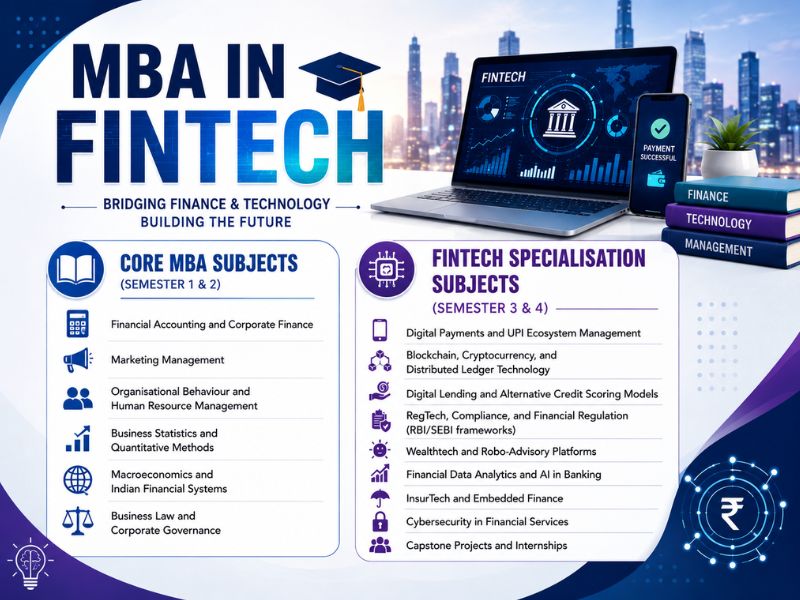
Core MBA Subjects (Semester 1 & 2)
Financial Accounting and Corporate Finance
Marketing Management
Organisational Behaviour and Human Resource Management
Business Statistics and Quantitative Methods
Macroeconomics and Indian Financial Systems
Business Law and Corporate Governance
Fintech Specialisation Subjects (Semester 3 & 4)
Digital Payments and UPI Ecosystem Management
Blockchain, Cryptocurrency, and Distributed Ledger Technology
Digital Lending and Alternative Credit Scoring Models
RegTech, Compliance, and Financial Regulation (RBI/SEBI frameworks)
Wealthtech and Robo-Advisory Platforms
Financial Data Analytics and AI in Banking
InsurTech and Embedded Finance
Cybersecurity in Financial Services
Capstone Projects and Internships
Most reputable programs include a mandatory internship or live industry project with a bank, NBFC, or fintech startup, giving students hands-on exposure to how products like UPI-based lending apps, neobanking platforms, or robo-advisory tools are actually built and scaled.
What Makes This Degree Different from a Traditional Finance MBA?
A traditional MBA in Finance trains you for roles in investment banking, corporate finance, or asset management. An MBA in Fintech, by contrast, trains you to sit at the intersection of financial services and technology product strategy - understanding not just how money moves, but how digital infrastructure, APIs, and data are reshaping the way it moves.
Why Fintech Has Become a Standalone Specialisation
The success of UPI has led to the emergence of digital lending and wealthtech unicorns, while the development of SIP culture brings one crore new investors into Indian markets every year. Meanwhile, the rise of GIFT City as a financial services hub has made it an attraction for global banks and hedge funds, creating an entirely new category of jobs that neither a pure technology degree nor a traditional finance MBA fully prepares students for.
Who Should Pursue This Degree?
Commerce, economics, or finance graduates who want to specialise in digital financial products rather than traditional banking
Engineering or computer science graduates interested in the business side of fintech, payments, or blockchain
Working professionals in banks, NBFCs, or fintech startups looking to move into strategic or leadership roles.
Entrepreneurially-minded students aiming to eventually build or scale their own fintech venture.
The Scale of Opportunity Behind This Degree
India accounts for 49% of global real-time payment volumes, and UPI transactions topped 10.5 billion in volume, amounting to more than USD 19 trillion in 2025. This scale of digital financial activity is precisely what has created sustained, long-term demand for fintech-trained management professionals across banks, NBFCs, and technology platforms.
Unlike conventional MBA programs that rely heavily on case studies and lectures, MBA in Fintech programs are designed around a more applied, technology-driven pedagogy:
Live Case Studies: Real scenarios drawn from UPI's growth, digital lending defaults, or neobank product launches, rather than purely theoretical finance cases
Simulation-Based Learning: Trading simulations, digital lending risk models, and blockchain sandbox environments are used to teach technical concepts experientially
Guest Lectures and Industry Immersion: Sessions from fintech founders, RBI/SEBI compliance officers, and product heads at companies like Razorpay or PhonePe
Hackathons and Product Sprints: Several institutes now run fintech hackathons where student teams design and pitch new digital finance products
Data and Coding Bootcamps: Short, intensive modules in Python, SQL, and financial data analytics, even for students without a technical background
This blended pedagogy ensures graduates leave not just understanding financial theory, but capable of speaking the language of both bankers and engineers - a rare and valuable combination in today's job market.
Salary outcomes for MBA Fintech graduates vary significantly by role, seniority, and specialisation, but the overall trend across the industry is strongly upward, particularly in product, risk, and compliance functions.
Product Management Roles:
Salary ranges for fintech product managers in India show junior PMs earning ₹12-20 LPA, mid-level PMs earning ₹20-35 LPA, senior PMs earning ₹35-60 LPA, and Heads of Product commanding ₹60-100 LPA or more. Senior PMs at companies like Razorpay or PhonePe go on to lead entire product verticals, making product management one of the highest-paying tracks available to MBA Fintech graduates.
Compliance and RegTech Roles:
This function has seen exceptional recent growth. Compliance-linked fintech hiring grew 17-22% in 2025 alone, according to SilverPeople HR Insights, and this trend is expected to continue as fintechs prepare for stricter RBI oversight on digital lending, cross-border payments, and AI governance through 2026. RBI's tightened NBFC regulations in 2023-24 made compliance and risk professionals premium hires, a trend that continues to push salaries upward in this niche.
Sector-wise Variation:
The payments sub-sector remains the most mature, dominated by companies like PhonePe, Razorpay, PayU, CCAvenue, and Cashfree, generally offering the most stable and well-benchmarked compensation. NBFCs and digital lenders like Lendingkart, KreditBee, CASHe, IIFL Finance, and Bajaj Finserv's digital arm hire heavily in credit risk, underwriting, and collections, often at a premium,m given the scarcity of talent who understand both lending and regulation simultaneously.
For MBA graduates specifically, starting compensation tends to track closely with institute pedigree - premier B-schools with direct fintech recruiter pipelines consistently produce stronger placement outcomes than generalist programs with only a fintech elective bolted on.
Eligibility Criteria
A bachelor's degree in any discipline from a recognised university with a minimum of 50% aggregate marks (graduation degree with a minimum of 50% marks)
Valid scores in national or institute-level entrance exams: CAT, XAT, GMAT, CMAT, MAT, ATMA, or MAH MBA CET
Most institutes require candidates to clear a Group Discussion (GD) and Personal Interview (PI) round following the entrance exam.
Some technology-focused fintech programs give preferential weightage to candidates with a quantitative or STEM educational background, though the program remains open to all streams.s
The admission journey for an MBA in Fintech follows a structured, multi-stage path similar to other specialised MBA programs, though with added attention to quantitative and tech-adjacent aptitude.
Step 1: Entrance Exam Registration and Preparation
Candidates must register for the Common Admission Test (CAT) by the deadline - typically between August and September 2026 for the current cycle - and appear for the exam in November 2026. Depending on the target institute, candidates may alternatively prepare for XAT, GMAT, CMAT, MAT, ATMA, or MAH-MBA-CET.
Step 2: Meeting Institute-Specific Score Cut-offs
Candidates must score well enough to meet the specific parameters set by their chosen university, which vary considerably - premier institutes often require percentiles in the high 90s, while mid-tier private universities accept more moderate scores alongside a stronger academic and extracurricular profile.
Step 3: Group Discussion and Personal Interview
Once shortlisted, candidates must appear for personal interviews and group discussion rounds, a stage that often carries high weightage in the final admission decision. For fintech-specific programs, interviewers frequently probe candidates' awareness of current developments - recent RBI guidelines, major fintech funding rounds, or specific product launches - so staying updated on sector news is essential preparation.
Step 4: Document Verification and Final Offer
If selected, candidates receive a final admission offer based on combined performance across the entrance exam, academic profile, and GD & PI rounds. This is typically followed by fee payment, document submission, and orientation scheduling, usually beginning in June or July for the new academic batch.
Tip for Aspiring Candidates: Given how heavily the GD/PI stage weighs in final decisions, candidates aiming specifically for fintech tracks should arrive prepared to discuss real, current examples - not generic statements about "passion for fintech" - since admission panels consistently reward demonstrated, specific industry awareness over enthusiasm alone.
Beyond entrance exam scores, most top MBA Fintech programs evaluate candidates holistically across several dimensions:
Academic Consistency: A steady academic record across Class 10, Class 12, and undergraduate studies, rather than one strong score alone
Quantitative Aptitude: Demonstrated comfort with numbers, logical reasoning, and data interpretation - heavily tested in CAT/XAT sections
Relevant Exposure: Prior internships, certifications (NSE Academy, NISM, or fintech-specific MOOCs), or even personal projects related to payments, trading apps, or blockchain
A strong Statement of Purpose (SOP) for MBA in Fintech admissions should go beyond generic interest statements and demonstrate genuine engagement with the sector. It should typically include:
A Personal Hook: A specific moment or experience that sparked your interest in fintech — using a UPI app, following a digital lending startup, or a college project on blockchain
Relevant Academic and Professional Background: How your undergraduate degree, internships, or work experience connect to financial technology
Specific Career Goals: Whether you aim to work in digital lending, wealthtech, payments product management, or eventually build your own fintech venture
Why This Specific Institute: Reference to specific faculty, electives, industry partnerships, or fintech labs that align with your goals - generic statements here weaken an SOP significantly
Evidence of Preparation: Any certifications, hackathons, internships, or self-study (such as following RBI's digital payment policies) that show genuine initiative
A Forward-Looking Closing: A brief statement on how you intend to contribute back to the fintech ecosystem or your institute's community post-graduation
Why This Industry Offers Long-Term Career Security
The Indian fintech market size is projected to rise from USD 148.1 billion in 2026 to USD 867.6 billion by 2033, at a CAGR of 28.7%, driven by financial inclusion, MSME lending, and AI-powered financial solutions. Digital payments held the largest segment share at 42.87% in 2025, while neobanking is projected to grow at a 19.64% CAGR through 2031 - meaning the career opportunities span far beyond just payments into lending, insurance, and digital banking infrastructure.
Career Roles After the MBA
Digital Payments Product Manager
Digital Lending and Credit Risk Manager
Wealthtech/Robo-Advisory Strategist
Blockchain and Cryptocurrency Business Analyst
RegTech and Compliance Manager
Embedded Finance Partnerships Manager
Fintech Business Development Manager
Top Recruiters in the Industry
Leading recruiters include major fintech players such as Paytm, PhonePe, Razorpay, CRED, and Groww, alongside traditional banks and NBFCs building digital arms, and global consulting firms running fintech advisory practices.
Salary Expectations in India (2026)
Salary outcomes vary considerably by institute pedigree and specialisation, but placement data from comparable finance-tech programs is encouraging. One leading institute reported the highest package of INR 41.2 LPA, with an average package between INR 6-11 LPA across its tech-management programs, while several listed MBA Fintech programs report the highest packages around INR 11 LPA for newer or mid-tier institutes. Premium B-schools with strong fintech industry tie-ups typically see considerably higher outcomes, particularly for graduates entering digital lending, payments strategy, or blockchain-focused roles.
A defining feature of this specialisation is its direct engagement with the technologies actually powering India's financial services transformation, rather than abstract theoretical coverage alone.
1. UPI and Digital Payment Infrastructure
Students study the architecture and business mechanics behind India's payment rails. UPI's transaction volume has grown exponentially, facilitating billions of transactions per year and enabling secure, real-time payments across both merchant and peer-to-peer use cases, making it the foundational case study across most fintech MBA curricula.
2. AI and Machine Learning in Financial Services
Industry surveys from institutions like NASSCOM and the World Economic Forum show that over 60% of financial services firms in the APAC region are prioritising AI-led automation in services, support, and fraud prevention to protect margins. Coursework typically covers AI applications in credit scoring, fraud detection, and personalised financial product recommendations.
3. Digital Lending and Alternative Credit Models
India's digital lending ecosystem has grown substantially, more than doubling from USD 150 billion in 2020 to USD 350 billion in 2023, and is regulated through the RBI's Digital Lending Guidelines, which focus on consumer protection, data security, and oversight of unlicensed technology partners known as lending service providers. Students study both the technology and the regulatory architecture governing this space.
4. Blockchain and Distributed Ledger Technology
Covers the fundamentals of blockchain architecture, smart contracts, and their emerging applications in cross-border payments, trade finance, and asset tokenisation within the Indian regulatory context.
5. RegTech and Compliance Technology
The RBI's regulatory sandbox framework has run multiple cohorts centred around retail payments, cross-border payments, MSME lending, and fraud prevention, giving students real frameworks to study how fintechs test and validate new technology under regulatory supervision.
6. Embedded Finance and API Infrastructure
Cloud and API architects are increasingly in demand to build resilient, scalable infrastructure for embedded-finance partnerships, and coursework increasingly covers how non-financial platforms integrate financial products directly into their ecosystems.
Challenge 1: Rising Fraud Sophistication
As digital transactions and AI usage explode, so does fraud - India is seeing a new wave of sophisticated fraud, from deepfake KYC to social engineering attacks. This has created sustained demand for fraud-prevention expertise, with account aggregator data and new AI models for anomaly detection making fraud-risk-management tools increasingly predictive.
Challenge 2: Tightening Regulatory Oversight
There is growing regulatory oversight and tighter regulation across different fintech business lines, including the RBI's expanded scope of regulation over Payment Aggregators to include physical point-of-sale aggregators. While this raises compliance costs for fintech firms, it simultaneously creates strong, well-paying career opportunities for professionals trained to navigate this complexity.
Challenge 3: Post-Crisis Lending Discipline
After a year of conservative lending following the microfinance crisis, the sector is entering a positive credit cycle with cleaner balance sheets, but disciplined underwriting remains essential even as growth pressures increase in 2026 - a balance that requires genuinely skilled risk management talent.
Opportunity 1: Co-lending and Credit-on-UPI Growth
Co-lending between banks and NBFCs has been a regulatory success story, with the market growing 3x in the last two years, and credit-on-UPI seeing similar momentum. As more banks embrace co-lending and credit-on-UPI partnerships with fintechs, robust technology infrastructure will become table stakes in 2026.
Opportunity 2: Potential IPO Wave
There is anticipation around possible IPOs of digital lenders like Kreditbee, Moneyview, Kissht, and Fibe, who have navigated the recent down cycle comfortably while managing regulatory compliance - a maturing signal for the sector that opens senior strategic and finance roles for well-trained graduates.
Opportunity 3: Tier-2 and Tier-3 City Expansion
The demand spike for fintech talent is most visible in Tier-2 and Tier-3 cities, where fintech back-offices, risk analytics, and KYC operations are expanding rapidly, opening career pathways well beyond the traditional metro fintech hubs of Mumbai, Bengaluru, and Gurgaon.
Opportunity 4: AI Agents and Next-Generation Payment Rails
As AI agents become mainstream in the economy, new payment rails are forming for use by agents rather than only humans, with companies like Stripe and Razorpay already launching products in this space, representing an entirely new frontier for fintech-trained strategists entering the market over the next few years.
This degree is best suited to a specific profile of student, and being honest about that fit matters more than chasing a trending specialisation.
This course is likely right for you if:
You're genuinely curious about how financial products are designed, not just how markets move - fintech rewards product thinking as much as financial analysis
You're comfortable engaging with both regulatory complexity and technology, since fintech product managers need to balance user experience with regulatory constraints, a uniquely difficult balancing act
You want a career with strong long-term demand visibility, given that the sector's workforce is projected to grow from 250,000 to over 400,000 professionals by 2026
You're drawn to hybrid roles rather than purely technical or purely financial ones -employers are explicitly redesigning teams to combine engineers, data scientists, and policy experts who can navigate both innovation and regulation
This course may not be the right fit if:
You're primarily interested in traditional investment banking, equity research, or asset management - a generalist Finance MBA may serve you better
You're uncomfortable with regulatory ambiguity or frequent rule changes, since fintech as a sector operates under constant regulatory evolution.
You're looking for a purely technical, hands-on coding career - in that case, a specialised technology degree or bootcamp may be more directly aligned than an MBA.
The Bottom Line: By 2026, the fintech employee won't just execute tasks - they'll train algorithms, interpret data, and design policy. If that blend of strategic, technological, and regulatory thinking excites rather than overwhelms you, an MBA in Fintech is very likely one of the smartest, most future-proof specialisations you can pursue in India's management education landscape today.
1. Faculty of Management Studies (FMS), University of Delhi
While not exclusively a fintech program, FMS Delhi's MBA Finance track increasingly incorporates fintech and digital finance modules, with a CAT cut-off requirement of 99.5+ percentile for the 2026 batch, reflecting its position as one of India's most prestigious and affordable government B-schools.
2. Indian Institute of Management (IIM) Bangalore
IIM Bangalore ranks among the top NIRF Finance programs in India and has steadily expanded its fintech elective offerings, given Bangalore's status as India's technology and startup hub.
3. Management Development Institute (MDI), Gurgaon
MDI Gurgaon maintains a CAT cut-off of 98+ percentile for its 2026 finance-focused batch, with strong placement linkages to Gurgaon's dense fintech and NBFC ecosystem.
4. University of Hyderabad, School of Management Studies
A government-affiliated institute that increasingly emphasises digital finance and analytics within its MBA curriculum, leveraging Hyderabad's growing fintech and technology corridor.
5. Jamia Millia Islamia, Faculty of Management Studies and Research
A respected central university offering finance-focused MBA tracks with increasing exposure to digital banking and fintech case studies, at significantly lower fees than premier private institutes.
1. SP Jain Institute of Management and Research (SPJIMR), Mumbai
SPJIMR's finance program carries fees of approximately INR 22.5 lakhs, with average packages around INR 33 LPA, leveraging Mumbai's position as India's financial capital and proximity to BSE/NSE and major fintech headquarters.
2. Symbiosis Institute of Business Management (SIBM), Pune
SIBM Pune's finance program carries fees of around INR 23 lakhs, with average packages of approximately INR 28.89 LPA, and a growing fintech-specific elective track.
3. Great Lakes Institute of Management, Gurgaon
Listed among dedicated MBA/PGDM Fintech programs with fees of approximately INR 6.11 lakhs and a highest package of INR 11 LPA, making it a strong mid-tier option with a focused fintech curriculum.
4. K J Somaiya Institute of Management, Mumbai
Offers a dedicated MBA/PGDM in Fintech with total fees of approximately INR 11.95 lakhs, accepting CAT, XAT, MAT, GMAT, ATMA, MAH MBA CET, and CMAT scores, leveraging Mumbai's fintech and banking ecosystem for strong placements.
5. Vignan's Foundation for Science, Technology and Research, Vijayawada
Offers an MBA/PGDM in Fintech with fees of approximately INR 10 lakhs and holds an NIRF 2025 ranking of #70/100, with admission through CAT scores.
The MBA in Fintech is ideal if you're drawn to the fast-moving world of digital finance and want a career that blends financial acumen with technology strategy. With India's fintech market projected to surge to USD 642.9 billion by 2034, the opportunity is real and growing. Choose your institute based on its industry tie-ups and curriculum currency, not fees alone - and you'll be well-positioned to lead in one of India's most dynamic sectors.
Q1: What is the difference between an MBA in Fintech and an MBA in Finance?
An MBA in Finance prepares you for traditional roles like investment banking, equity research, and corporate finance. An MBA in Fintech specifically trains you for digital-first roles - payments, digital lending, wealthtech, and RegTech - that sit at the intersection of financial services and technology product strategy.
Q2: Do I need a technical or engineering background to pursue this MBA?
No. While a quantitative background helps, most programs are open to graduates from any discipline, including commerce, economics, and even humanities, provided they meet the minimum eligibility criteria and demonstrate genuine interest in the sector.
Q3: Which entrance exams are accepted for MBA Fintech programs in India?
Most institutes accept CAT, XAT, GMAT, CMAT, MAT, ATMA, or MAH-MBA-CET, with premier B-schools generally requiring higher percentile cut-offs than mid-tier private universities.
Q4: What is the average salary after an MBA in Fintech in India?
This varies widely by role and institute. Entry-level roles in product or analytics typically start between ₹12-20 LPA at well-placed institutes, while senior roles in product management or compliance can reach ₹35-100 LPA or more over time, particularly at leading fintech companies.
Q5: Is fintech a stable, long-term career, or is it just a current trend?
The data suggests genuine long-term stability rather than a passing trend - the sector's workforce is projected to nearly double by 2026, and demand is increasingly concentrated in specialised hybrid roles rather than generalist positions, suggesting structural rather than cyclical growth.
Q6: What kind of companies hire MBA Fintech graduates?
Recruiters span digital payment companies (PhonePe, Razorpay, Cashfree), digital lenders and NBFCs (KreditBee, Lendingkart, Bajaj Finserv), traditional banks building digital arms, and global consulting firms running dedicated fintech advisory practices.
Q7: How important is the GD/PI round in the admission process?
Very important - it often carries significant weightage in the final admission decision, alongside entrance exam scores and academic profile. For fintech-specific programs, demonstrating current awareness of sector developments during this round is particularly valued by admission panels.