Understanding the financial investment required for B.Tech. Agricultural Engineering is essential for students and parents planning higher education strategically.
Compared to many traditional engineering branches, Agricultural Engineering often offers a more affordable education path—especially in government institutions—while still providing strong long-term career opportunities.
Fee Structure Overview
Government Colleges
👉 ₹50,000 – ₹2.5 Lakhs total (entire course)
Government institutions generally provide the best value due to lower tuition fees and access to scholarships.
👉 ₹3 Lakhs – ₹8 Lakhs total
Private institutions may offer advanced infrastructure and broader campus facilities, but costs are significantly higher.
Key Highlights
-
Government colleges = best ROI
-
Scholarships available for eligible students
-
More affordable than many core engineering programs
-
Strong long-term value due to evergreen sector demand
Key Insights
-
Low investment + stable sector = strong ROI
-
Government colleges = financially smarter option
-
Scholarship support = major affordability factor
-
Agricultural engineering = budget-friendly professional degree
B.Tech. Agricultural Engineering remains one of the more cost-effective engineering programs, particularly for students targeting government institutions.
Top Colleges for Agricultural Engineering in India
Choosing the right college significantly impacts academic quality, practical exposure, placements, and long-term career growth.
India has several prestigious institutions known for excellence in agricultural engineering education.
Top Institutes
-
Indian Agricultural Research Institute
-
Punjab Agricultural University
-
Tamil Nadu Agricultural University
-
GB Pant University of Agriculture and Technology
-
Acharya N. G. Ranga Agricultural University
Key Factors to Consider
-
Accreditation
-
Faculty quality
-
Practical training opportunities
-
Research facilities
-
Placement support
-
Government recognition
Key Insights
-
Top universities = better placements
-
Government institutes = stronger ROI
-
Research exposure = career advantage
-
Institutional reputation = long-term value
Selecting a reputable institution can significantly improve both educational quality and future career opportunities.
Career Scope After B.Tech. Agricultural Engineering
The career landscape for agricultural engineering graduates is expanding rapidly due to the modernisation of farming systems, increasing food security concerns, and growing investment in agricultural infrastructure.
Career Opportunities Include
Graduates can work in:
-
Government agriculture departments
-
Irrigation and water resource departments
-
Farm machinery manufacturing companies
-
Food processing industries
-
Research and development organizations
-
Agri-tech startups
-
Environmental consulting firms
Popular Job Roles
-
Agricultural Engineer
-
Irrigation Engineer
-
Farm Manager
-
Food Processing Engineer
-
Research Officer
-
Agricultural Consultant
Key Insights
-
Government jobs = strong stability
-
Agri-tech startups = fastest growth segment
-
Research careers = long-term advancement
-
Food processing = industrial demand
-
Smart agriculture = future-ready opportunity
The scope of BTech Agricultural Engineering is expanding significantly, especially as agriculture becomes more technology-driven and sustainability-focused.
Salary After B.Tech. Agricultural Engineering
Salary potential in this field depends on experience, specialisation, location, and sector.
While starting salaries may be moderate, long-term earning potential improves considerably with technical expertise and industry growth.
Salary Breakdown
Freshers
👉 ₹3 LPA – ₹6 LPA
Experienced Professionals
👉 ₹8 LPA – ₹15 LPA+
Sector-Based Salary Trends
Government Sector
-
Stable salary
-
Job security
-
Pension and additional benefits
Private Sector
-
Higher growth potential
-
Performance-based salary increases
-
Better opportunities in the agri-tech and machinery sectors
Key Insights
-
Government sector = security-focused income
-
Private sector = growth-focused earnings
- Technical specialisation = salary accelerator
-
Experience + innovation skills = major earning boost
B.Tech. Agricultural Engineering offers moderate initial earnings but strong long-term salary growth, especially for professionals who combine engineering expertise with modern agricultural technology.
Benefits of BTech Agricultural Engineering
B.Tech. Agricultural Engineering offers students a unique opportunity to build a career at the intersection of technology, sustainability, and one of the world’s most essential industries—agriculture.
As global food demand rises and farming systems become increasingly technology-driven, agricultural engineering is emerging as a highly relevant and future-proof career path.
Major Benefits of This Course
Strong Demand in the Agriculture Sector
Agriculture remains one of the largest and most critical sectors globally, ensuring continuous demand for skilled professionals.
Contribution to Sustainability
Agricultural engineers play a direct role in improving water management, soil conservation, renewable energy use, and eco-friendly farming systems.
Government Job Opportunities
Graduates can access careers in irrigation departments, agricultural boards, rural development agencies, and public infrastructure projects.
Growing Agri-Tech Industry
The rise of automation, AI, drones, and smart farming solutions is expanding private-sector opportunities significantly.
Stable Career Path
Unlike volatile industries, agriculture remains an evergreen field with long-term stability.
Key Insights
-
Agriculture = essential global sector
-
Sustainability = future-driven advantage
-
Government jobs = high stability
-
Agri-tech = rapid expansion
-
Social impact + technical growth = strong ROI
BTech Agricultural Engineering provides a stable, meaningful, and innovation-focused career with long-term relevance.
Agricultural Engineering vs Traditional Farming
While traditional farming remains foundational, agricultural engineering introduces scientific efficiency, automation, and sustainability into modern agriculture.
| Factor | Agricultural Engineering | Traditional Farming |
|---|
| Approach | Technology-based | Manual |
| Productivity | High | Moderate |
| Efficiency | Advanced systems | Conventional methods |
| Sustainability | Optimised resource use | Variable |
| Career Scope | Wide | Limited |
| Innovation Potential | High | Lower |
Key Insights
-
Engineering-driven agriculture = higher efficiency
-
Smart systems = better productivity
-
Technology = competitive advantage
-
Career opportunities = broader and more scalable
Agricultural engineering modernises traditional farming by increasing efficiency, profitability, and sustainability.
Latest Trends in Agricultural Engineering (2026)
The agricultural sector is rapidly evolving, with technology becoming central to productivity and sustainability.
Emerging Trends
Smart Farming Technologies
IoT-enabled farming systems improve crop monitoring and operational efficiency.
AI in Agriculture
Artificial intelligence supports predictive farming, crop analysis, and automated decision-making.
Precision Farming
Data-driven resource management improves yield while reducing waste.
Drone Technology
Drones are increasingly used for field surveys, spraying, and crop health monitoring.
Sustainable Irrigation Systems
Water conservation technologies are becoming essential amid climate concerns.
Organic and Eco-Friendly Farming
Demand for sustainable food production continues to rise globally.
Key Insights
-
Technology = future of agriculture
-
AI + farming = high-growth career area
-
Sustainability = global priority
-
Smart agriculture = next-generation opportunity
-
Innovation = stronger career prospects
Agricultural engineering is transitioning into a highly advanced, technology-powered field with enormous future potential.
Pros and Cons of B.Tech. Agricultural Engineering
Like any professional degree, this course has both advantages and limitations.
Pros
Stable and Evergreen Industry
Agriculture will always remain essential.
Government Employment Opportunities
Strong public-sector presence.
Growing Technology Demand
Modern agriculture is expanding rapidly.
Social and Environmental Impact
Graduates contribute directly to national development and sustainability.
Cons
Lower Initial Salary
Starting salaries may be lower than in some core engineering branches.
Limited Awareness
Many students underestimate the field’s potential.
Rural Work Locations
Certain job roles may involve field-based or rural assignments.
Key Insights
-
Long-term growth > short-term salary
-
Stability = major strength
-
Awareness gap = hidden opportunity
-
Practical adaptability = a success factor
For students interested in agriculture, sustainability, and innovation, the long-term advantages often outweigh the initial challenges.
Common Mistakes to Avoid
Strategic planning is crucial for maximising success in this field.
Major Mistakes Students Make
-
Choosing the course without a genuine interest in agriculture
-
Ignoring practical and technical skill development
-
Overlooking government sector opportunities
-
Selecting low-quality colleges
-
Failing to stay updated with emerging technologies
Key Insights
-
Passion + strategy = stronger outcomes
-
Practical exposure = essential
-
College quality = career impact
-
Agri-tech knowledge = future advantage
Avoiding these mistakes can significantly improve career growth and ROI.
Expert Tips for Success in Agricultural Engineering
Success in this field requires both academic knowledge and real-world technical adaptability.
Proven Career Strategies
Focus on Internships
Practical industry experience improves employability.
Learn Modern Farming Technologies
Develop expertise in automation, AI, drones, and smart irrigation.
Stay Updated with Industry Trends
Agriculture is rapidly evolving.
Prepare for Government Exams
Public sector jobs offer excellent stability.
Build Strong Practical Skills
Hands-on engineering knowledge is critical.
Key Insights
-
Practical skills > theory alone
-
Technology specialisation = higher career growth
-
Government prep = strategic advantage
-
Continuous learning = essential
Combining technical expertise with industry awareness is the key to building a successful career in agricultural engineering.
Future Scope of B.Tech. Agricultural Engineering (2026 and Beyond)
Agricultural engineering is expected to become increasingly important due to major global and national challenges.
Growth Drivers
Increasing Food Demand
Population growth requires advanced agricultural systems.
Climate Change Challenges
Sustainable solutions are becoming essential.
Technology Adoption
AI, robotics, and smart systems are reshaping agriculture.
Government Initiatives
Policies supporting rural development, food security, and agricultural modernisation continue to expand.
Future Outlook
-
Agriculture modernisation = inevitable
-
Sustainability = long-term necessity
-
Government support = strong sector security
-
Agri-tech = massive innovation potential
B.Tech. Agricultural Engineering is positioned to become one of the most important, stable, and technology-driven career fields in the coming decades.

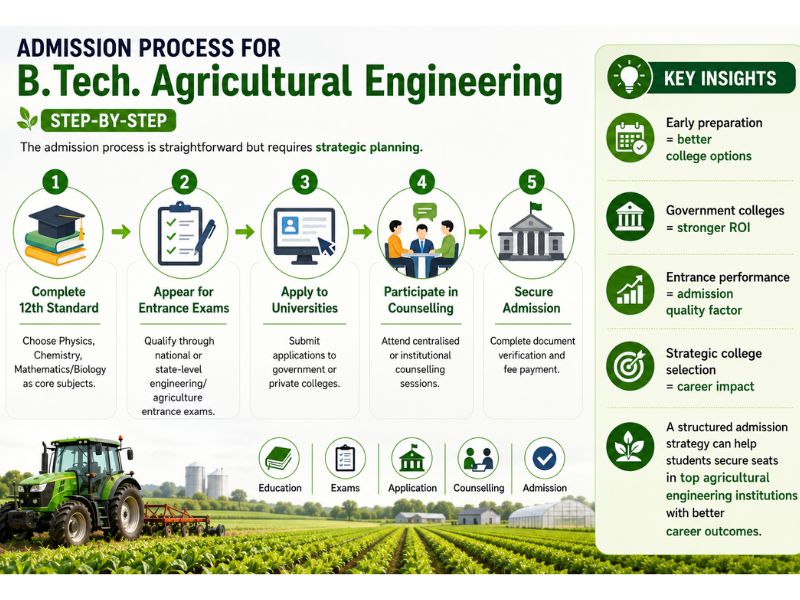 Complete 12th Standard