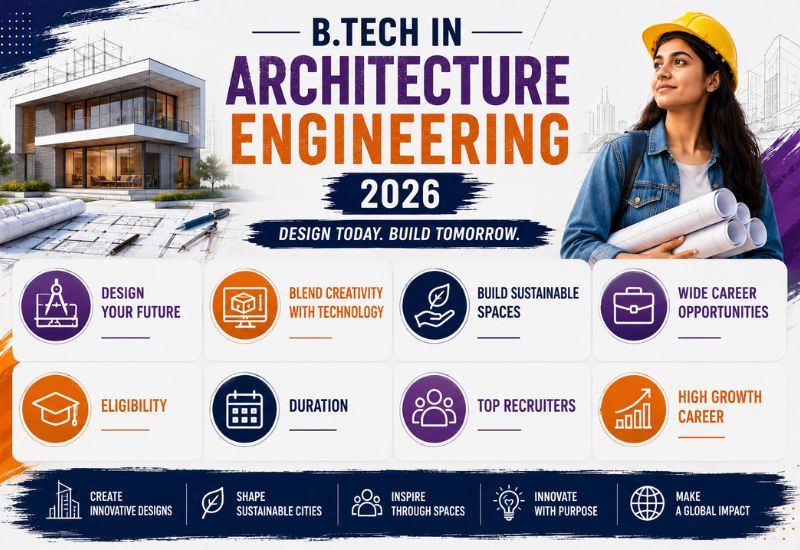
BTech in Architecture Engineering
is a four-year undergraduate programme that merges the technical precision of engineering with the creative discipline of architectural design. It's distinct from the traditional five-year BArch degree - built for students who want to design buildings while also mastering structural systems, building services, and construction technology. Here's a complete breakdown of the course, colleges, fees, and career scope for 2026-2027.
BTech in Architecture Engineering is a four-year engineering degree that bridges architectural design and core engineering principles. Unlike traditional architecture programs that focus primarily on design aesthetics, this course emphasises the technical aspects of building construction, including structural systems, building services, and environmental considerations. It fuses the artistic aspect of design with the science involved in architecture, preparing students to design, construct, and manage facilities and infrastructure.
It's important to understand that this is a different qualification from B.Arch. B.Tech in Architecture Engineering focuses more on the engineering and technical side of architectural design, while BArch focuses on artistic and conceptual design. To become a licensed architect in India, you still need a barch degree and registration with the Council of Architecture (COA). B.Tech in Architecture Engineering instead prepares you for technical, structural, and project-management-oriented roles in the construction and built-environment sector.
Course Details at a Glance
Particular | Details |
Full Form | Bachelor of Technology in Architecture Engineering |
Duration | 4 years (8 semesters) |
Level | Undergraduate |
Eligibility | 10+2 with PCM, minimum 50-55% |
Admission Mode | Entrance exam (JEE Main/NATA-accepting colleges) + merit, or direct admission |
Common Entrance Exams | JEE Main, NATA, state CETs, university-level tests |
Average Fees | ₹2 lakh – ₹8 lakh (full course) |
Average Starting Salary | ₹3 LPA – ₹10 LPA |
Top Recruiters | L&T, CPWD, DRDO, Shapoorji Pallonji, DLF |
Key Highlights
A four-year undergraduate course that combines architecture and engineering, focused on creating the built environment using modern technology
High industry demand, as the architectural industry is the second-fastest-growing industry in India, fuelled further by green and smart city projects
Graduates go on to work as architects, construction managers, and structural engineers across both public and private sectors
Versatile career paths including Architect, Urban Planner, Interior Designer, and Design Engineer, across MNCs and government bodies like CPWD and DRDO
Indian architectural engineering graduates are sought after internationally, particularly in growing civil engineering markets abroad
Strong overlap with civil engineering fundamentals, giving graduates flexibility across design and construction-management roles
Eligibility criteria:
Candidates must have passed the 10+2 examination from a recognised board, with at least 55% aggregate marks, including Physics, Chemistry, and Mathematics as core subjects
Students need to qualify a national-level entrance exam (JEE Main or NATA, depending on the college) or a university-specific entrance exam
Candidates who have completed a Diploma in Architecture Engineering after Class 10 can get direct lateral entry into the second year
There's generally no upper age limit, and category-based relaxation of around 5% applies for SC/ST/OBC candidates at most institutes
Fee structure:
Average course fees typically range from ₹2-5 lakh for the full programme, varying based on college infrastructure and facilities
Government institutes (IITs, NITs) tend to sit at the lower end of this range, while private universities can reach ₹6-8 lakh for the complete course.
Students can usually pay fees semester-wise, and at some universities, annual payment is also accepted.d
Additional costs include studio/material fees, hostel charges, and a one-time application/registration fee.
The typical admission journey looks like this:
Check eligibility -Confirm your 10+2 PCM percentage meets the cutoff (usually 50-55%).
Register for entrance exams — Apply for JEE Main, NATA, or the relevant state-level CET depending on your target colleges.
Appear for the exam - Exams generally test Mathematics, Physics, Chemistry, and in some cases, drawing/aptitude sections.
Attend counselling - Eligible candidates attend centrally organised counselling, entering course options into the system, with allocation based on merit and seat availability.
Seat allotment -Candidates are assigned seats according to their entrance exam ranking, preferences, and seat availability, after which provisional allotment letters are issued.
Document verification -Candidates must reach the allotted institute with original documents for verification.
Fee payment and confirmation: Final step where the seat is locked in after fee payment.
Private colleges also offer admission via management quota for limited seats, which may require additional capitation fees.
Documents typically required: Class 10 and 12 mark sheets, entrance exam scorecard, transfer/migration certificate, category certificate (if applicable), and passport-size photographs.
The questions asked in most B. Tech in Architecture Engineering entrance exams are generic, accompanied by questions based on architectural sketches and focused on PCM concepts, with additional questions testing design aptitude. The main exams accepted across colleges include:
JEE Main (Paper 1) -Accepted by many engineering colleges offering this specific B.Tech branch
NATA (National Aptitude Test in Architecture) -Conducted by the Council of Architecture and accepted by approximately 500 colleges across India, relevant for colleges blending design components into the course
State-level CETs Such as MHT CET, KEAM, and other state engineering entrance exams
University-level entrance tests: Several private universities conduct their own entrance exams or admit students directly based on merit
It's worth noting that exam requirements vary significantly by college -some treat this as a pure engineering branch (JEE-based), while others blend in design-aptitude testing similar to B.Arch admissions. Always verify the specific entrance route with your target college before applying.
Selection Criteria
Entrance exam rank/score JEE Main or NATA score, depending on the institute
Class 12 marks -Used as a baseline eligibility filter, and in several states, contributes a percentage weightage to the final merit score alongside the entrance exam.
Category-based reservation -Quotas for SC/ST/OBC/EWS/PwD as per government norms
Institute-specific interviews/portfolio review -A handful of design-oriented programmes may ask for a basic sketching or portfolio round
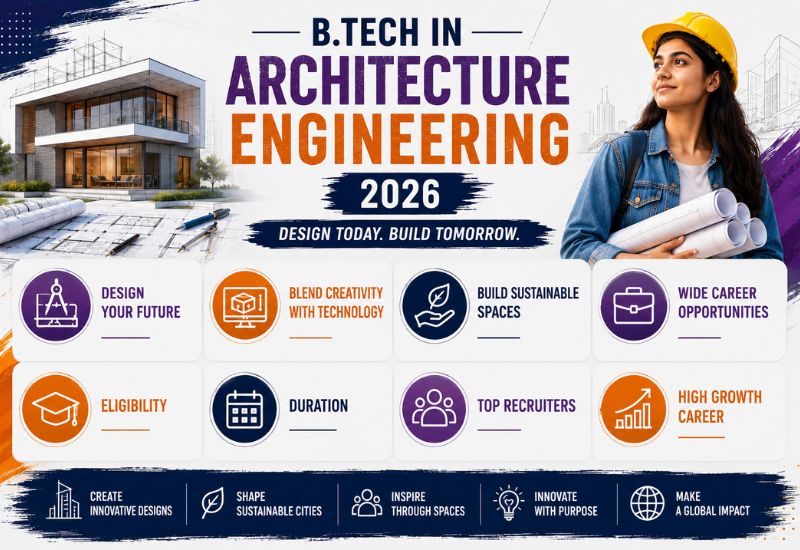
The curriculum for B.Tech in Architecture Engineering typically includes foundational subjects like Mathematics and Physics that form the basis of engineering principles, alongside:
Building Materials and Construction -understanding various materials and their applications
Structural Analysis and Design -learning how to ensure buildings can withstand various forces
Architectural Design - developing creative design skills while considering functionality
Building Services - including HVAC, plumbing, electrical systems, and fire safety
Core civil engineering concepts alongside architectural design, delivered through core subjects, electives, practical sessions, studio sessions, and industrial visits
Urban planning, environmental sustainability, and digital design tools (AutoCAD, REVIT, BIM)
The teaching approach blends technical coursework with hands-on design practice:
Classroom theory for engineering fundamentals -mathematics, mechanics, structural analysis
Studio-based learning where students work on design projects under faculty supervision, similar to architecture schools
Practical lab sessions covering building materials testing, surveying, and CAD/BIM software training
Industrial visits to active construction sites, giving real-world exposure to project execution
Internships in the later years, which give students practical, on-ground experience often with a stipend
Mini and major projects - most programmes require a substantial design-and-build project in the final year, combining structural calculations with architectural drawings
Industry collaboration through guest lectures and tie-ups with construction firms and government bodies
1. IIT Kharagpur - IIT Kharagpur's programme integrates engineering fundamentals with architectural design, with a comprehensive syllabus covering core technical and creative subjects across eight semesters. It's renowned for its legacy in design innovation, interdisciplinary research, and global ties, encouraging creativity and advanced technology use in architecture and planning. Strong faculty depth and research infrastructure make it a top choice for students wanting both rigour and design exposure.
2. IIT Roorkee - One of India's oldest engineering institutions, IIT Roorkee combines a strong foundation in civil engineering with architectural excellence, fostering research, innovation, and strong placement outcomes. The institute's blend of structural engineering depth and design studios makes it ideal for students who want a technically rigorous path into the built-environment sector.
3. NIT Calicut — NIT Calicut is renowned for its strong practical focus and green, advanced campus, with its architecture department offering industry-oriented and research-backed learning. The programme balances sustainability-focused design with solid engineering training, and the institute has a strong placement record in construction and infrastructure firms.
4. SPA Delhi (School of Planning and Architecture) - SPA Delhi is India's premier government institution specialising exclusively in architecture and planning studies, with top government projects, urban research, and high placement records. While traditionally known for B.Arch, its planning and technical programmes attract students seeking strong government and policy-linked career paths.
5. IIEST Shibpur - A historical institute with a reputation for research and top-tier architecture teaching, IIEST Shibpur is a leader in the eastern region. It combines a strong civil engineering legacy with growing emphasis on architectural technology, offering affordable fees and solid placement support in core construction sectors.
1. Manipal University One of the top private institutions offering this course, known for its latest infrastructure, good placements, and updated curriculum. The university blends design studios with strong technical training and offers admission through entrance exams as well as merit-based routes.
2. Lovely Professional University (LPU) — LPU is recognised among the top private colleges offering B.Tech in Architecture Engineering, with modern infrastructure and an industry-aligned curriculum. The large campus provides extensive studio space, CAD labs, and a dedicated placement cell connecting students to construction and design firms.
3. Chandigarh University - Known for the latest infrastructure and updated curriculum, Chandigarh University offers admission through its own entrance exams or based on Class 12 board marks. It maintains active recruitment ties with construction and infrastructure companies for its engineering graduates.
4. Amity University - Amity University is among the top private colleges for this programme, offering strong infrastructure and consistent placement support. With campuses across multiple cities, it provides flexibility in location alongside structured industry exposure through internships and live projects.
5. CEPT University, Ahmedabad — CEPT University is famous for urban planning and innovative studio projects, with collaborations and real-world learning that stand out in the architecture field. Though best known for design-focused programmes, its technical and planning-oriented courses offer strong exposure to real infrastructure projects across India.
B.Tech in Architecture Engineering, being a professional course, offers remuneration that typically falls in the range of ₹4 lakh to ₹12 lakh in India. Here's a more detailed breakdown:
Freshers: Starting salaries generally range from ₹3-5 lakh per annum, though some sources place fresher earning potential between ₹4-10 LPA depending on the specific role — Design Architect, Civil Engineer, Interior Designer, or Urban Planner
Mid-career (5-10 years): Experienced professionals in architecture-adjacent roles can earn up to ₹5-7 LPA, with specialised designations like Associate Architect averaging around ₹22 LPA
Senior level: Principal Architects and senior designations can average around ₹34 LPA, while architectural engineers more broadly report an average salary of around ₹13.78 lakh per annum across experience levels.
City-wise variation: Bangalore offers the highest average salary for architecture-related roles at around ₹21.7 LPA, with other metros also commanding a premium over smaller cities
Government roles: Government architect-adjacent salaries in India typically range from ₹60,000 to ₹90,000 per month including allowances, offering strong job security
Graduates can pursue careers as Architects, Urban Planners, Interior Designers, Graphic Designers, and Design Engineers, with additional paths including:
Construction Manager — running the overall process of a construction project
Structural Engineer — surveying and designing the structural elements of buildings
Civil & Structural Design roles, Budget Control Engineer, Cost Estimator, and Community Resilience Specialist
Site Engineer/Site Manager, overseeing on-ground execution of construction projects
BIM Specialist or CAD Engineer, focusing on digital modelling for large-scale projects
Government roles in bodies like CPWD, DRDO, and PWD departments
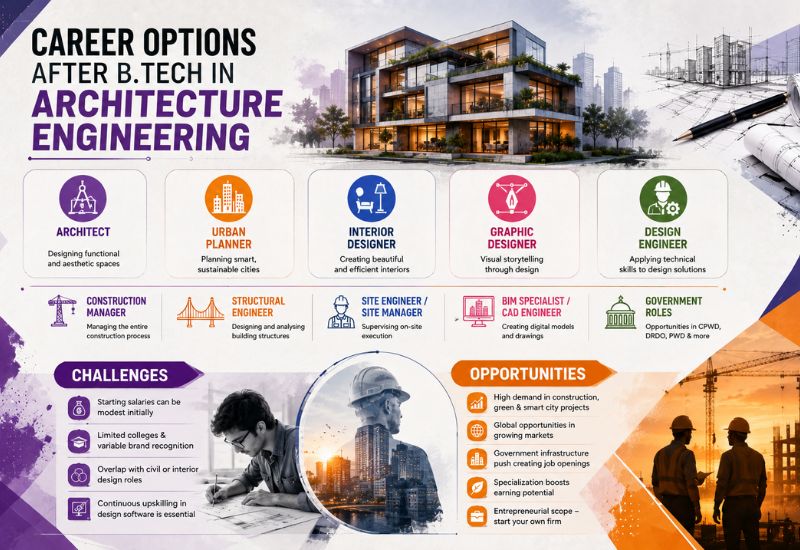
Challenges:
Starting salaries can be modest compared to mainstream engineering branches like CSE, especially in the first few years
The course's relative newness means fewer colleges offer it, and brand recognition among recruiters can be inconsistent
Career paths sometimes overlap with civil engineering or interior design, requiring graduates to clearly position their specific skill set to employers
Heavy reliance on design software proficiency (AutoCAD, REVIT, BIM) means continuous upskilling is necessary to stay competitive
Opportunities:
High industry demand driven by India's thriving construction sector and the growth of green and smart city projects
Global prospects, with Indian architectural engineers highly sought after in growing international civil engineering markets
Government infrastructure pushes (smart cities, affordable housing, metro projects) are steadily expanding job openings.s
Specialisation in sustainable design, BIM, or urban planning can significantly increase earning potential.
Entrepreneurial scope — many graduates eventually start their own design-and-build firms or consultancy practices .ices
This course is well-suited for creative thinkers with technical aptitude — those who enjoy artistic design but also want to apply engineering problem-solving to real structures. It particularly favours students who are strong in mathematics and science, since physics, chemistry, and mathematics form the essence of the course and its entrance criteria.
It's the right fit if you:
Enjoy both sketching/design work and technical, calculation-heavy subjects
Want a career that blends creativity with structural problem-solving rather than choosing one over the other
Are comfortable with studio-style, project-based learning rather than purely theoretical coursework
Are open to a career path where mid-to-senior level pay typically takes a few years to peak
It may not suit you if you specifically want to become a licensed, practising architect — for that, a B.Arch remains the necessary route. It also isn't the best fit if your primary goal is the fastest, highest first-year salary, since branches like CSE or AI/ML currently offer steeper starting packages.
Conclusion
B.Tech in Architecture Engineering offers a distinctive middle path for students who want to shape the built environment without choosing purely between design and engineering. While it isn't a substitute for a B.Arch if your goal is to become a licensed architect, it opens solid, growing career opportunities across construction, infrastructure, and design-engineering roles — especially as India's urban development and smart-city projects continue to expand.
Q1. Is B.Tech in Architecture Engineering the same as B.Arch? No. B. Tech in Architecture Engineering focuses more on the engineering and technical side of architectural design, while B. Arch focuses on artistic and conceptual design.
Q2. Can I become a licensed architect after B.Tech in Architecture Engineering? You can work in architecture-related fields, but to become a licensed architect in India, you need a B.Arch degree and registration with the Council of Architecture (COA).
Q3. What is the course duration? The course runs for four years, divided into eight semesters.
Q4. What entrance exams are accepted? JEE Main, NATA, and various state-level CETs, depending on the specific college's admission policy.
Q5. What is the average course fee? Average course fees typically range from ₹2-5 lakh, varying based on college infrastructure and facilities, with some private institutes charging up to ₹8 lakh for the full programme.
Q6. Is lateral entry available? Yes, candidates who have completed a Diploma in Architecture Engineering after Class 10 can get direct admission into the second year.
Q7. What jobs can I get after this course? Roles include architect, construction manager, and structural engineer, along with urban planner, design engineer, site manager, and BIM specialist.
Q8. What is the starting salary for graduates? Starting salaries typically fall between ₹3-5 lakh per annum, with potential to rise significantly with specialisation and experience.