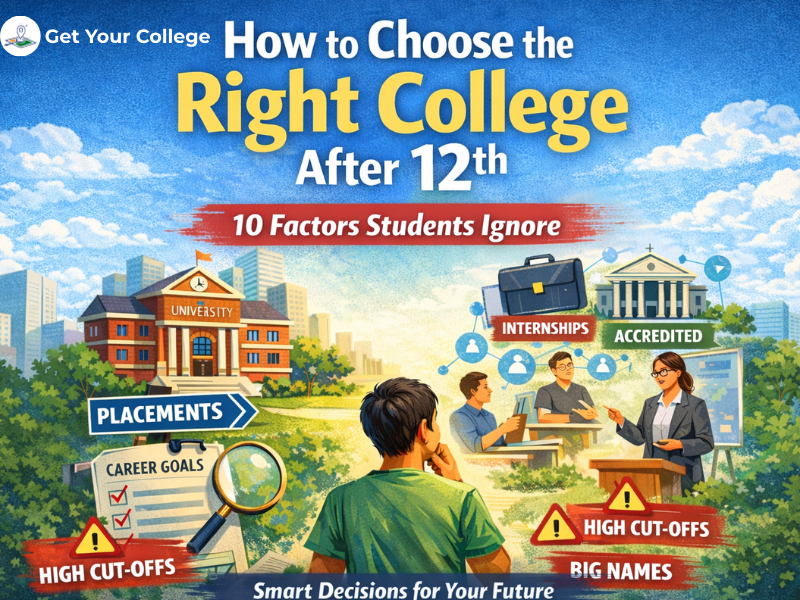
Choosing the right college after Class 12 is not just an academic decision—it is a career-defining milestone that shapes a student’s professional direction, confidence, exposure, and long-term success. Yet, despite its importance, most students and parents approach this decision with limited information, emotional pressure, and surface-level comparisons.
At Get Your College, after counselling thousands of students across Science, Commerce, and Arts streams, one truth stands out clearly:
Students do not regret their course as much as they regret their college choice.
This comprehensive guide highlights 10 critical factors students commonly ignore while choosing a college after 12th, but which have the maximum long-term impact on career outcomes, employability, and personal growth.
This article is designed for:
Class 12 students
Parents involved in decision-making
Students are confused between multiple colleges
Those planning UG courses in India or abroad
Today’s education ecosystem has changed dramatically:
More colleges than ever before
New-age careers are emerging every year
Employers focusing on skills, exposure, and mindset, not just degrees
Yet, many students still choose colleges based on:
Cut-off marks
Brand name
City preference
Peer pressure
Social media perception
These factors alone do not guarantee career success.
Students often select courses based on:
Current trends
High enrollment numbers
Advice from friends or relatives
They rarely analyse whether the course aligns with:
Their interests
Their natural strengths
Their long-term career goals
Before finalising a college, ask:
What career paths does this course actually open?
Does the college provide specialisations or electives?
Are students trained for real job roles or just exams?
Course | Common Student Assumption | Actual Career Outcome Depends On |
|---|---|---|
BBA | Easy management degree | Internships, specialisation, exposure |
B.Com | Finance job guaranteed | Skill-based training, certifications |
B.Tech | High-paying IT job | College ecosystem + practical skills |
BA | Limited scope | College mentorship + career guidance |
Key Insight:
Never choose a college unless the course clearly aligns with a real, achievable career pathway.
Many colleges advertise:
PhD-qualified faculty
Senior professors
Academic excellence
However, academic qualifications alone do not ensure quality teaching or career readiness.
Evaluate whether faculty members:
Have industry exposure
Update curriculum regularly
Mentor students beyond classroom teaching
Encourage research, projects, and internships
Do professors have corporate or field experience?
Are guest lectures conducted by industry professionals?
Do students receive career mentoring, not just syllabus coverage?
Criteria | Good College | Poor College |
|---|---|---|
Industry Experience | Regular guest faculty | No industry interaction |
Teaching Method | Case studies, projects | Only theory |
Student Mentorship | Active guidance | No personal support |
Exposure | Industry visits, workshops | Classroom-only learning |
Many students believe internships happen after graduation.
In reality, career-ready students start internships from Year 1 or Year 2.
Internships help students:
Build real-world skills
Understand workplace expectations
Clarify career interests early
Strengthen resumes before final placements
Does the college facilitate internships?
Are internships mandatory or optional?
Are industry projects part of the curriculum?
Feature | Career-Focused College | Degree-Focused College |
|---|---|---|
Internship Support | Structured & guided | Student-managed |
Industry Tie-ups | Active partnerships | None |
Project-Based Learning | Yes | Rare |
Resume Building | Continuous | Last semester only |
Colleges often advertise:
“100% placements”
“Highest package ₹20 LPA”
But they rarely clarify:
Average package
Median salary
Placement roles
Company relevance
Average salary, not the highest
Type of companies visiting
Job roles offered
Placement consistency over the years
Placement Metric | Important? | Why |
|---|---|---|
Average Salary | Yes | Reflects true student outcome |
Median Salary | Yes | Shows typical earnings |
Highest Package | No | Applies to very few |
Job Roles | Yes | Determines career growth |
Internship-to-Placement | Yes | Showsan's employability focus |
Professional Advice:
A transparent placement report is more valuable than exaggerated claims.
Many students do not check whether the college is:
UGC approved
AICTE recognised (for technical courses)
NAAC accredited
This can lead to:
Degree validity issues
Problems in higher studies
Limited acceptance abroad
Accreditation Body | Why It Matters |
|---|---|
UGC | Degree validity |
AICTE | Technical course approval |
NAAC | Overall quality assessment |
NBA | Program-level credibility |
Infrastructure is not just about:
Big campus
Modern buildings
It also includes:
Libraries
Labs
Digital resources
Classroom technology
Study culture
Facility | Strong College | Weak College |
|---|---|---|
Library | Updated, digital access | Outdated books |
Labs | Industry-standard | Basic |
Classrooms | Smart learning tools | Chalk & board only |
Study Culture | Competitive & focused | Casual |
A strong alumni network:
Helps with internships
Supports placements
Provides mentorship
Builds professional connections
Are alumni working in reputed organisations?
Does the college actively engage alumni?
Are alumni invited to mentorship sessions?
Alumni Strength | Career Impact |
|---|---|
Active network | High |
Passive network | Limited |
No alumni engagement | Minimal |
Choosing a college in a metro or education hub can provide:
Better internships
Corporate exposure
Networking opportunities
But location must be strategically relevant to the course.
Course | Ideal Location Type |
|---|---|
Engineering | Tech hubs |
Management | Corporate cities |
Media & Design | Creative hubs |
Science & Research | Academic clusters |
Many colleges focus only on academics and ignore:
Mental health support
Career counselling
One-on-one mentoring
This leads to:
Dropouts
Career confusion
Low confidence
Support Area | Importance |
|---|---|
Career Counselling | Very High |
Academic Mentorship | High |
Mental Health Support | High |
Skill Development Cells | Very High |
A good college should help students:
Plan higher studies
Prepare for competitive exams
Build entrepreneurial skills
Develop global exposure
Opportunity | Career Benefit |
|---|---|
Higher Studies Guidance | Strong |
Global Exposure | High |
Competitive Exam Prep | Valuable |
Skill Certifications | Essential |
Choosing the right college after 12th is not about prestige—it’s about purpose.
A good college:
Builds skills
Provides exposure
Offers mentorship
Creates career clarity
A wrong college:
Limits opportunities
Wastes potential
Delays success
Before finalising college, pause and evaluate:
Are you choosing with clarity or pressure?
Does the college support your long-term vision?
Are you investing in a career ecosystem, not just a degree?
At Get Your College, we believe every student deserves the right guidance before making the most important academic decision of their life.
If you choose wisely today, your future becomes easier tomorrow.