
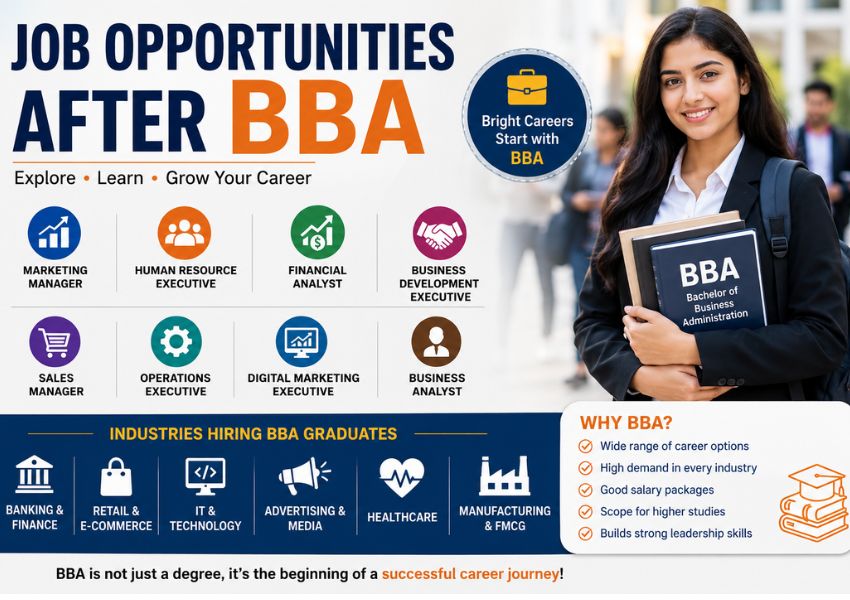
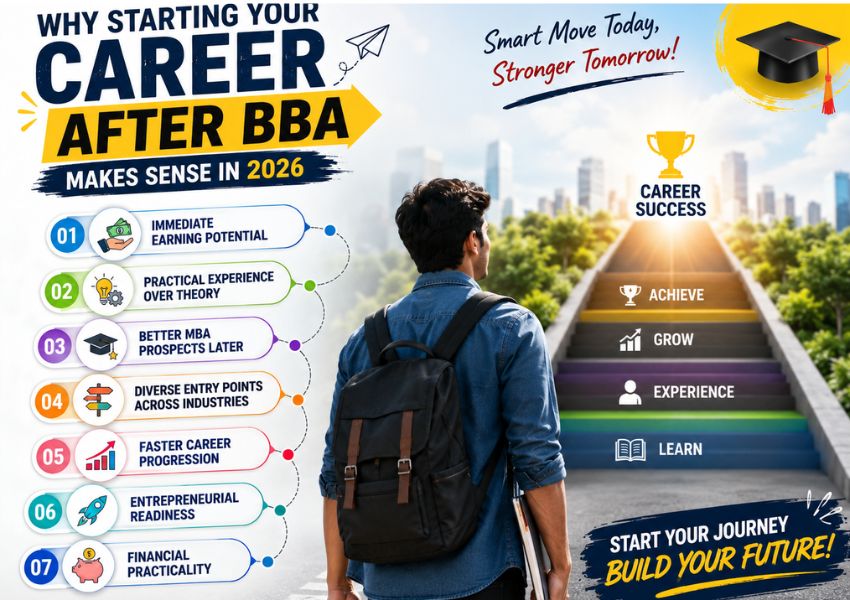
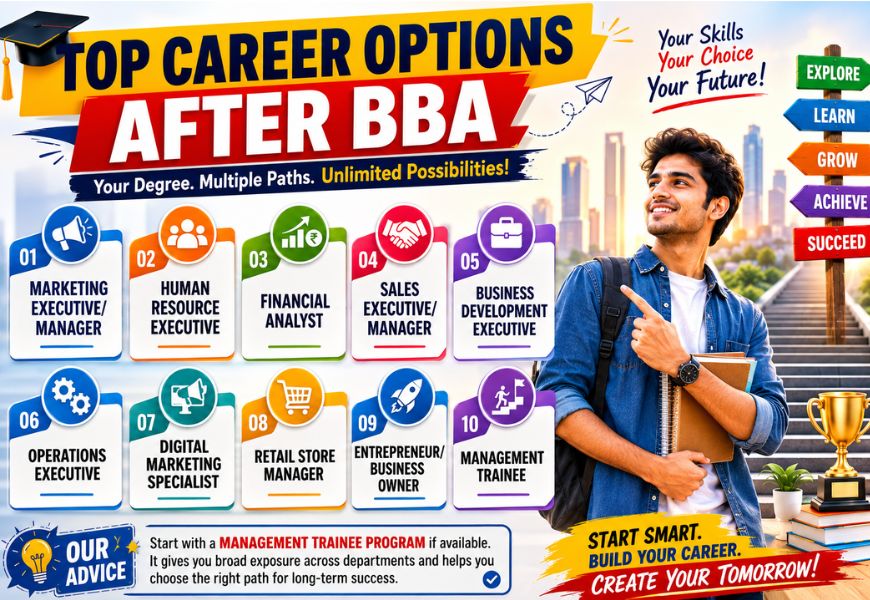
BBA's broad curriculum makes graduates employable across nearly every industry. Here's a sector-by-sector breakdown for 2026.
1. Banking and Financial Services
Roles in retail banking, financial analysis, wealth management, and credit analysis remain consistently strong, particularly given India's expanding banking sector.
2. Information Technology and E-commerce
IT companies and e-commerce platforms hire BBA graduates for business analyst, operations, and project coordination roles, especially those combining business understanding with basic tech literacy.
3. FMCG (Fast-Moving Consumer Goods)
Companies in this sector actively recruit for sales, marketing, and brand management roles, given the constant demand for product promotion and distribution management.
4. Retail and E-commerce
Store management, retail operations, and supply chain coordination roles offer consistent opportunities, particularly as retail chains and online marketplaces continue expanding.
5. Consulting
Entry-level business analyst and associate consultant roles at consulting firms provide strong analytical exposure, particularly valuable for graduates considering an MBA later.
6. Hospitality and Tourism
Hotel management, event coordination, and tourism-related business roles offer opportunities for graduates interested in client-facing, service-oriented careers.
7. Real Estate
Sales, marketing, and business development roles within real estate firms provide strong earning potential, often with attractive commission structures.
8. Healthcare and Pharmaceuticals
Hospital administration, pharmaceutical sales, and healthcare management roles offer stable, growing career paths within this expanding sector.
9. Media and Entertainment
Marketing, brand partnerships, and business development roles within media companies suit graduates interested in creative industries.
Our advice:
Rather than limiting yourself to one industry, use your BBA's broad foundation to explore roles across 2-3 sectors early in your career, helping you identify genuine long-term interest before specialising further in 2026.
Government Job Opportunities After BBA
Looking for stability and structured career growth? Government roles remain a solid option for BBA graduates in 2026.
1. Banking Sector (PSU Banks)
Public sector banks like SBI, PNB, and Bank of Baroda regularly recruit for Probationary Officer (PO) and clerical positions through exams like IBPS PO and SBI PO, open to BBA graduates.
2. SSC (Staff Selection Commission) Exams
BBA graduates can appear for SSC CGL (Combined Graduate Level) exams, opening doors to various administrative and clerical government positions across ministries and departments.
3. Public Sector Undertakings (PSUs)
Companies like ONGC, BHEL, and NTPC occasionally recruit management trainees and administrative staff through management-focused entrance processes.
4. Civil Services (UPSC)
While requiring separate, intensive preparation, BBA graduates are fully eligible to appear for UPSC Civil Services exams, leading to prestigious administrative roles like IAS, IPS, and IFS.
5. Railway Recruitment
Indian Railways regularly conducts recruitment drives for various administrative and management roles suitable for BBA graduates.
6. State Public Service Commissions
Each state conducts its own public service exams for administrative and clerical positions, offering region-specific government career opportunities.
7. Defence Sector (Officer Roles)
BBA graduates can apply for various administrative and management officer positions within defence organisations through relevant entrance processes.
Why choose government roles?
Beyond job security, government positions typically offer structured career progression, pension benefits, and better work-life balance compared to many private sector roles.
Our advice:
Government exam preparation requires significant dedicated time, so if you're interested in this path, start preparing early alongside your BBA studies or immediately after graduation to maximise your attempts within eligible age limits for 2026.
Private Sector Job Opportunities After BBA
The private sector offers the widest range of opportunities for BBA graduates in 2026, spanning diverse company sizes and industries.
1. Multinational Corporations (MNCs)
Large MNCs across FMCG, IT, and consulting sectors offer structured management trainee programs, competitive salaries, and strong career growth potential for BBA graduates.
2. Startups
India's growing startup ecosystem offers dynamic, fast-paced roles with broader responsibilities early in your career, ideal for graduates wanting hands-on, diverse experience.
3. Banking and NBFCs
Private banks and non-banking financial companies actively recruit for sales, relationship management, and credit analysis roles.
4. Consulting Firms
Both boutique and large consulting firms hire BBA graduates for research analyst and associate consultant roles, particularly valuable for building analytical skills.
5. E-commerce Companies
Companies like Amazon, Flipkart, and Myntra offer roles in operations, category management, and business development.
6. Retail Chains
Organised retail companies provide store management, merchandising, and supply chain roles with clear promotion pathways.
7. Real Estate and Insurance
These sectors offer strong sales-driven roles, often with performance-based incentives significantly boosting overall compensation.
8. Media and Advertising Agencies
Roles in client servicing, brand management, and digital marketing suit graduates interested in creative, fast-paced work environments.
Our advice:
Private sector roles often reward initiative and performance more directly than tenure alone, so focus on building measurable achievements early in your career to accelerate promotions and salary growth through 2026 and beyond.
Top Recruiters Hiring BBA Graduates
Curious which companies actively hire BBA graduates? Here's a look at major employers across sectors in 2026.
FMCG companies:
- Hindustan Unilever
- ITC Limited
- Nestlé India
- Procter & Gamble
Banking and financial services:
- HDFC Bank
- ICICI Bank
- Axis Bank
- Kotak Mahindra Bank
Consulting firms:
- Deloitte
- EY (Ernst & Young)
- KPMG
- Accenture
E-commerce and technology:
- Amazon
- Flipkart
- Myntra
- Swiggy/Zomato
Retail chains:
- Reliance Retail
- Tata Group (Tata Trent, Croma)
- Aditya Birla Retail
Real estate and insurance:
- DLF
- HDFC Life
- ICICI Prudential
Media and advertising:
- WPP Group
- Ogilvy
- Publicis Groupe
Our advice:
These recruiters typically prioritise candidates with strong internship experience, relevant certifications, and demonstrated leadership through college activities or projects. Building a strong resume with practical business exposure significantly improves your chances of landing roles with these top employers in 2026.
Average Salary After BBA in India
Here's a realistic breakdown of what you can expect to earn after completing your BBA in India for 2026.
Overall average starting salary
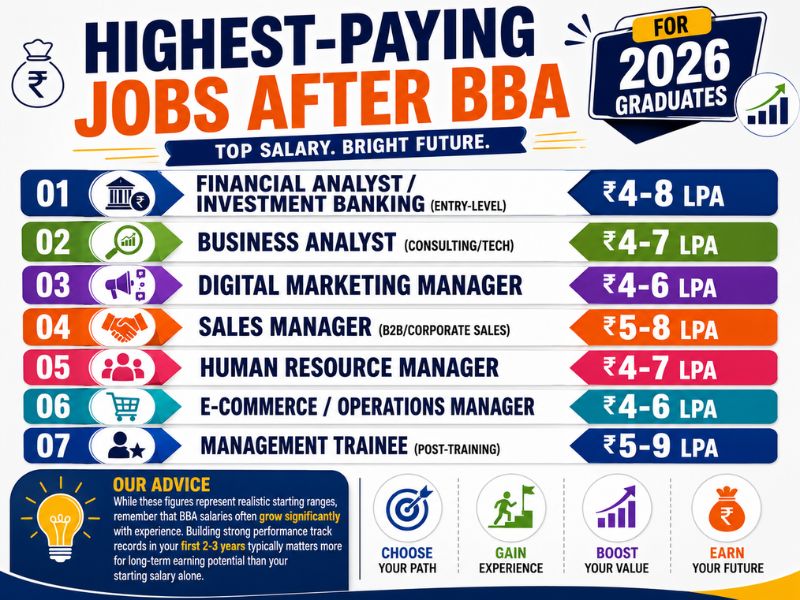
Fresh BBA graduates typically earn between ₹3-6 LPA, depending on the college, specialisation, and specific job role.
Salary by job role
- Marketing Executive: ₹3-5 LPA
- Sales Executive: ₹3-6 LPA (often with performance incentives pushing this higher)
- HR Executive: ₹3-5 LPA
- Financial Analyst: ₹4-7 LPA
- Business Analyst: ₹4-7 LPA
- Digital Marketing Executive: ₹3-5 LPA
- Management Trainee (post-training): ₹5-9 LPA
What influences your salary?
- College reputation and placement track record
- Specific specialisation chosen during BBA (Finance, Marketing, HR)
- Internship experience and practical skill demonstration
- Company type (MNC vs. startup vs. mid-sized firm)
- Location (metro cities typically offer higher packages)
Career growth potential
With 3-5 years of experience, BBA graduates often see salaries rise to ₹8-12 LPA, particularly in sales, marketing, or business development roles with strong performance track records.
The bigger picture
While BBA starting salaries may not match specialised technical fields, the degree offers genuine versatility, diverse industry exposure, and strong long-term earning potential — especially when combined with an MBA or specialised certifications down the line, making it a solid foundational choice for 2026 graduates.
Skills Required to Get the Best Jobs After BBA
Having a BBA degree alone isn't enough anymore. Here's what actually sets top candidates apart in 2026.
Technical and analytical skills
- MS Excel and data analysis: Essential for nearly every business function, from finance to marketing reporting
- Basic understanding of digital tools: Familiarity with CRM software, digital marketing platforms, and business intelligence tools like Power BI or Tableau
- Financial literacy: Understanding financial statements, budgeting, and basic accounting principles, regardless of your specialisation
Business and strategic skills
- Critical thinking and problem-solving: Ability to analyse business situations and propose practical solutions
- Market awareness: Staying updated on industry trends, competitor activities, and consumer behaviour shifts
- Project management basics: Understanding how to plan, execute, and track business initiatives
Communication and interpersonal skills
- Verbal and written communication: Critical for client interactions, presentations, and internal reporting
- Negotiation skills: Particularly valuable for sales, business development, and vendor management roles
- Presentation skills: Ability to communicate ideas clearly and persuasively to stakeholders
Leadership and adaptability
- Team collaboration: Working effectively within cross-functional teams
- Adaptability: Comfort with changing business environments and evolving job responsibilities
- Initiative and ownership: Taking proactive responsibility for tasks and outcomes, rather than waiting for direction
Emerging skills for 2026
- Basic data analytics understanding: Even non-technical roles increasingly value comfort with interpreting data
- Digital marketing fundamentals: Useful across nearly every business function given the shift toward online business models
- AI tool familiarity: Basic comfort using AI-powered productivity and analytics tools is becoming a genuine differentiator
Our advice:
Since your BBA coursework provides foundational knowledge, actively build these practical skills through internships, online certifications, and real projects during your degree to stand out in a competitive 2026 job market.
Best BBA specialisations for Better Career Opportunities
Choosing the right specialisation can significantly shape your career trajectory. Here's a look at the top options for 2026.
1. BBA in Finance
Ideal for students interested in banking, investment analysis, or corporate finance roles. This specialisation also provides a strong foundation for pursuing CFA or an MBA in Finance later.
2. BBA in Marketing
Perfect for creative, people-oriented students interested in brand management, digital marketing, or market research careers across nearly any industry.
3. BBA in Human Resource Management
Suited for students interested in talent acquisition, employee relations, and organisational development, offering stable, people-focused career paths.
4. BBA in International Business
Valuable for students interested in global trade, export-import management, or careers with multinational corporations requiring cross-border business understanding.
5. BBA in Business Analytics
Increasingly popular given rising demand for data-driven decision-making, combining business fundamentals with analytical and technical skills.
6. BBA in Digital Marketing
A newer, highly relevant specialisation given the growing importance of online business presence, covering SEO, social media, and digital advertising strategy.
7. BBA in Entrepreneurship
Designed for students planning to start their own business, focusing on venture creation, business planning, and startup management.
8. BBA in Retail Management
Suited for students interested in retail operations, merchandising, and supply chain management within the growing retail sector.
Our advice:
Choose your specialisation based on genuine interest rather than just perceived salary potential — career satisfaction and long-term performance typically improve significantly when your work aligns with your natural strengths and interests for 2026 and beyond.
Higher Studies After BBA
Considering further education after your BBA? Here are the most valuable pathways for 2026.
1. MBA (Master of Business Administration)
The most popular choice among BBA graduates, offering advanced management education, specialisation options, and significantly improved career prospects, particularly when pursued after 2-3 years of work experience.
2. MBA Specialisations to Consider
- Finance, Marketing, HR, Operations (traditional specialisations)
- Business Analytics, International Business (emerging, high-demand specialisations)
3. Master's in Specific Fields
Students can also pursue focused master's degrees like MS in Finance, MS in Marketing, or MS in Business Analytics, particularly if seeking deep specialisation rather than broad management training.
4. Professional Certifications as Alternatives
For students not wanting a full postgraduate degree, certifications like CFA (Finance), CPA, or digital marketing certifications can provide specialised credibility without the time and cost of an additional degree.
5. PGDM (Post Graduate Diploma in Management)
Offered by top business schools like IIMs (as PGP) and other autonomous institutes, PGDM programs provide similar value to an MBA, often with a more flexible, industry-aligned curriculum.
6. Study Abroad Options
Many BBA graduates pursue master's programs abroad (MS in Management, MBA) in countries like the US, UK, or Canada, gaining international exposure and global career opportunities.
7. PhD/Doctoral Studies
For those interested in academia or research-focused careers, pursuing a PhD in Management or a related field after BBA and MBA offers a long-term academic career path.
Our advice:
If you're considering an MBA, gaining 2-3 years of relevant work experience first often leads to better admission chances, richer classroom learning, and stronger long-term career outcomes compared to pursuing an MBA immediately after BBA.
Professional Certifications After BBA
Want to boost your employability without committing to a full postgraduate degree? Here are valuable certification options for 2026.
1. CFA (Chartered Financial Analyst)
Highly respected in finance and investment management, this globally recognised certification significantly strengthens your profile for finance-focused careers.
2. Digital Marketing Certifications
Platforms like Google (Google Ads, Google Analytics certifications) and HubSpot offer credible, industry-recognised digital marketing credentials valuable across nearly every business function.
3. Six Sigma Certification
Particularly valuable for operations and process improvement roles, demonstrating your ability to enhance business efficiency and quality management.
4. Project Management Certifications (PMP, PRINCE2)
Useful across industries, these certifications validate your ability to plan, execute, and manage business projects effectively.
5. Data Analytics Certifications
Certifications in Excel, Power BI, Tableau, or SQL significantly boost your analytical credibility, particularly valuable given growing demand for data-driven decision-making.
6. HR Certifications (SHRM, HRCI)
Valuable for students pursuing HR careers, demonstrating specialised knowledge in talent management and organisational development.
7. Financial Modelling Certifications
Particularly useful for finance and business analyst roles, showing practical skills in building financial models and valuations.
8. Certified Business Analytics Professional (CBAP)
Growing in relevance as companies increasingly seek certified analytics professionals across business functions.
Our advice:
Choose certifications aligned with your intended career path rather than collecting broad, unrelated credentials — a focused, relevant certification demonstrates genuine expertise far more effectively than multiple unrelated ones for 2026 job applications.
Entrepreneurship Opportunities After BBA
Thinking about starting your own venture instead of a traditional job? BBA provides a solid foundation for entrepreneurship in 2026.
Why BBA suits aspiring entrepreneurs
The degree's broad coverage of finance, marketing, operations, and HR gives you practical, well-rounded business knowledge essential for running your own venture, unlike narrower technical degrees.
Popular entrepreneurial paths for BBA graduates
- E-commerce ventures: Leveraging digital marketing and operations knowledge to start online retail businesses
- Service-based startups: Consulting, digital marketing agencies, or event management businesses
- Retail businesses: Physical or hybrid retail ventures using supply chain and merchandising knowledge
- Food and beverage ventures: Cafes, cloud kitchens, or food delivery businesses
- Ed-tech or content-based businesses: Leveraging business knowledge to create educational or informational content platforms
Building entrepreneurial skills during BBA
Many BBA programs now offer dedicated entrepreneurship electives, business plan competitions, and startup incubation support, providing practical experience before graduation.
Government support for young entrepreneurs
Initiatives like Startup India and MUDRA loans provide funding, tax benefits, and mentorship support specifically designed to help young entrepreneurs launch their ventures with reduced financial risk.
Building practical experience first
Many successful entrepreneurs recommend gaining 2-3 years of industry work experience before starting a venture, allowing you to build practical skills, industry contacts, and a clearer understanding of market gaps.
Our advice:
If entrepreneurship interests you, start small — perhaps a side project or freelance venture during your BBA — to test business ideas and build practical experience before committing fully to a startup after graduation in 2026.
Future Scope of BBA Graduates
Wondering if a BBA degree still holds value in the years ahead? Here's why the outlook remains genuinely strong for 2026 and beyond.
1. Continued corporate expansion
As India's economy continues growing and more companies establish operations domestically and internationally, demand for skilled management professionals across marketing, finance, HR, and operations remains consistently strong.
2. Rise of digital and analytics-driven roles
The business landscape is increasingly shifting toward digital-first operations, creating growing demand for BBA graduates skilled in digital marketing, e-commerce management, and business analytics.
3. Startup ecosystem growth
India's thriving startup culture continues creating fresh opportunities for BBA graduates, both as employees in growing companies and as entrepreneurs launching their own ventures.
4. Strong foundation for further specialisation
BBA remains an excellent stepping stone toward MBA programs, professional certifications, or specialised master's degrees, ensuring graduates can continuously build on their foundational business knowledge.
5. Cross-industry versatility
Unlike narrower technical degrees, BBA's broad skill set remains relevant across virtually every industry, providing genuine career flexibility even as specific sectors evolve.
6. Growing importance of soft skills
As automation handles more technical tasks, uniquely human skills like leadership, communication, and strategic thinking — core strengths of BBA education — are becoming increasingly valuable rather than less relevant.
7. Global career opportunities
With growing international business ties and remote work normalisation, BBA graduates increasingly have access to global career opportunities beyond domestic markets.
The bigger picture:
While specific job roles will continue evolving alongside technology and market shifts, the fundamental business management skills BBA graduates develop remain foundational and adaptable, ensuring strong long-term career relevance well into 2026 and beyond.
Tips to Get a High-Paying Job After BBA
Want to maximise your earning potential right out of college? Here's practical advice for 2026 graduates.
1. Choose your specialisation strategically
Align your BBA specialisation with genuinely high-demand fields like Finance, Business Analytics, or Digital Marketing, rather than choosing based on perceived ease alone.
2. Prioritise internships during your degree
Real-world experience significantly strengthens your resume. Aim for at least 2-3 internships across different functions to build both skills and professional references.
3. Build in-demand technical skills
Supplement your degree with practical skills in Excel, data analysis tools, or digital marketing platforms — these directly translate into stronger job offers.
4. Earn relevant certifications
Credentials like CFA, Google Analytics, or Six Sigma add credibility and demonstrate specialised expertise beyond your degree alone.
5. Network actively
Attend industry events, connect with alumni, and build professional relationships on platforms like LinkedIn — many high-paying opportunities come through referrals rather than job portals alone.
6. Target companies with strong training programs
Management trainee programs at large corporations often provide structured growth paths and better long-term compensation compared to starting at smaller, less established companies.
7. Develop strong communication skills
Since business roles heavily involve client interaction and internal collaboration, strong verbal and written communication skills genuinely set candidates apart during interviews and on the job.
8. Consider location strategically
Metro cities and industrial hubs typically offer higher starting salaries, though factor in cost of living when comparing overall value.
9. Negotiate confidently
Many fresh graduates accept initial offers without negotiation — research market rates for your role and don't hesitate to discuss compensation before finalising offers.
Our advice:
Combining the right specialisation, practical skills, and genuine internship experience matters far more than college reputation alone when it comes to landing high-paying roles in 2026's competitive job market.
Why Choose Get Your College?
Navigating career decisions after BBA — whether choosing a job, planning an MBA, or picking the right certification — can feel overwhelming. That's where Get Your College makes the difference.
1. Personalised career guidance
Our expert counsellors help you evaluate career paths, specialisations, and further education options that genuinely align with your strengths and long-term goals.
2. MBA and higher studies planning
If you're considering an MBA or specialised master's program, we help you strategise entrance exam preparation, college shortlisting, and application timing for maximum impact.
3. Resume and profile building support
We help you craft a compelling resume and LinkedIn profile that highlights your BBA skills, internships, and achievements effectively to potential employers.
4. Certification and skill-building recommendations
Based on your career interests, we guide you toward the most relevant certifications and skill-building resources to strengthen your job market competitiveness.
5. Interview preparation
Our mock interview sessions help you build confidence and articulate your value clearly to potential employers or admission panels.
6. Entrepreneurship mentorship
For BBA graduates considering their own ventures, we connect you with mentorship resources and practical guidance on turning business ideas into reality.
7. Proven track record
With years of experience guiding students through successful career transitions and further education decisions, we bring honest, practical advice to every step of your journey.
The bottom line: Choosing the right path after BBA is a pivotal decision — partnering with Get Your College ensures that decision translates into real career success in 2026.
FAQs
1. What is the average starting salary after BBA in India?
Fresh BBA graduates typically earn between ₹3-6 LPA, depending on specialisation, college reputation, and specific job role.
2. Should I pursue an MBA immediately after BBA?
Not necessarily. Many experts recommend gaining 2-3 years of work experience first, as this often leads to better MBA admission chances and richer learning outcomes.
3. Which BBA specialisation offers the best career prospects?
Finance, Business Analytics, and Digital Marketing are among the most in-demand specialisations, though your choice should align with genuine personal interest for long-term success.
4. Can BBA graduates apply for government jobs?
Yes, BBA graduates are eligible for various government positions through exams like SSC CGL, IBPS PO, and even UPSC Civil Services, among others.
5. What skills should I focus on during my BBA to improve job prospects?
Prioritise Excel and data analysis skills, communication abilities, digital marketing fundamentals, and relevant certifications alongside your core coursework.
6. Is entrepreneurship a realistic option right after BBA?
While possible, most successful entrepreneurs recommend gaining 2-3 years of industry experience first to build practical skills and market understanding before starting a venture.
7. Which companies commonly hire BBA graduates?
Companies like Hindustan Unilever, HDFC Bank, Deloitte, Amazon, and Reliance Retail regularly recruit BBA graduates across various business functions.
Conclusion
A BBA degree continues to offer genuinely strong career prospects in 2026, providing graduates with versatile business knowledge applicable across nearly every industry. From immediate job opportunities in marketing, finance, HR, and operations to pathways toward higher studies, certifications, and entrepreneurship, BBA graduates have multiple viable routes to build successful, fulfilling careers.
The key to maximising your BBA's value lies in strategic choices — selecting the right specialisation, gaining practical experience through internships, building in-demand technical skills, and staying adaptable as business landscapes continue evolving alongside technology and digital transformation.