

Efficiently locate colleges, exams, or coachings with our intuitive search modal.
0 results

Completing a BTech degree opens doors to multiple career opportunities across technology, engineering, manufacturing, research, government sectors, and emerging industries. However, one of the biggest questions students ask after graduation is:
"What are the best jobs after BTech, and how much salary can I expect?"
The answer depends on multiple factors, including specialisation, technical skills, college reputation, internships, certifications, and industry demand.
In 2026, the job market is changing rapidly because of artificial intelligence, automation, digital transformation, electric vehicles, cloud computing, and advanced manufacturing technologies. Companies are now looking for engineers who combine technical knowledge with practical skills.
Why Career Planning After BTech Matters
Many engineering students focus primarily on completing their degree and securing a job immediately after graduation, but long-term career planning plays an important role in building sustainable career growth. Proper planning helps students make better decisions regarding specialisation, skills, higher education, and future opportunities.

Students who plan their careers early generally have better clarity, stronger skill development, and improved chances of securing high-growth opportunities.
Helps Choose the Right Specialisation
Career planning helps students identify which specialisation aligns with their interests, skills, and future industry demand. Choosing the right specialisation early can significantly influence long-term career growth and professional opportunities.
Improves Salary Opportunities
Students who plan their careers strategically often focus on developing relevant skills, certifications, internships, and technical expertise that improve employability and increase salary potential after graduation.
Creates Better Placement Chances
Early career planning allows students to prepare for placements more effectively by improving communication skills, technical knowledge, practical experience, and industry readiness throughout their academic journey.
Helps Identify High-Growth Industries
Technology and industry demands change rapidly, making it important for students to understand which sectors are growing faster. Career planning helps students focus on industries with better long-term opportunities and future demand.
Reduces Career Confusion
Many students face uncertainty after graduation because they have a limited understanding of available career paths. Proper planning helps create clear goals and reduces confusion regarding jobs, higher studies, specialisation choices, and industry selection.
Skills Matter More Than a Degree Alone
Modern employers increasingly focus on practical skills, technical expertise, internships, certifications, and project experience rather than relying only on academic qualifications. Developing industry-relevant skills has become essential for career growth.
Industry Demand Changes Rapidly
Technologies, business requirements, and job markets continue evolving quickly. Students who regularly update their knowledge and adapt to industry trends are generally better positioned for long-term career success.
Specialised Knowledge Increases Salary Potential
Professionals with specialised skills and technical expertise often receive better career opportunities and higher compensation compared to candidates with only general knowledge. Specialisation helps students build stronger competitive advantages.
Career planning after BTech is important because it helps students build stronger skills, choose better opportunities, improve salary potential, and prepare for rapidly changing industries. Students who start planning early often make better career decisions and achieve stronger long-term growth.
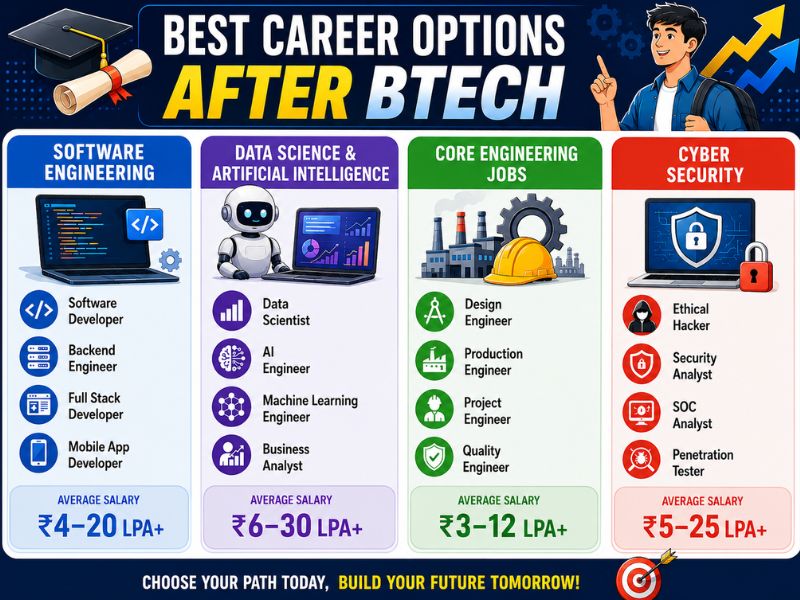
Software Engineering
Software Engineering remains one of the most popular and highest-paying career options after B.Tech. because almost every industry depends heavily on software solutions and digital technologies. Students with programming knowledge and development skills can build strong careers in technology companies, startups, and multinational organisations.
Software Developer
Software Developers create applications, websites, platforms, and digital solutions used across industries. They work on coding, testing, debugging, and improving software systems.
Backend Engineer
Backend Engineers focus on server-side systems, databases, APIs, and application architecture that power modern digital platforms and software products.
Full Stack Developer
Full-stack developers work on both front-end and back-end technologies, making them highly valuable for startups, software companies, and product-based organisations.
Mobile App Developer
Mobile App Developers create applications for smartphones and tablets using technologies for Android, iOS, and cross-platform development.
Average Salary
Professionals entering Software Engineering can generally expect salaries ranging between ₹4–20 LPA+, depending on technical skills, projects, and experience.
Data Science and Artificial Intelligence
Data Science and Artificial Intelligence are among the fastest-growing career fields because companies increasingly rely on data-driven decision-making and intelligent automation systems.
Data Scientist
Data Scientists analyze large datasets to generate business insights, identify trends, and support strategic decision-making using statistical and analytical techniques.
AI Engineers develop intelligent systems using machine learning, neural networks, and automation technologies for real-world applications.
Machine Learning Engineer
Machine Learning Engineers build predictive models and intelligent systems that learn from data and continuously improve performance.
Business Analyst
Business Analysts use data and market insights to help organisations improve operations, increase efficiency, and make better business decisions.
Average Salary
Data Science and AI professionals often receive salary packages ranging between ₹6–30 LPA+ because of high industry demand and specialised technical expertise.
Students from mechanical, electrical, civil, electronics, automobile, and related branches often pursue careers within their core engineering sectors where technical expertise remains highly valuable.
Design Engineer
Design Engineers develop products, systems, and technical solutions using engineering principles and design software.
Production Engineer
Production Engineers manage manufacturing operations, industrial processes, and production efficiency within factories and manufacturing facilities.
Project Engineer
Project Engineers supervise engineering projects, coordinate technical teams, and manage implementation activities.
Quality Engineer
Quality Engineers ensure products meet technical standards, manufacturing requirements, and performance expectations.
Average Salary
Core engineering professionals generally receive salaries ranging between ₹3–12 LPA+, depending on industry, specialisation, and experience.
Cyber Security
Cybersecurity continues to grow rapidly because organisations increasingly require professionals capable of protecting digital systems, networks, and sensitive information.
Ethical Hacker
Ethical Hackers legally test systems for vulnerabilities and help organisations strengthen their digital security infrastructure.
Security Analyst
Security Analysts monitor networks, identify threats, and protect organisations from cyberattacks and security risks.
SOC Analyst
SOC Analysts work within security operation centres to detect, analyse, and respond to cyber threats in real time.
Penetration Tester
Penetration Testers simulate cyberattacks to identify vulnerabilities before malicious attackers exploit them.
Average Salary
Cyber Security professionals often receive salaries ranging from ₹5–25 LPA+, depending on technical expertise and certifications.
Government jobs remain highly attractive because they offer stability, structured career growth, benefits, and long-term job security.
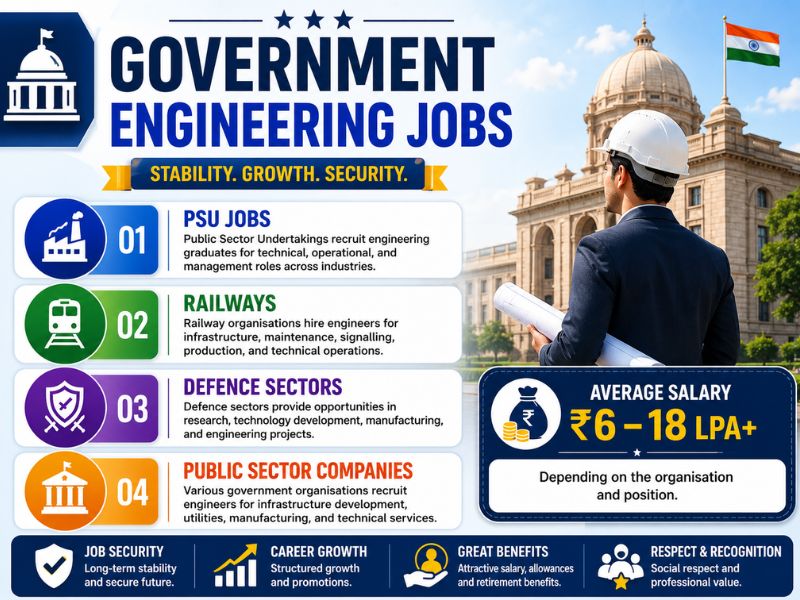
Public Sector Undertakings recruit engineering graduates for technical, operational, and management roles across industries.
Railway organisations hire engineers for infrastructure, maintenance, signalling, production, and technical operations.
Various government organisations recruit engineers for infrastructure development, utilities, manufacturing, and technical services.
Government engineering jobs generally offer salary packages ranging between ₹6–18 LPA+, depending on the organisation and position.
Many students choose higher education to improve specialisation, increase salary potential, and expand career opportunities.
MTech programs help students develop advanced technical knowledge and specialisation in engineering domains.
MBA programs prepare students for management, leadership, operations, finance, marketing, and business-focused careers.
International master's programs provide global exposure, advanced research opportunities, and access to international job markets.
Research-based programs help students build careers in innovation, technology development, academia, and advanced engineering research.
BTech graduates have multiple career options ranging from software development and AI to core engineering, government jobs, cyber security, and higher education. Choosing the right career path depends on personal interests, technical skills, industry trends, and long-term career goals.

AI Engineer
AI Engineers are among the highest-paid professionals after B.Tech. because companies increasingly depend on Artificial Intelligence for automation, analytics, and intelligent systems. These professionals build machine learning models, AI applications, and intelligent software solutions used across industries.
Average Salary
₹8–30 LPA+
Data Scientist
Data Scientists analyze large amounts of information to identify trends, generate business insights, and support decision-making processes. Growing dependence on data-driven business strategies continues to increase demand for skilled data professionals.
₹7–25 LPA+
Software Engineer
Software Engineering remains one of the most popular high-paying career paths because almost every industry requires software solutions, applications, and digital platforms. Strong coding skills and development experience can significantly improve salary growth.
Average Salary
₹5–20 LPA+
Cloud Engineer
Cloud Engineers work with cloud platforms, infrastructure management, security systems, and enterprise applications hosted on cloud environments. As businesses increasingly move toward cloud computing, demand for cloud professionals continues to grow rapidly.
Average Salary
₹6–25 LPA+
Cyber Security Engineer
Cyber Security Engineers protect organisations from cyber threats, security breaches, and digital attacks. Increasing cybercrime and digital transformation have created a strong demand for professionals with cybersecurity expertise.
Average Salary
₹5–25 LPA+
Product Manager
Product Managers are responsible for planning, developing, and managing products from concept to market launch. These roles combine technical knowledge, business strategy, leadership, and problem-solving skills.
Average Salary
₹10–35 LPA+
Investment Analyst
Investment Analysts work in financial markets, research firms, banking sectors, and investment organisations. Here, they analyse financial data, market trends, and business opportunities to support investment decisions.
Average Salary
₹8–20 LPA+
The highest-paying jobs after BTech are increasingly driven by technology, data, automation, cloud computing, and digital transformation. Students who focus on technical skills, certifications, practical projects, and industry-relevant expertise generally achieve better salary growth and long-term career success.
Computer Science Engineering
Computer Science Engineering offers some of the broadest career opportunities because technology companies, startups, financial institutions, healthcare organisations, and digital businesses heavily depend on software and computing solutions. Graduates often work in software development, cloud computing, artificial intelligence, and emerging technology domains.
Software Developer
Software Developers create applications, websites, enterprise software, and digital platforms used across industries. Strong programming skills and project experience are highly valuable in this role.
AI Engineer
AI Engineers work on machine learning systems, automation technologies, predictive analytics, and intelligent software solutions used in modern businesses.
Data Scientist
Data Scientists analyze large datasets and build data-driven solutions that help companies make better business decisions and improve operational efficiency.
Cloud Engineer
Cloud Engineers manage cloud infrastructure, enterprise systems, cloud applications, and digital services that support modern businesses.
Mechanical Engineering
Mechanical Engineering provides opportunities across manufacturing, production, automotive industries, energy systems, and industrial operations. This branch remains important because manufacturing and industrial growth continue creating employment opportunities.
Design Engineer
Design Engineers create products, machine components, industrial systems, and engineering solutions using technical software and engineering principles.
Production Engineer
Production Engineers manage manufacturing processes, industrial operations, production planning, and process optimisation.
Manufacturing Engineer
Manufacturing Engineers focus on improving industrial efficiency, automation systems, quality control, and production technologies.
Electrical Engineering
Electrical Engineering offers career opportunities in power generation, automation, manufacturing, renewable energy, and industrial systems. Rapid technological growth continues to increase demand for electrical engineers.
Power Engineer
Power Engineers work with electricity generation, transmission systems, power distribution networks, and energy infrastructure projects.
Automation Engineer
Automation Engineers develop intelligent industrial systems using robotics, control technologies, and automated manufacturing solutions.
Control Systems Engineer
Control Systems Engineers design and manage systems used to control machines, industrial equipment, and automated processes.
Civil Engineering
Civil Engineering remains important because infrastructure development, urbanisation, transportation projects, and construction activities continue to grow globally.
Site Engineer
Site Engineers supervise construction activities, project execution, workforce coordination, and infrastructure development projects.
Structural Engineer
Structural Engineers design buildings, bridges, industrial structures, and infrastructure systems while ensuring safety and durability.
Project Engineer
Project Engineers coordinate planning, execution, budgeting, and technical management activities within construction projects.
Electronics Engineering
Electronics Engineering offers strong opportunities in semiconductors, embedded systems, telecommunications, robotics, and consumer electronics industries.
Embedded Engineer
Embedded Engineers develop software and hardware systems used in smart devices, automotive systems, industrial equipment, and consumer electronics.
VLSI Engineer
VLSI Engineers work on semiconductor chip design, integrated circuits, microprocessors, and advanced electronic systems.
Communication Engineer
Communication Engineers work on networking technologies, wireless systems, telecommunications infrastructure, and digital communication platforms.
GATE + PSU Jobs
Many engineering graduates prepare for GATE examinations to secure jobs in Public Sector Undertakings (PSUs). These organisations recruit engineers for technical, operational, and management roles while offering strong salary packages, career stability, and long-term growth opportunities.
Engineering Services Examination provides opportunities for engineers to work in various government departments responsible for infrastructure development, transportation systems, public projects, and technical administration. These positions are considered highly respected because of their responsibility and career growth.
The railway sector remains one of the largest recruiters of engineering graduates in India. Engineers work in operations, maintenance, signalling systems, infrastructure projects, production units, and transportation management.
ISRO
Space research organisations provide opportunities for engineers interested in advanced technologies, satellite systems, aerospace projects, and scientific research. These roles are highly competitive and attract technically skilled candidates.
DRDO
Research organisations working in defence technologies recruit engineers for innovation, research projects, weapon systems, electronics, mechanical systems, and advanced engineering development programs.
State Engineering Departments
State government departments recruit engineers for infrastructure projects, public works, energy systems, transportation, construction projects, and technical administration roles.
Job Security
Government engineering jobs are popular because they generally provide long-term employment stability and structured career progression compared to many private sector roles.
Stable Income
Most government jobs offer predictable salary structures with periodic increments, making them attractive for students seeking financial stability and long-term career planning.
Government employees often receive additional benefits such as housing allowances, medical support, travel benefits, insurance coverage, and other employment-related perks.
Pension Opportunities
Certain government positions provide retirement benefits and pension-related advantages, making these careers attractive for long-term financial security.
Government jobs after BTech remain a popular career choice because they offer stability, structured career growth, financial security, and opportunities to work on large-scale national projects and technical initiatives.
IT Companies
IT companies remain one of the largest recruiters of engineering graduates because businesses across industries depend heavily on software, cloud computing, artificial intelligence, and digital technologies. Engineers can work in software development, cybersecurity, cloud systems, analytics, and emerging technology domains.
Manufacturing
Manufacturing industries continue to create strong employment opportunities for engineers across production, industrial operations, automation, quality management, and process optimisation. Growing industrial expansion increases demand for skilled technical professionals.
Automobile Industry
The automobile sector offers opportunities in vehicle manufacturing, production systems, electric mobility, research and development, quality control, and automotive technologies. Rapid growth in electric vehicles and automation is expanding hiring opportunities.
Startups
Startups provide dynamic work environments where engineers often gain exposure to multiple technologies, faster learning opportunities, and innovation-driven projects. Many graduates choose startups because they offer faster career growth and skill development.
Fintech
Financial technology companies combine finance with advanced digital solutions, creating opportunities in software engineering, analytics, cybersecurity, AI systems, and cloud technologies. The rapid expansion of digital payments continues to increase hiring demand.
Consulting Firms
Consulting companies recruit engineers for business analysis, technology consulting, operations improvement, project management, and digital transformation projects. These roles often provide exposure to multiple industries and business challenges.
Telecom Sector
Telecommunication companies hire engineers for networking systems, communication technologies, infrastructure development, cloud services, and digital connectivity projects. Growing digital infrastructure investments continue to support job growth.
Faster Promotions
Private sector companies often provide performance-based growth where employees can achieve promotions more quickly depending on skills, contributions, and business performance.
Higher Salaries
Private organisations generally provide stronger salary growth opportunities, especially for professionals working in high-demand technical domains such as software, AI, cybersecurity, cloud computing, and analytics.
International Opportunities
Many private companies operate globally and provide opportunities to work on international projects, overseas assignments, remote roles, and multinational business environments.
Skill-Based Growth
Career growth in the private sector largely depends on technical skills, certifications, practical knowledge, project experience, and continuous learning rather than only years of experience.
Bottom Line
Private sector jobs after BTech provide strong opportunities for faster growth, higher salaries, international exposure, and skill development. Students who continuously improve their technical expertise and practical skills often achieve better long-term career success.
Freshers Salary Range
Freshers completing BTech generally receive salary packages depending on their branch, technical skills, internships, college reputation, and industry demand. Most engineering graduates typically start with salary packages ranging between ₹3 LPA and ₹8 LPA, although students with strong technical profiles may secure higher packages.
Mid-Level Professionals
Engineers with several years of industry experience usually move into more specialised technical roles, leadership positions, or project management responsibilities. Mid-level professionals often receive salary packages ranging between ₹8 LPA and ₹20 LPA, depending on specialisation and industry.
Experienced Professionals
Experienced engineering professionals with strong technical expertise, leadership abilities, specialised knowledge, and industry exposure can achieve salary packages ranging between ₹20 LPA and ₹50 LPA or even higher in certain industries and domains.
College Reputation
The reputation of a college often influences placement opportunities, company participation, networking opportunities, and initial salary packages. Graduates from institutions with strong placement records may receive better starting opportunities.
Technical Skills
Technical expertise remains one of the biggest factors affecting salary growth because employers increasingly prioritise practical skills, programming knowledge, engineering tools, and industry-specific competencies.
Internships
Internships provide practical exposure and industry experience, making candidates more attractive to employers. Students with relevant internship experience often receive better placement opportunities and higher salary offers.
Certifications
Industry certifications help students develop specialised expertise and demonstrate additional skills beyond academic qualifications. Certifications in high-demand technologies can significantly improve earning potential.
Location
Salary packages often vary depending on job location because metropolitan cities, technology hubs, and industrial regions generally offer higher compensation compared to smaller locations.
Industry Demand
Industries experiencing rapid growth, such as Artificial Intelligence, Cyber Security, Cloud Computing, Electric Vehicles, Automation, and Data Science,e often provide stronger salary growth opportunities.
Bottom Line
Salary after BTech depends on multiple factors, rs including technical specialisation, practical experience, industry demand, and continuous learning. Students who focus on skill development and practical exposure generally experience faster salary growth and stronger long-term career opportunities.
Communication Skills
Strong communication skills help professionals explain ideas clearly, collaborate effectively with teams, and perform better during interviews, meetings, and workplace interactions. Good communication often plays a major role in career growth and leadership opportunities.
Technical Expertise
Technical expertise remains one of the most important requirements for high-paying jobs because employers prefer candidates who can solve real-world problems using practical knowledge and specialised skills.
Problem-Solving Ability
High-paying careers often require professionals to analyse complex situations and create effective solutions. Strong problem-solving abilities help engineers and technical professionals perform better in challenging work environments.
Programming Knowledge
Programming skills have become valuable across multiple industries, including software development, automation, data science, cybersecurity, and engineering technologies. Learning coding significantly increases career opportunities.
Teamwork
Most organisations require employees to work within teams to complete projects, solve problems, and achieve business goals. Strong teamwork skills improve workplace efficiency and career progression.
Leadership Skills
Leadership abilities become increasingly important as professionals move into senior roles where they manage projects, teams, and business decisions. Strong leadership often leads to better career growth.
Coding
Coding skills are increasingly valuable because software systems, automation technologies, and digital solutions are becoming important across nearly every industry.
Data Analysis
Data analysis helps professionals understand information, identify trends, and make better decisions using data-driven approaches. These skills are highly valuable in modern industries.
AI Tools
Artificial Intelligence tools are becoming increasingly important across business operations, engineering, software development, and automation systems. Understanding AI technologies improves career opportunities.
Cloud Platforms
Cloud computing skills are highly demanded because organisations increasingly depend on cloud infrastructure for storage, applications, and enterprise systems.
Software Tools
Learning industry-standard software improves productivity and technical efficiency while increasing employability across engineering and technology domains.
Industry-Specific Software
Different industries require specialised software tools for design, manufacturing, analytics, development, and technical operations. Learning relevant software provides competitive advantages.
Multiple Career Options
BTech graduates can explore careers across engineering, software, management, research, manufacturing, consulting, government sectors, and entrepreneurship, providing significant flexibility.
Global Opportunities
Engineering and technology skills are globally recognised, allowing graduates to explore international career opportunities across multiple industries and countries.
High Salary Potential
Technical careers often provide strong salary growth opportunities, particularly for professionals who continuously upgrade skills and specialise in high-demand domains.
Strong Long-Term Growth
Rapid technological advancements continue to create demand for engineers and technical professionals, supporting long-term career growth and stability.
Opportunity for Specialisation
Students can specialise in multiple domains such as AI, cybersecurity, automation, cloud computing, manufacturing, robotics, and management, depending on career goals.
Technology-Driven Careers
Technology continues transforming industries worldwide, creating an increasing demand for professionals who understand modern tools, digital systems, and emerging technologies.
Income
Students choosing jobs generally begin earning immediately after graduation, while higher studies may delay earnings because additional education requires extra time investment.
Experience
Entering the workforce immediately allows students to gain practical industry experience earlier, whereas higher education may delay professional exposure but increase specialisation.
Specialization
Higher studies generally provide deeper technical expertise and advanced specialisation opportunities compared to entering general job roles immediately after graduation.
Investment
Starting a job usually requires lower financial investment compared to higher studies, where tuition fees, living expenses, and additional education costs may increase overall investment.
Both jobs and higher studies offer valuable opportunities after BTech. The right choice depends on career goals, financial priorities, specialisation interests, and long-term professional objectives.
Engineering careers are evolving rapidly due to technological advancements, automation, digital transformation, and changing industry requirements. Modern engineering professionals increasingly need technical expertise, practical skills, and adaptability to stay competitive in emerging industries.
Artificial Intelligence is transforming industries by enabling automation, intelligent decision-making, predictive analytics, and smart systems. Engineers with AI knowledge are increasingly finding opportunities across software, manufacturing, healthcare, finance, and industrial sectors.
The rapid expansion of electric mobility is creating strong demand for engineers specialising in battery systems, charging infrastructure, vehicle electronics, sustainable transportation, and automotive technologies.
Organisations increasingly depend on cloud infrastructure for storage, applications, business operations, and digital transformation. Cloud computing skills are becoming highly valuable for engineering and technology professionals.
As businesses continue moving toward digital systems, protecting networks, applications, and sensitive information has become a major priority. Cybersecurity remains one of the fastest-growing engineering career domains.
Robotics technologies are increasingly used across manufacturing, healthcare, logistics, industrial automation, and advanced engineering systems. Engineers with robotics expertise continue seeing growing career opportunities.
Automation technologies are changing manufacturing processes, industrial operations, software systems, and business workflows. Engineers who understand automation tools and intelligent systems are increasingly in demand.
Growing focus on sustainability is creating opportunities in renewable energy, energy-efficient technologies, smart grids, electric mobility, and environmentally friendly engineering solutions.
Artificial Intelligence is changing traditional job roles by automating repetitive tasks and creating demand for professionals who can build, manage, and improve intelligent systems.
Automation does not simply replace jobs—it creates demand for engineers who can design, operate, maintain, and improve automated systems and advanced technologies.
Technology-driven careers involving AI, cloud computing, cybersecurity, automation, robotics, and data science are currently among the fastest-growing career paths for engineering graduates.
Engineering careers in 2026 are becoming increasingly technology-focused, skill-driven, and innovation-oriented. Students who continuously upgrade technical skills and adapt to emerging technologies are more likely to benefit from stronger career growth and future opportunities.
Government jobs remain one of the most popular career options after BTech because they offer job security, structured career growth, stable income, and opportunities to work on large-scale national projects. Engineering graduates from different branches can explore multiple government sectors depending on their specialisation and career goals.
Public Sector Undertakings recruit engineering graduates through competitive examinations and technical recruitment processes. Engineers working in PSUs often get opportunities in manufacturing, energy, infrastructure, oil and gas, transportation, and technology sectors.
Engineering Services Examination provides opportunities for engineers to work in government departments related to infrastructure, railways, transportation systems, defence projects, and public engineering services. These roles are considered highly competitive and prestigious.
Railways remain one of the largest recruiters of engineering graduates. Engineers work in operations, maintenance, signalling systems, infrastructure projects, production units, and technical management roles.Defencee Sector Jobs
Defence organisations recruit engineering graduates for technical positions related to manufacturing, research, communication systems, aerospace technologies, maintenance, and national security projects.
Engineering graduates interested in advanced technologies and research can explore opportunities in space-related organisations working on satellites, aerospace systems, scientific research, and technology development.
Government research organisations recruit engineers for innovation, advanced technologies, scientific development, electronics systems, defence technologies, and engineering research projects.
State government departments recruit engineers for infrastructure development, public works projects, transportation systems, electricity boards, construction projects, and technical administration roles.
One of the major reasons students prefer government jobs is long-term employment stability and structured career progression throughout professional life.
Government jobs generally provide fixed salary structures, periodic increments, allowances, healthcare benefits, insurance coverage, and additional employment-related benefits.
Government engineering careers often provide promotion structures, training programs, leadership opportunities, and long-term professional development.
Government jobs after BTech continue to attract engineering graduates because they provide stability, financial security, career growth, and opportunities to contribute to large-scale infrastructure, research, technology, and national development projects.
Mumbai offers strong opportunities for BTech graduates because of its large corporate presence, financial sector growth, manufacturing industries, IT companies, and startup ecosystem. Engineers can find opportunities across software development, consulting, manufacturing, finance, technology, and infrastructure sectors. The city is particularly attractive for students interested in technology-driven corporate careers.
Kolkata provides career opportunities across manufacturing, infrastructure, IT services, public sector organisations, and industrial operations. Engineering graduates often explore roles in software companies, manufacturing industries, government sectors, and construction projects. Growing startup activity is also creating new opportunities for fresh graduates.
Bangalore is considered one of the largest technology hubs in India and offers extensive opportunities for engineering graduates. The city attracts professionals interested in software engineering, Artificial Intelligence, Data Science, Cyber Security, Cloud Computing, startups, and product-based companies. Strong technology growth makes Bangalore one of the preferred destinations for BTech graduates.
Hyderabad has rapidly emerged as a major technology and innovation centre with strong hiring across IT services, cloud computing, cybersecurity, pharmaceuticals, manufacturing, and startup ecosystems. Engineering graduates often explore opportunities in software development, analytics, automation, and emerging technology sectors.
Delhi offers diverse opportunities for engineering graduates across government sectors, infrastructure projects, IT companies, consulting firms, telecommunications, and startup ecosystems. Due to the presence of corporate offices, public sector organisations, and growing technology companies, Delhi remains an attractive destination for BTech graduates.
Job opportunities after BTech vary across cities depending on industry presence, technology growth, infrastructure development, and hiring demand. Students should consider industry preferences, salary potential, living costs, and career goals while selecting cities for employment opportunities.
Early Career Start
Starting a job immediately after graduation allows students to enter the professional world earlier and begin gaining industry experience. Early exposure often helps build stronger technical skills, professional networks, and long-term career growth.
Financial Independence
One of the biggest advantages of starting a job after BTech is financial independence. Students can begin earning salaries, support personal goals, and reduce financial pressure associated with additional education.
Practical Learning
Career Growth Opportunities
High Competition-The job market for engineering graduates is highly competitive because large numbers of students graduate every year. Candidates often need strong technical skills and practical experience to stand out.
Skill Upgrades Required
Technology and industry requirements continuously evolve, making continuous learning important. Professionals often need to upgrade technical skills, certifications, and industry knowledge throughout their careers.
Industry Changes Rapidly
The engineering and technology sectors change quickly due to automation, AI, digital transformation, and emerging technologies. Professionals who fail to adapt may find career growth more challenging.
Jobs after BTech provide early career growth, financial independence, and valuable practical experience. However, long-term success usually depends on continuous learning, skill development, and adapting to changing industry demands.
Future Scope After BTech (2026 and Beyond)
The future scope after BTech remains strong because industries worldwide are increasingly depending on technology, automation, digital systems, and advanced engineering solutions. Engineering careers are expected to continue expanding as businesses invest heavily in innovation, infrastructure, and emerging technologies.
Students who continuously upgrade their skills and adapt to changing industry requirements are likely to benefit from stronger long-term career opportunities.
Digital Transformation
Organisations across industries are rapidly adopting digital technologies to improve operations, customer experiences, and business efficiency. This transformation continues to create demand for engineers with expertise in software, automation, cloud technologies, and digital systems.
AI Growth
Artificial Intelligence is becoming one of the biggest drivers of future engineering careers. AI technologies are increasingly used in manufacturing, healthcare, transportation, finance, robotics, and business operations, creating a strong demand for skilled professionals.
Infrastructure Development
Large-scale infrastructure projects, including transportation systems, smart cities, energy networks, and industrial expansion,n continue to generate employment opportunities for engineering graduates across multiple disciplines.
Manufacturing Expansion
Manufacturing industries are increasingly adopting automation, robotics, smart factories, and advanced production systems. Growing industrial expansion continues to create strong opportunities for engineering professionals.
Smart Technologies
Smart technologies, including IoT devices, intelligent systems, automation platforms, connected infrastructure, and digital ecosystems, are transforming industries and increasing demand for technically skilled professionals.
Sustainable Engineering Solutions
Governments and industries are increasingly focusing on sustainability, renewable energy, green manufacturing, and environmentally friendly technologies. Engineers working on sustainable solutions are expected to see growing career opportunities.
The future after BTech remains highly promising because engineering careers are increasingly driven by technology, innovation, automation, and global industrial growth. Students who focus on emerging technologies, practical skills, and continuous learning are likely to benefit from stronger career growth in the coming years.
Q1. What is the best job after BTech?
Software engineering, AI, cybersecurity, and data science are among the strongest options.
Q2. What is the average salary after BTech?
Freshers generally earn ₹3–8 LPA.
Q3. Are government jobs good after BTech?
Yes, they provide stability and long-term growth.
Q4. Which engineering branch offers the highest salary?
Computer Science, AI, Data Science, and Cyber Security.
Not always, but specialisation can improve opportunities.

Get personalized college recommendations and scholarship opportunities