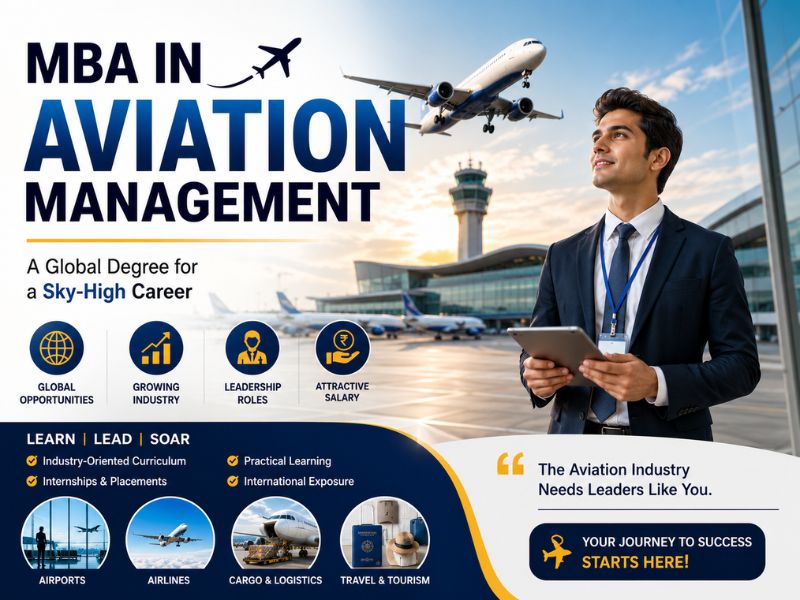
The aviation industry is one of the fastest-growing sectors in the world, connecting countries, businesses, and millions of passengers every day. As global air travel continues to expand, airlines, airports, cargo companies, and aviation service providers require skilled management professionals who can handle operations, customer experience, logistics, safety, and business growth.
MBA in Aviation Management is a specialized postgraduate management program designed for students who want to build leadership careers in the aviation and airline industry. The course combines traditional business management education with aviation-specific knowledge, helping students understand airline operations, airport management, aviation marketing, logistics, finance, and strategic planning.
What is an MBA in Aviation Management?
MBA in Aviation Management is a two-year postgraduate degree program that focuses on developing managerial and leadership skills for the aviation sector.
The program prepares students to manage:
The course combines business management concepts with aviation industry knowledge, making graduates suitable for managerial positions in airlines, airports, and aviation-related organisations.
The aviation industry offers exciting and dynamic career opportunities for management professionals.
Key Benefits
Key Insights
MBA in Aviation Management is a specialized postgraduate management program that prepares students for leadership and operational roles in the aviation industry. The course combines business administration concepts with aviation-specific knowledge, helping students understand airline operations, airport management, aviation safety, logistics, and customer service. With the rapid growth of the global aviation sector, this program offers excellent career opportunities in airlines, airports, cargo companies, and aviation consulting firms.
The MBA in Aviation Management program is generally completed over 2 years and is divided into four semesters. During this period, students study both management subjects and aviation-focused modules that provide industry-specific knowledge and practical exposure.
Candidates must have a Bachelor's degree from a recognised university with a minimum of 50% marks. Some institutions may offer relaxation in eligibility criteria for reserved categories according to their admission policies.
Admission is usually based on management entrance examinations followed by further selection rounds. Students can gain admission through:
Strong entrance scores improve the chances of securing admission to reputed aviation management institutions.
The curriculum focuses on developing both managerial and aviation-specific skills.
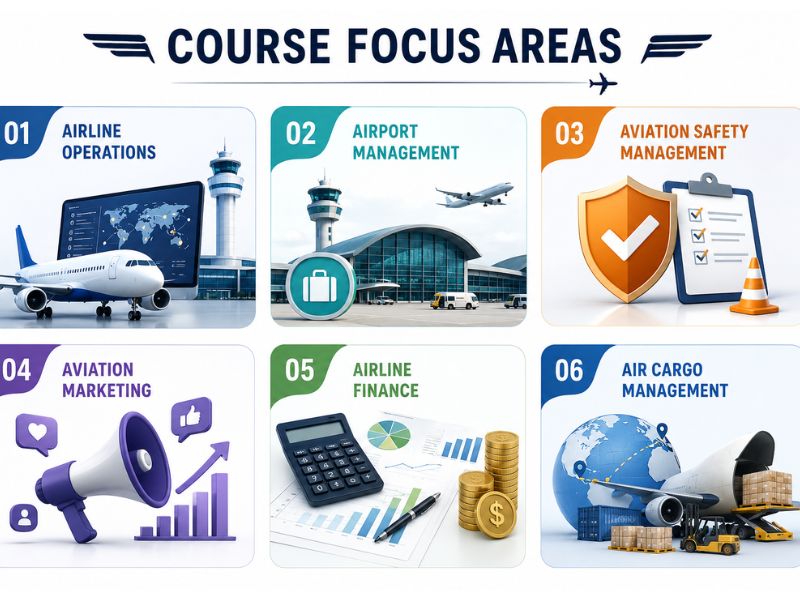
Students learn how airlines manage flight scheduling, route planning, passenger services, fleet management, and operational efficiency to ensure smooth airline functioning.
This subject focuses on airport operations, terminal management, security procedures, passenger handling, and airport infrastructure management.
Students gain knowledge about aviation regulations, risk management, safety procedures, and compliance standards required for safe aviation operations.
This area teaches airline branding, customer acquisition strategies, service marketing, digital promotions, and competitive positioning within the aviation industry.
Students learn financial planning, revenue management, cost control, budgeting, and financial decision-making processes used by airlines and airports.
This specialisation covers cargo transportation, logistics operations, freight management, international shipping regulations, and supply chain management.
Students can choose specialised fields based on their career interests.
Focuses on airline business operations, customer service management, route planning, and airline profitability strategies.
Covers airport administration, passenger services, security management, and terminal operations.
Deals with transportation systems, cargo handling, supply chain management, and aviation logistics planning.
Concentrates on airline financial planning, investment management, revenue optimisation, and budgeting processes.
Provides expertise in aviation regulations, safety systems, compliance management, and risk assessment.
Specialises in global cargo operations, logistics planning, freight transportation, and supply chain coordination.
The program helps students build essential management and aviation skills.
Students learn how to manage teams, make strategic decisions, and lead aviation organisations effectively.
Effective communication is critical in the aviation industry, where coordination between multiple departments and stakeholders is required.
Students develop analytical thinking and problem-solving skills necessary for managing aviation operations.
The course teaches students how to handle daily operations efficiently within airlines and airports.
Students learn customer service strategies and passenger experience management, which are crucial in the aviation sector.
This skill helps professionals plan business growth, optimise resources, and improve organisational performance.
Graduates can pursue various management positions in aviation and related industries.
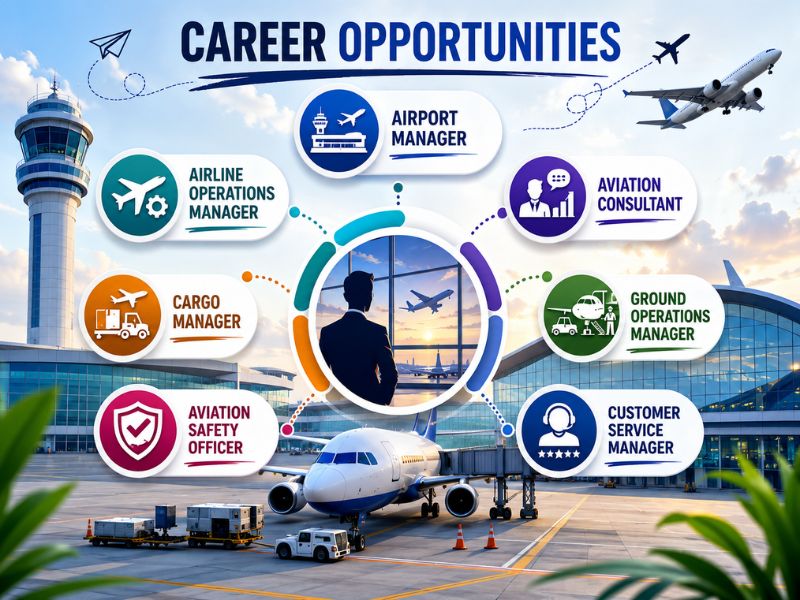
Airport Managers oversee airport operations, security coordination, passenger services, and facility management.
These professionals supervise airline operations, flight scheduling, and operational performance.
Consultants provide strategic advice to airlines, airports, and aviation organisations to improve efficiency and profitability.
Cargo Managers handle freight operations, logistics planning, and cargo transportation systems.
They coordinate airport ground services, baggage handling, passenger support, and aircraft servicing activities.
Safety Officers ensure compliance with aviation regulations and implement safety procedures.
These professionals focus on enhancing passenger experiences and maintaining service quality standards.
Salary packages depend on experience, employer, location, and skill level.
Freshers: ₹4–8 LPA
Mid-Level Professionals: ₹8–18 LPA
Experienced Professionals: ₹20 LPA+
International aviation markets may offer significantly higher compensation packages.
MBA Aviation Management graduates are recruited by:
The aviation sector is expanding rapidly due to increasing passenger traffic and global connectivity.
Airlines, airports, logistics firms, and aviation consultancies continue creating new management positions.
Aviation is a global industry, allowing professionals to work in various countries and international organisations.
The program develops leadership, decision-making, and management skills needed for senior-level positions.
The increasing demand for air travel creates long-term career growth opportunities.
Practical exposure, internships, and aviation-specific training improve employability and professional readiness.
Global air travel demand continues to drive aviation industry growth.
Airports and airlines require skilled management professionals to handle increasingly complex operations.
International aviation careers offer strong salary potential and global exposure.
Management expertise combined with aviation knowledge creates excellent long-term career prospects.
The MBA in Aviation Management curriculum is designed to provide students with a strong foundation in business management while developing specialised knowledge of the aviation industry. The program typically spans two years (four semesters) and combines management principles, aviation operations, logistics, finance, marketing, and leadership training. The curriculum focuses on both theoretical learning and practical industry exposure.
Semester 1: Management Fundamentals
The first semester introduces students to core business and management concepts that form the foundation of aviation management.
Principles of Management
Students learn the fundamentals of planning, organising, leading, and controlling business operations. This subject helps build managerial and leadership skills required in aviation organisations.
Organizational Behavior
This subject focuses on employee behaviour, teamwork, workplace culture, motivation, and leadership styles that influence organisational performance.
Business Communication
Students develop professional communication skills, presentation techniques, business writing abilities, and interpersonal communication skills necessary for management roles.
Financial Management
The course introduces budgeting, accounting principles, financial planning, and decision-making processes used in business organisations.
Marketing Management
Students learn customer behaviour, branding strategies, market research, and promotional techniques applicable to aviation and service industries.
Semester 2: Aviation Industry Foundations
The second semester focuses on introducing students to aviation-specific concepts and operational systems.
Introduction to the Aviation Industry
Students gain an overview of the aviation sector, including airline operations, airport systems, industry regulations, and market trends.
Airline Operations Management
This subject covers flight scheduling, route planning, fleet management, passenger services, and airline operational efficiency.
Airport Management
Students learn airport administration, terminal operations, passenger handling, security procedures, and infrastructure management.
Aviation Economics
The course explains economic factors affecting aviation businesses, including pricing strategies, demand forecasting, and industry competition.
Human Resource Management
Students learn recruitment, employee development, workforce planning, and performance management within aviation organisations.
Semester 3: Advanced Aviation Management
The third semester emphasises strategic and specialised aviation management subjects.
Aviation Safety Management
Students learn aviation safety regulations, risk assessment, safety auditing, and compliance procedures essential for airline and airport operations.
Air Cargo and Logistics Management
This subject focuses on freight transportation, cargo handling, supply chain systems, and logistics operations within the aviation industry.
Aviation Law and Regulations
Students study international aviation laws, government regulations, airline policies, and legal frameworks governing aviation operations.
Aviation Finance
The course covers airline revenue management, cost control, investment planning, and financial analysis specific to aviation businesses.
Customer Relationship Management
Students learn passenger service management, customer satisfaction strategies, complaint handling, and loyalty program development.
Semester 4: Strategic Management and Industry Exposure
The final semester focuses on practical application and strategic decision-making.
Strategic Aviation Management
Students learn long-term business planning, competitive strategies, operational improvements, and organisational growth within aviation companies.
Aviation Marketing and Branding
This subject focuses on airline branding, digital marketing, customer acquisition, and promotional strategies.
International Aviation Management
Students explore global aviation systems, international airline operations, aviation alliances, and global market trends.
Project Work
Students complete industry-based projects that allow them to apply classroom knowledge to real-world aviation challenges.
Internship and Industrial Training
Most institutions provide internships with airlines, airports, logistics companies, or aviation service providers to enhance practical learning and industry exposure.
Practical Learning Components
Industry Visits
Students visit airports, airline facilities, and aviation organisations to gain firsthand industry exposure.
Case Studies
Real-world aviation business cases help students understand operational challenges and management solutions.
Workshops and Seminars
Industry experts conduct sessions on current aviation trends, emerging technologies, and career opportunities.
Internship Programs
Internships help students gain practical experience and improve employability before graduation.
Key Insights
The curriculum combines management education with aviation-specific expertise.
Practical exposure and internships play a major role in career development.
Airline operations, airport management, and aviation safety are core learning areas.
Industry-focused training improves placement opportunities and professional readiness.
The MBA in Aviation Management curriculum is designed to develop future aviation leaders by combining business management skills, aviation industry knowledge, operational expertise, and practical exposure, preparing graduates for successful careers in airlines, airports, logistics, and aviation consulting.
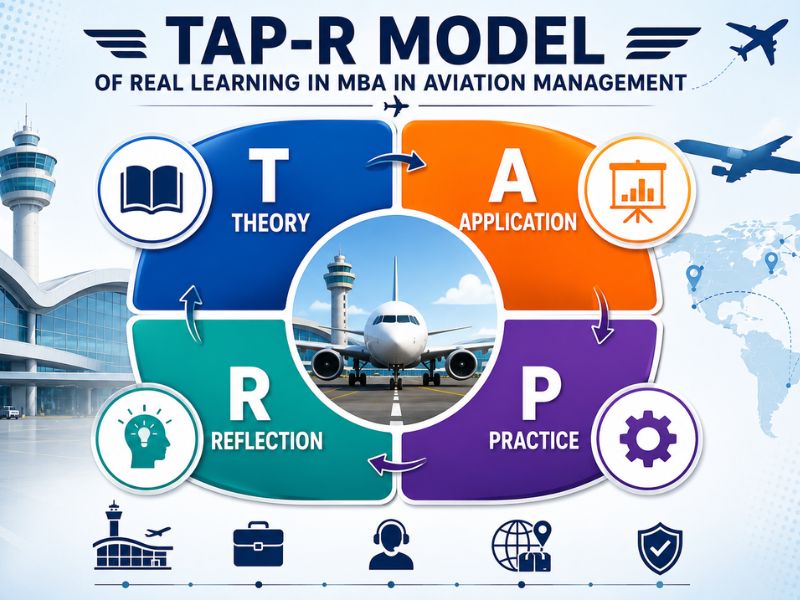
Application Activities:
This approach improves analytical thinking and helps students understand practical industry challenges.
Practice is one of the most important components of the TAP-R model. Students gain hands-on experience through internships, industrial visits, workshops, live projects, and industry interactions.
Practical Learning Opportunities:
Practical exposure helps students develop confidence and workplace readiness before entering the aviation industry.
R – Reflection
Reflection allows students to evaluate their experiences, identify strengths and weaknesses, and continuously improve their professional skills. Students analyse project outcomes, internship experiences, and industry interactions to enhance their learning.
Reflection Activities:
This stage encourages continuous improvement and helps students become more effective managers and leaders.
Students become better prepared for real-world aviation careers through continuous practical exposure and industry interaction.
Enhanced Problem-Solving Skills
Case studies and practical projects help students develop analytical and decision-making abilities.
The model improves leadership, communication, teamwork, and management skills required in aviation organisations.
Employers often prefer candidates with practical experience and industry exposure, making TAP-R graduates more employable.
Key Insights
Theory Builds Knowledge, While Practice Builds Confidence.
Industry Exposure Helps Students Understand Real Aviation Operations.
Continuous Reflection Encourages Personal and Professional Growth.
The TAP-R Model Creates Job-Ready Aviation Management Professionals.
The TAP-R Model of Real Learning in MBA in Aviation Management combines Theory, Application, Practice, and Reflection to create a comprehensive learning experience. This approach helps students develop industry-relevant skills, gain practical exposure, and become successful aviation management professionals in airlines, airports, logistics companies, and aviation consulting firms.
Yes, Aviation Management and Airport Management are related but different fields within the aviation industry. While both focus on the smooth functioning of aviation services, Aviation Management covers the broader aviation sector, whereas Airport Management specifically focuses on airport operations and administration.
Aviation Management
Aviation Management is a wider field that deals with the overall management of aviation businesses, including airlines, airports, cargo operations, aviation logistics, safety management, and aviation marketing. Students learn how the entire aviation industry functions from a business and management perspective.
Graduates can work as:
Aviation Management is ideal for students who want broader career opportunities across the aviation ecosystem.
Airport Management is a specialised field focused specifically on managing airport facilities, passenger services, terminal operations, security systems, and airport infrastructure. The program emphasises the day-to-day functioning of airports.
Airport Management is best suited for students interested specifically in airport administration and operations.
Major Differences Between Aviation Management and Airport Management
Scope
Aviation Management: Covers the entire aviation industry, including airlines, airports, cargo, logistics, and aviation services.
Airport Management: Focuses mainly on airport operations and airport-related services.
Career Opportunities
Aviation Management: Offers wider career options across airlines, airports, cargo companies, consulting firms, and aviation organisations.
Airport Management: Career opportunities are primarily concentrated within airports and airport service companies.
Industry Coverage
Aviation Management: Broad industry exposure.
Airport Management: Specialised airport-focused education.
Job Flexibility
Aviation Management: Higher flexibility with multiple industry sectors.
Airport Management: A more focused career path within airport operations.
Key Insights
Students can work across airlines, airports, logistics companies, and aviation consulting firms.
The program focuses specifically on airport operations and administration.
The expansion of global air travel continues to create opportunities in both sectors.
Leadership, communication, customer service, and operational management skills are valuable in both career paths.
Aviation Management is the broader field, while Airport Management is a specialised branch focused on airport operations. Students seeking diverse aviation career opportunities often choose Aviation Management, whereas those interested specifically in airport administration may find Airport Management a better fit.
Aviation Management offers diverse career opportunities across airlines, airports, cargo companies, aviation consulting firms, logistics organisations, and government aviation agencies. As the global aviation industry continues expanding, the demand for skilled aviation management professionals is increasing rapidly. Graduates can pursue leadership, operational, customer service, logistics, and strategic management roles in both domestic and international markets.
Airline Operations Manager
Airline Operations Managers oversee daily airline activities, including flight scheduling, route planning, operational efficiency, and passenger services. They ensure smooth airline operations while maintaining safety and service standards.
Average Salary: ₹6–15 LPA+
Airport Manager
Airport Managers are responsible for managing airport facilities, terminal operations, security coordination, passenger services, and infrastructure management. They play a crucial role in ensuring efficient airport functioning.
Average Salary: ₹7–18 LPA+
Aviation Consultant
Aviation Consultants help airlines, airports, and aviation organisations improve business performance, operational efficiency, and strategic planning. They provide expert advice on industry challenges and growth opportunities.
Average Salary: ₹8–20 LPA+
Air Cargo Manager
Cargo Managers supervise freight transportation, logistics operations, cargo handling, and supply chain activities. They ensure efficient movement of goods through air transportation networks.
Average Salary: ₹5–15 LPA+
These professionals focus on safety compliance, risk assessment, regulatory requirements, and operational safety procedures within aviation organisations.
Average Salary: ₹6–18 LPA+
Ground Operations Manager
Ground Operations Managers coordinate baggage handling, aircraft servicing, passenger support services, and airport ground activities to ensure efficient flight operations.
Average Salary: ₹5–12 LPA+
Customer Service Managers work to improve passenger satisfaction, service quality, complaint resolution, and customer experience management.
Average Salary: ₹5–10 LPA+
These professionals develop branding strategies, marketing campaigns, customer acquisition programs, and promotional activities for airlines and aviation companies.
Average Salary: ₹6–15 LPA+
Aviation Logistics Manager
Logistics Managers oversee transportation planning, cargo operations, supply chain management, and distribution systems within the aviation sector.
Average Salary: ₹6–16 LPA+
Revenue Managers analyse market trends, optimise ticket pricing strategies, forecast demand, and improve airline profitability through effective revenue management techniques.
Average Salary: ₹8–20 LPA+
Top Recruiters in Aviation Management
Graduates are recruited by:
Key Insights
Increasing air travel demand continues to create new management opportunities.
Graduates can work in airlines, airports, cargo, consulting, logistics, and government sectors.
Aviation professionals often find career opportunities across global markets.
Experience and industry expertise can lead to senior leadership positions with attractive salary packages.
Aviation Management offers excellent career opportunities across airlines, airports, cargo operations, logistics, consulting, safety management, and customer service sectors. With the aviation industry expanding globally, skilled professionals can expect strong career growth, competitive salaries, and international employment opportunities.
Aviation Management offers several specialisations that allow students to develop expertise in specific areas of the aviation industry. These specialisations help students align their education with career goals and industry requirements. As the aviation sector continues growing, specialised professionals are increasingly in demand across airlines, airports, logistics companies, and aviation service providers.
Airline Management focuses on the operational and business aspects of airlines. Students learn about flight scheduling, route planning, fleet management, passenger services, and airline profitability. This specialisation is ideal for students who want to build careers with domestic and international airlines.
Career Opportunities:
Airport Management specialises in the administration and operation of airports. Students gain knowledge of terminal management, airport security, passenger handling, and airport infrastructure systems. This field is suitable for those interested in airport operations and management.
Career Opportunities:
This specialisation focuses on aviation safety standards, risk assessment, regulatory compliance, and accident prevention. Students learn how aviation organisations maintain high safety standards and comply with international regulations.
Career Opportunities:
Air Cargo and Logistics Management deals with freight transportation, supply chain operations, cargo handling, and logistics planning. Students learn how goods are transported efficiently through global aviation networks.
Career Opportunities:
Aviation Finance focuses on financial planning, revenue management, airline budgeting, investment analysis, and cost control. Students develop financial management skills specific to the aviation industry.
Career Opportunities:
This specialisation teaches branding, customer acquisition, airline promotions, digital marketing, and market research. Students learn strategies used to attract and retain customers in the competitive aviation industry.
Career Opportunities:
Students learn workforce planning, employee recruitment, training, leadership development, and performance management within aviation organisations. Human resource professionals play a vital role in managing aviation workforces.
Career Opportunities:
This specialisation focuses on passenger experience, customer satisfaction, hospitality management, and service quality. Students learn how to deliver exceptional customer experiences across aviation services.
Career Opportunities:
Students can focus on specific aviation sectors based on their career interests and strengths.
These areas continue to offer strong employment opportunities due to the aviation industry growth.
Increasing air cargo operations and strict safety requirements create demand for specialised professionals.
Specialisations open doors to airlines, airports, cargo companies, consulting firms, and international aviation organisations.
Aviation Management specialisations help students develop expertise in areas such as Airline Management, Airport Management, Aviation Safety, Air Cargo & Logistics, Aviation Finance, Aviation Marketing, and Customer Service Management. Choosing the right specialisation can improve career prospects and create opportunities in the rapidly growing global aviation industry.
An MBA in Aviation and Airport Management can be an excellent choice for students who are passionate about the aviation industry and want to build careers in airlines, airports, aviation logistics, cargo operations, and aviation consulting. The program combines business management education with specialised aviation knowledge, preparing graduates for leadership and operational roles in one of the world's fastest-growing industries.
However, choosing this specialisation should depend on your interests, career goals, skills, and long-term aspirations.
You Should Choose This Course If...
You Are Passionate About Aviation
If you are fascinated by airlines, airports, aircraft operations, and the aviation industry, this program can provide the knowledge and industry exposure needed to turn that interest into a successful career.
You Want Management Roles
The course is designed for students who want to move beyond technical aviation jobs and pursue managerial, operational, and leadership positions within aviation organisations.
You Enjoy Customer Service and Operations
Aviation businesses rely heavily on operational efficiency and customer satisfaction. Students who enjoy managing people, solving problems, and improving service quality often perform well in this field.
You Seek Global Career Opportunities
Aviation is a truly international industry. Professionals with aviation management qualifications can explore opportunities in airlines, airports, cargo companies, and aviation organisations across the world.
You Like Dynamic Work Environments
The aviation sector is fast-paced and constantly evolving. Students who enjoy challenges, innovation, and continuous learning may find the industry highly rewarding.
This Course May Not Be Ideal If...
You Prefer Highly Technical Engineering Roles
Students interested in aircraft design, aeronautical engineering, or technical aviation maintenance may find specialised engineering programs more suitable.
You Prefer Desk-Based Careers
Many aviation management positions involve operational responsibilities, team coordination, and customer interaction. Those seeking less dynamic work environments may prefer other management fields.
You Have No Interest in the Aviation Industry
While management concepts are transferable, the curriculum is heavily focused on aviation-related operations and business activities.
Skills That Help You Succeed
Communication Skills
Strong communication is essential for managing teams, customers, and industry stakeholders.
Leadership Ability
Managers in aviation organisations are expected to make decisions, lead teams, and solve operational challenges.
Problem-Solving Skills
The aviation industry requires professionals who can think quickly and handle complex situations effectively.
Customer Service Orientation
Passenger satisfaction remains a major priority for airlines and airports, making customer-focused thinking extremely valuable.
Analytical Thinking
Data analysis, operational planning, and business decision-making play an important role in aviation management careers.
Career Benefits
Strong Industry Growth
The aviation sector continues to expand due to increasing passenger traffic and global connectivity.
Diverse Career Opportunities
Graduates can work in airlines, airports, cargo companies, logistics firms, tourism organisations, and aviation consulting companies.
International Mobility
Skills acquired through the program can open doors to global employment opportunities.
Competitive Salary Potential
Management positions often offer attractive compensation packages and long-term career growth.
Key Insights
Aviation Is One of the Fastest-Growing Industries
Increasing air travel demand continues to create new opportunities for management professionals.
Leadership Skills Are Highly Valued
Organisations seek professionals who can manage operations, teams, and customer experiences effectively.
Global Exposure Is a Major Advantage
The aviation industry offers opportunities to work with international companies and global markets.
Practical Experience Matters
Internships, industry projects, and aviation exposure significantly improve career prospects.
Bottom Line
An MBA in Aviation and Airport Management is the right choice if you are interested in aviation, management, customer service, operations, and global career opportunities. Students who combine a passion for the aviation industry with strong leadership, communication, and problem-solving skills can build rewarding careers in airlines, airports, logistics, cargo operations, and aviation consulting.
The eligibility criteria for the MBA in Aviation Management are designed to ensure that students possess the academic background and skills required to succeed in the aviation and management sectors. While eligibility requirements may vary slightly across institutions, most colleges follow similar admission standards.
Bachelor's Degree
Candidates must have completed a Bachelor's degree from a recognised university in any discipline. Students from Commerce, Science, Engineering, Management, Arts, and other academic backgrounds are generally eligible to apply.
Minimum Qualification:
A diverse educational background often helps students bring different perspectives to aviation management studies.
Most colleges require candidates to secure a minimum percentage in their undergraduate degree.
General Category:
Reserved Categories:
Higher academic scores can improve admission chances at reputed institutions.
Many MBA Aviation Management colleges accept national and university-level management entrance examinations.
Some private universities may also offer direct admission based on academic performance and interview rounds.
After qualifying for entrance examinations, candidates may be required to participate in a Personal Interview.
The interview helps institutions assess a candidate's suitability for management education.
Some colleges conduct Group Discussion rounds as part of the admission process.
Performance in GD rounds may contribute to the final selection process.
Strong communication skills are highly valued in the aviation industry. Some institutions may assess English proficiency through interviews or admission tests.
These skills are particularly important because aviation professionals regularly interact with passengers, clients, and international stakeholders.
Work experience is generally not mandatory for admission. However, candidates with professional experience may gain additional advantages during the selection process.
Experienced professionals often bring practical insights to classroom discussions and projects.
Before applying, candidates should ensure they meet the following requirements:
✔ Bachelor's Degree from a recognised university
✔ Minimum 50% aggregate marks (may vary by institution)
✔ Valid entrance exam score (if required)
✔ Participation in GD/PI rounds (if applicable)
✔ Strong communication and interpersonal skills
MBA Aviation Management welcomes graduates from various disciplines.
Strong scores in CAT, CMAT, MAT, or XAT can increase admission chances.
The aviation industry values professionals with excellent customer service and communication abilities.
Fresh graduates and working professionals can both pursue this program.
To pursue an MBA in Aviation Management, candidates typically need a Bachelor's degree with at least 50% marks, along with qualifying entrance exam scores and participation in selection rounds such as GD and PI. Strong communication skills, leadership potential, and interest in the aviation industry can further improve admission prospects and future career opportunities.
Step 1: Complete Graduation
Candidates must complete a bachelor's degree from a recognised institution.
Step 2: Appear for Entrance Exams
Many institutions accept:
Step 3: Submit Application
Students apply through the institution's admission portal.
Step 4: Group Discussion and Interview
Some colleges conduct GD and personal interview rounds.
Step 5: Final Admission
Selected candidates complete document verification and fee payment.
Students study both management and aviation-related subjects.
Core Subjects
Understanding aviation industry operations and management practices.
Managing airline services, scheduling, and operational efficiency.
Learning airport infrastructure and administration.
Marketing strategies used by airlines and aviation companies.
Financial planning and revenue management in aviation.
Managing logistics and cargo transportation.
Understanding regulatory compliance and passenger safety.
Managing the aviation workforce and organisational development.
Graduates can work across multiple aviation sectors.
The aviation sector offers opportunities in both public and private organisations.