
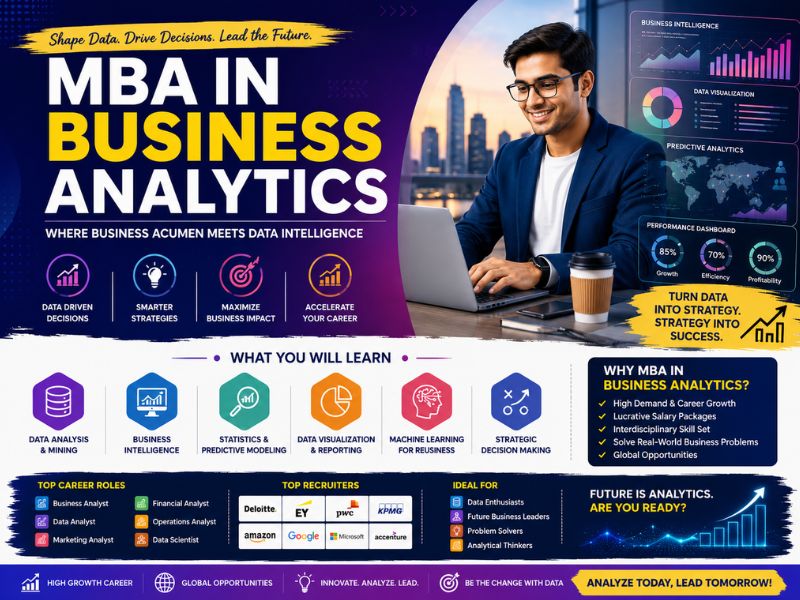
MBA in Business Analytics Admission Process 2026
Getting into a top MBA in Business Analytics program follows a structured, multi-stage process. Here's what to expect for 2026 admissions.
Step 1: Register for entrance exams
Begin by registering for relevant management entrance exams like CAT, XAT, GMAT, NMAT, or SNAP, depending on your target business schools.
Step 2: Prepare and appear for exams
Dedicate sufficient preparation time for quantitative aptitude, logical reasoning, verbal ability, and data interpretation sections, as these directly assess skills relevant to business analytics.
Step 3: Apply to shortlisted business schools
Submit applications to your chosen institutes, including academic transcripts, entrance exam scores, SOP, LORs, and updated CV/resume.
Step 4: Shortlisting based on exam scores
Business schools shortlist candidates based on entrance exam percentiles, along with academic performance and profile strength.
Step 5: Group Discussion (GD) round
Shortlisted candidates participate in GD rounds, where communication skills, analytical thinking, and ability to articulate data-driven perspectives are evaluated.
Step 6: Personal Interview (PI) round
The PI assesses your motivation for pursuing business analytics, career goals, and overall fit for the program, often including questions on current business and technology trends.
Step 7: Final merit list and admission offer
Based on combined performance across entrance exams, GD, and PI rounds, business schools release merit lists and admission offers.
Step 8: Document verification and fee payment
Confirm your seat by completing document verification and paying the required admission fee within specified deadlines.
Our advice: Start entrance exam preparation at least 6-8 months in advance, and research each business school's specific weightage for GD-PI rounds to strategize your application effectively for 2026.
Entrance Exams for MBA in Business Analytics
Securing admission to a top MBA in Business Analytics program starts with the right entrance exam. Here are the key exams accepted in 2026.
1. CAT (Common Admission Test)
The most widely recognized exam, mandatory for IIMs and accepted by numerous top business schools offering Business Analytics specializations. It tests quantitative ability, verbal reasoning, and data interpretation.
2. XAT (Xavier Aptitude Test)
Conducted by XLRI, this exam is accepted by several premier institutes and includes a unique decision-making section relevant to analytics-focused programs.
3. GMAT (Graduate Management Admission Test)
Widely accepted by top Indian and international business schools, GMAT is particularly useful for students considering global MBA programs with analytics specializations.
4. NMAT by GMAC
Accepted by NMIMS and several other reputed institutes, this exam offers multiple attempts, giving candidates flexibility to improve their scores.
5. SNAP (Symbiosis National Aptitude Test)
Required for admission to Symbiosis-affiliated institutes offering strong Business Analytics programs.
6. CMAT (Common Management Admission Test)
A government-conducted exam accepted by numerous AICTE-approved institutes, particularly useful for students targeting a broader range of colleges.
7. MAT (Management Aptitude Test)
Accepted by various private business schools, offering multiple test windows throughout the year.
Our advice:
Since Business Analytics programs value strong quantitative and analytical skills, focus extra preparation time on data interpretation and logical reasoning sections, as these directly reflect skills you'll need throughout the program in 2026.
MBA in Business Analytics Syllabus
Understanding the curriculum structure helps you know exactly what to expect from an MBA in Business Analytics program in 2026.
Year 1: Foundation subjects
- Business Statistics and Probability
- Principles of Management
- Financial Accounting and Management
- Marketing Management
- Organizational Behavior
- Introduction to Data Analytics
- Programming Fundamentals (Python/R)
- Database Management Systems (SQL)
Year 2: Specialized analytics subjects
- Predictive Analytics and Modeling
- Data Mining and Machine Learning
- Business Intelligence and Data Visualization (Tableau/Power BI)
- Big Data Analytics
- Marketing Analytics
- Financial Analytics
- Operations and Supply Chain Analytics
- Customer Relationship Management (CRM) Analytics
Practical components:
- Live industry projects with real business datasets
- Summer internship (typically after Year 1)
- Capstone project applying analytics to solve business problems
- Case study analysis using real-world business scenarios
Elective specializations:
Many programs offer additional electives in areas like Healthcare Analytics, Retail Analytics, Risk Analytics, or HR Analytics, allowing students to tailor their expertise.
Assessment methods:
Programs typically combine written examinations, project work, case study presentations, and continuous evaluation through assignments and class participation.
Our advice:
When comparing programs, check the balance between theoretical coursework and practical, hands-on training with real datasets, as this significantly impacts job readiness upon graduation in 2026.
Top MBA in Business Analytics Colleges in India
Choosing the right college significantly impacts your career outcomes. Here are India's top institutes offering MBA in Business Analytics for 2026.
Indian Institutes of Management (IIMs)
Several IIMs, including IIM Calcutta, IIM Lucknow, and IIM Kashipur, offer specialized Business Analytics programs known for rigorous curriculum and excellent placement records with top recruiters.
Indian School of Business (ISB), Hyderabad
Offers a highly regarded Business Analytics specialization within its MBA program, known for strong industry connections and global recognition.
XLRI Jamshedpur
Known for its strong analytics-focused curriculum and excellent placement outcomes across finance, consulting, and technology sectors.
Great Lakes Institute of Management, Chennai/Gurgaon
Offers a dedicated PGPM in Business Analytics with strong industry partnerships and practical, hands-on training.
NMIMS Mumbai
Recognized for its comprehensive Business Analytics specialization, backed by strong corporate connections and placement support.
Symbiosis Institute of Business Management (SIBM), Pune
Offers a well-regarded analytics specialization within its MBA program, known for practical, industry-aligned coursework.
Narsee Monjee Institute of Management Studies
Known for integrating technical analytics training with traditional management education.
MICA, Ahmedabad
While primarily known for marketing, MICA offers strong analytics-focused electives particularly valuable for marketing analytics careers.
Our advice:
When shortlisting colleges, prioritize placement records specifically for Business Analytics specializations, industry partnerships, and curriculum practicality over general institute rankings alone.
Best Private MBA in Business Analytics Colleges
Looking specifically at private institutes for your MBA in Business Analytics? Here are top options offering strong programs in 2026.
Great Lakes Institute of Management (Chennai/Gurgaon)
Widely recognized for its dedicated Business Analytics program, offering strong industry partnerships, practical training, and excellent placement records with top analytics recruiters.
NMIMS Mumbai
A leading private institute known for its comprehensive Business Analytics specialization, backed by strong corporate connections and consistent placement performance.
Symbiosis Institute of Business Management (SIBM), Pune
Offers a well-structured analytics specialization within its MBA program, known for industry-aligned coursework and strong alumni network.
Institute of Management Technology (IMT), Ghaziabad
Recognized for its practical approach to Business Analytics education, with strong corporate tie-ups for internships and placements.
Welingkar Institute of Management, Mumbai
Offers a dedicated Business Analytics program known for flexible learning formats and strong industry relevance.
T.A. Pai Management Institute (TAPMI), Manipal
Known for its data-driven curriculum and strong placement support in Business Analytics roles.
Amity Business School, Noida
Offers accessible, well-structured Business Analytics programs with decent industry connections and placement support.
Jaipuria Institute of Management
Known for practical, industry-relevant Business Analytics coursework across multiple campus locations.
What to prioritize:
When choosing between private institutes, focus on placement records specific to analytics roles, faculty industry experience, and availability of hands-on training with real business datasets rather than institute reputation alone.
Best Government MBA in Business Analytics Colleges
For students seeking quality education at more affordable fees, government institutes offering MBA in Business Analytics remain excellent choices for 2026.
Indian Institutes of Management (IIMs)
Several IIMs offer dedicated Business Analytics programs, including IIM Calcutta's PGDBA (in collaboration with ISI and IIT Kharagpur), IIM Lucknow, and IIM Kashipur, known for rigorous academics and strong industry recognition.
Indian Institute of Foreign Trade (IIFT)
While primarily known for international business, IIFT offers strong analytics-focused electives valuable for global business analytics careers.
Faculty of Management Studies (FMS), Delhi University
Known for its affordable fee structure combined with excellent placement records, FMS offers analytics-focused coursework within its MBA program.
Indian Institute of Management, Kashipur
Offers a dedicated MBA in Business Analytics program with strong emphasis on practical, data-driven decision-making skills.
National Institute of Industrial Engineering (NITIE), Mumbai
Known for its strong quantitative and analytics-focused curriculum, particularly valuable for operations and supply chain analytics careers.
University of Delhi Management Programs
Various Delhi University-affiliated colleges offer analytics-focused MBA specializations at government-subsidized fee structures.
Jamia Millia Islamia, Delhi
Offers MBA programs with analytics electives at significantly lower fees compared to private institutes.
Why choose government institutes?
Beyond lower fees, government institutes often benefit from strong alumni networks, established industry credibility, and rigorous academic standards that carry significant weight during placements.
Our advice:
Government institutes typically have more competitive entrance requirements, so start entrance exam preparation early and maintain strong academic records throughout your undergraduate studies to maximize admission chances for 2026.
MBA in Business Analytics Fees
Understanding tuition costs helps you budget realistically for your MBA in Business Analytics journey in 2026.
Government institute fees:
- IIMs (Business Analytics programs): Approximately ₹15-25 Lakhs for the entire program, though this includes comprehensive infrastructure and placement support
- FMS Delhi: Remarkably affordable at approximately ₹2-3 Lakhs for the entire program
- NITIE Mumbai: Approximately ₹8-12 Lakhs for the complete program
- Other government institutes: Generally range between ₹3-10 Lakhs
Private institute fees:
- ISB Hyderabad: Approximately ₹35-42 Lakhs for the accelerated program
- Great Lakes Institute: Approximately ₹15-20 Lakhs
- NMIMS Mumbai: Approximately ₹18-22 Lakhs
- SIBM Pune: Approximately ₹16-20 Lakhs
- Other private institutes: Generally range between ₹8-18 Lakhs
Additional costs to consider:
- Application fees (₹1,000-2,500 per institute)
- Study materials and software licensing costs
- Hostel/accommodation fees, if applicable
- Industry certification costs, if not included in curriculum
Scholarship and loan options:
Most institutes offer merit-based scholarships, and education loans are widely available given the strong ROI typically associated with this specialization.
Our advice:
While private institutes often charge significantly higher fees, evaluate the cost against placement records and average salary packages to determine genuine value for money for your 2026 admission.
MBA in Business Analytics Placements
Placement outcomes are often the deciding factor when choosing an MBA program. Here's what to expect from Business Analytics placements in 2026.
Overall placement trends:
Given the high industry demand for analytics professionals, MBA in Business Analytics programs generally report strong placement percentages, often reaching 95-100% at top institutes.
Who's recruiting?
Companies actively hiring Business Analytics MBA graduates span multiple sectors:
- Consulting firms: McKinsey, BCG, Deloitte, EY
- Technology companies: Amazon, Microsoft, Google
- Banking and finance: Goldman Sachs, JP Morgan, ICICI Bank
- E-commerce: Flipkart, Amazon
- FMCG: Unilever, P&G
Common job roles offered:
- Business Analyst
- Data Analyst/Scientist
- Marketing Analytics Manager
- Financial Analytics Consultant
- Business Intelligence Manager
- Strategy Consultant (Analytics-focused)
Factors affecting placement quality:
- Institute reputation and industry connections
- Internship performance during the program
- Individual academic performance and skill demonstration
- Specific analytics tools proficiency (Python, SQL, Tableau)
Placement support systems:
Top institutes typically offer dedicated placement cells, mock interview preparation, resume building workshops, and strong corporate relationships built through guest lectures and live projects.
Our advice:
Before finalizing your college choice, always check historical placement reports, average and median salary packages, and the specific companies that recruited from previous batches to gauge realistic outcomes for 2026.
MBA in Business Analytics Salary in India
Here's a realistic breakdown of what you can expect to earn after completing an MBA in Business Analytics in India for 2026.
Average starting salary:
Fresh graduates typically earn between ₹8-15 LPA, though this varies significantly based on institute reputation and individual performance during placements.
Salary by institute tier:
- Top IIMs and ISB: ₹18-30 LPA
- Tier-1 private institutes (Great Lakes, NMIMS, SIBM): ₹10-18 LPA
- Tier-2 institutes: ₹6-10 LPA
- Government institutes (FMS, NITIE): ₹12-20 LPA
Salary by job role:
- Business Analyst: ₹8-14 LPA
- Data Scientist/Analyst: ₹10-18 LPA
- Marketing Analytics Manager: ₹9-15 LPA
- Financial Analytics Consultant: ₹10-16 LPA
- Strategy Consultant (Analytics-focused): ₹15-25 LPA
What influences your salary?
- Institute reputation and placement track record
- Prior work experience before pursuing MBA
- Technical proficiency in analytics tools and programming
- Specific industry and company size
- Location (metro cities typically offer higher packages)
Career growth potential:
With 3-5 years of experience, professionals often see salaries rise to ₹20-35 LPA, particularly in leadership roles like Analytics Manager or Director of Business Intelligence.
The bigger picture:
Given the consistent, growing demand for data-driven decision-makers across industries, MBA in Business Analytics continues to offer strong ROI and competitive salaries well into 2026 and beyond.
Top Recruiters for MBA in Business Analytics Graduates
Curious which companies actively hire MBA in Business Analytics graduates? Here's a look at major recruiters across key sectors in 2026.
Consulting firms:
- McKinsey & Company
- Boston Consulting Group (BCG)
- Deloitte
- EY (Ernst & Young)
- KPMG
- Accenture
Technology companies:
- Amazon
- Microsoft
- IBM
- SAP
Banking and financial services:
- Goldman Sachs
- JP Morgan Chase
- ICICI Bank
- HDFC Bank
- American Express
E-commerce and retail:
- Flipkart
- Amazon
- Myntra
- Reliance Retail
FMCG companies:
- Hindustan Unilever
- Procter & Gamble
- Nestlé
Healthcare and pharma:
- Pfizer
- Cipla
- Apollo Hospitals
Telecommunications:
- Airtel
- Reliance Jio
Our advice:
MBA in Business Analytics: ROI (Fees vs Salary)
Is an MBA in Business Analytics actually worth the investment? Let's break down the real numbers for 2026.
Government institutes: Best ROI
Institutes like FMS Delhi offer exceptional value, with total fees around ₹2-3 Lakhs against average placement packages of ₹12-20 LPA — meaning your entire education cost can be recovered within your first few months of employment.
Top-tier private institutes: Strong ROI
Programs like Great Lakes or NMIMS charge ₹15-22 Lakhs in fees but offer average packages of ₹10-18 LPA, meaning most graduates recover their investment within 1-2 years of working.
Premier institutes (IIMs/ISB): Long-term value
While IIMs and ISB charge higher fees (₹15-42 Lakhs), their average packages of ₹18-30 LPA combined with strong brand value and alumni networks provide substantial long-term career acceleration, even if initial ROI timelines are longer.
Factors affecting your actual ROI:
- Pre-MBA work experience and salary (higher baseline means better comparative ROI)
- Specific job role and industry post-graduation
- Location of employment (metro cities typically offer higher packages)
- Individual skill development beyond curriculum requirements
The honest calculation:
Beyond direct salary comparison, factor in career acceleration, skill development, and network value — these often provide returns that extend well beyond initial salary figures.
Our advice:
When evaluating ROI, don't just compare fees to starting salary. Consider placement consistency, salary growth trajectory over 3-5 years, and the specific skills you'll gain — these factors ultimately determine whether your MBA investment truly pays off by 2026 and beyond.
MBA in Business Analytics Specializations
Not all Business Analytics programs are the same. Here are the popular sub-specializations you can choose from in 2026.
1. Marketing Analytics
Focuses on customer behavior analysis, campaign performance measurement, and data-driven marketing strategy development.
2. Financial Analytics
Covers risk assessment, investment analysis, and financial forecasting using advanced statistical and predictive modeling techniques.
3. Operations and Supply Chain Analytics
Concentrates on optimizing production processes, inventory management, and logistics through data-driven decision-making.
4. Healthcare Analytics
Applies data analysis techniques specifically to healthcare systems, patient outcomes, and hospital operations management.
5. HR Analytics (People Analytics)
Focuses on using data to improve talent acquisition, employee retention, and organizational performance management.
6. Retail Analytics
Specializes in customer purchasing patterns, inventory optimization, and pricing strategy for retail and e-commerce businesses.
7. Risk Analytics
Concentrates on identifying, measuring, and managing business risks using statistical and predictive modeling approaches, particularly valuable in banking and insurance sectors.
8. Digital and Social Media Analytics
Focuses on analyzing online consumer behavior, social media engagement, and digital marketing performance metrics.
Why does specialization matter?
Choosing a focused specialization helps you build deeper expertise in a specific domain, making you more attractive to niche employers seeking targeted analytical skills rather than generalist knowledge.
Our advice:
Select a specialization based on both your personal interest and the industry sector you envision building your long-term career in, as this focused expertise significantly impacts your placement opportunities in 2026.
Skills Required for Business Analytics Professionals
Wondering what skills you'll need to succeed in this field? Here's a comprehensive breakdown for 2026.
Technical skills:
- Programming languages: Proficiency in Python and R for statistical analysis and data manipulation
- Database management: Strong SQL skills for querying and managing large datasets
- Data visualization tools: Expertise in Tableau, Power BI, or similar platforms for presenting insights
- Statistical analysis: Understanding of regression analysis, hypothesis testing, and predictive modeling
- Machine learning fundamentals: Basic understanding of ML algorithms and their business applications
- Excel proficiency: Advanced Excel skills remain relevant for quick data analysis and reporting
Business and analytical skills:
- Critical thinking: Ability to identify relevant business problems that data can solve
- Data interpretation: Translating complex datasets into clear, actionable business insights
- Strategic thinking: Connecting data findings to broader business strategy and decision-making
- Problem-solving: Approaching business challenges systematically using analytical frameworks
Soft skills:
- Communication: Explaining complex data findings to non-technical stakeholders clearly
- Presentation skills: Creating compelling data visualizations and reports for leadership audiences
- Business acumen: Understanding overall business operations beyond just technical analytics
- Collaboration: Working effectively with cross-functional teams, including IT, marketing, and finance
Our advice:
While technical skills get you noticed, strong communication and business acumen ultimately determine your career growth, since senior roles require translating data insights into strategic business decisions for 2026 and beyond.
Career Scope After MBA in Business Analytics
Let's talk about long-term career prospects — what does your professional journey actually look like after this degree?
Immediate career scope:
With businesses across every sector increasingly relying on data for strategic decisions, MBA in Business Analytics graduates enter a job market with genuinely strong and growing demand in 2026.
Industries actively hiring:
- Technology and IT: Constant demand for data-driven product and business strategy roles
- Banking and Financial Services: Risk analytics, fraud detection, and investment analysis roles
- E-commerce and Retail: Customer analytics, inventory optimization, and pricing strategy positions
- Healthcare: Growing demand for healthcare analytics professionals improving patient outcomes and operational efficiency
- Consulting: Analytics-focused consulting roles helping businesses across industries make data-driven decisions
Career progression path:
- 0-3 years: Business Analyst, Data Analyst, Associate Consultant
- 3-6 years: Senior Analyst, Analytics Manager, Team Lead
- 6-10 years: Analytics Director, Head of Business Intelligence, Senior Consultant
- 10+ years: Chief Data Officer, VP of Analytics, Chief Strategy Officer
Entrepreneurial opportunities:
Many graduates leverage their analytics expertise to start data-consulting firms or analytics-focused startups, given the growing market demand for specialized data services.
Global career prospects:
Business analytics skills are universally valuable, opening doors to international career opportunities across US, European, and Asian markets.
The bigger picture:
As AI and automation continue transforming business operations, professionals who understand both data and strategic business context will remain essential, ensuring long-term career relevance well beyond 2026.
Job Profiles After MBA in Business Analytics
Here's a detailed look at the specific job roles available to MBA in Business Analytics graduates in 2026.
1. Business Analyst
Analyzes business processes and data to identify improvement opportunities, working closely with management to implement data-driven solutions.
2. Data Analyst
Focuses on collecting, cleaning, and analyzing data to generate reports and insights that support business decision-making.
3. Business Intelligence Manager
Oversees BI systems and dashboards, ensuring stakeholders have access to accurate, real-time business performance data.
4. Marketing Analytics Manager
Analyzes customer data and campaign performance to optimize marketing strategies and improve ROI on marketing spend.
5. Financial Analyst (Analytics-focused)
Uses data modeling and statistical analysis to support investment decisions, risk assessment, and financial forecasting.
6. Data Scientist
Applies advanced statistical and machine learning techniques to solve complex business problems and predict future trends.
7. Operations Analyst
Focuses on optimizing supply chain, production processes, and operational efficiency through data-driven insights.
8. Strategy Consultant (Analytics-focused)
Works with consulting firms to help client organizations develop data-driven business strategies and competitive advantages.
9. Risk Analyst
Particularly relevant in banking and insurance, focusing on identifying and quantifying business risks using statistical models.
10. Product Analyst
Common in technology companies, analyzing user behavior and product performance data to guide product development decisions.
Our advice:
MBA in Business Analytics vs MBA in Data Analytics
Confused between these two similar-sounding specializations? Here's a clear comparison to help you decide for 2026.
Core focus difference
MBA in Business Analytics emphasizes applying data insights to broader business strategy, marketing, finance, and operations decisions. MBA in Data Analytics, on the other hand, leans more technical, focusing deeply on data engineering, advanced statistical modeling, and algorithm development.
Curriculum comparison
Business Analytics programs balance technical skills with core MBA subjects like Marketing, Finance, and Strategy. Data Analytics programs typically include more intensive coding, machine learning, and data engineering coursework, sometimes at the expense of traditional management subjects.
Career path differences
Business Analytics graduates often move into roles like Business Analyst, Analytics Manager, or Strategy Consultant, where business context matters as much as technical skill. Data Analytics graduates typically pursue more technical roles like Data Scientist, Data Engineer, or Machine Learning Specialist.
Who should choose which?
- Choose Business Analytics if you want to blend management leadership with data skills, aiming for strategic or managerial roles
- Choose Data Analytics if you prefer deeper technical work and are drawn toward hands-on data science careers
Salary comparison
Both specializations offer competitive salaries, though Data Analytics roles sometimes command slightly higher starting packages in pure tech companies, while Business Analytics roles offer better long-term growth into leadership positions.
Our advice: If you enjoy both business strategy and data work but want to keep leadership options open, Business Analytics offers better long-term versatility for 2026 and beyond.
MBA in Business Analytics vs MBA in Finance
Trying to choose between these two popular MBA specializations? Here's an honest comparison for 2026.
Core focus difference
MBA in Business Analytics trains you to extract insights from data across all business functions — marketing, operations, HR, and finance. MBA in Finance focuses specifically on financial management, investment strategy, corporate finance, and capital markets.
Skill set developed
Business Analytics builds technical skills (Python, SQL, data visualization) alongside business acumen. Finance MBAs develop deep expertise in financial modeling, valuation, and investment analysis, with comparatively less emphasis on programming skills.
Career paths
Business Analytics graduates work across diverse industries in analytics-focused roles. Finance MBA graduates typically pursue specialized careers in investment banking, private equity, corporate finance, or financial consulting.
Industry demand
Both fields show strong demand, but Business Analytics offers broader industry applicability since virtually every sector needs data-driven decision-making, while Finance careers remain more concentrated in banking, financial services, and corporate finance departments.
Salary potential
Finance MBAs, especially in investment banking, can command very high starting salaries, sometimes exceeding Business Analytics packages, though this often comes with more demanding work hours. Business Analytics offers more consistent, well-balanced compensation across a wider range of industries.
Which one should you choose?
- Choose Business Analytics if you want broader industry flexibility and enjoy working with data across various business functions
- Choose Finance if you have a specific passion for financial markets, investment analysis, or corporate finance careers
Our advice: Consider your genuine interest area — Finance offers deep specialization with potentially higher peak salaries, while Business Analytics provides broader, more flexible career opportunities across industries in 2026.
Is an MBA in Business Analytics Worth It?
This is the question every prospective student asks. Let's break down an honest answer for 2026.
The case for "yes, it's worth it":
- Strong industry demand: Nearly every sector now needs data-driven decision-makers, ensuring consistent job opportunities
- Competitive salaries: Average packages of ₹8-15 LPA (higher at top institutes) offer strong financial returns
- Future-proof skills: As AI and automation reshape industries, analytics skills remain essential rather than obsolete
- Versatile career options: Skills apply across technology, finance, healthcare, retail, and consulting sectors
- Strong ROI at government institutes: Programs like FMS Delhi offer exceptional value with minimal fees against strong placement packages
Potential considerations:
- High fees at premier institutes: Programs like ISB or top IIMs require significant financial investment, though placement packages typically justify this over time
- Continuous learning required: Analytics tools and techniques evolve rapidly, requiring ongoing skill updates even after graduation
- Competitive admission process: Top institutes have rigorous entrance requirements, demanding serious preparation
Who should pursue this MBA?
This specialization particularly suits candidates who enjoy working with data, want versatile career options across industries, and are comfortable balancing technical skills with business strategy thinking.
Our verdict:
For most candidates, especially those choosing well-regarded institutes with strong placement records, an MBA in Business Analytics offers genuine value — combining strong salary potential, career flexibility, and long-term relevance in an increasingly data-driven business world through 2026 and beyond.
Why Choose Get Your College?
Choosing the right MBA in Business Analytics program involves countless decisions — from selecting the ideal specialization to navigating entrance exams and applications. That's where Get Your College makes all the difference.
1. Personalized program guidance
Our expert counselors help you evaluate institutes and specializations that genuinely align with your career goals, academic background, and budget considerations.
2. Entrance exam strategy support
We help you plan your CAT, XAT, GMAT, or NMAT preparation timeline and choose the right combination of exams based on your target colleges.
3. End-to-end application assistance
From SOP writing to LOR coordination and application form submission, we handle every step of your MBA application process with precision.
4. GD-PI preparation
Our mock Group Discussion and Personal Interview sessions help you build confidence and articulate your analytics interest clearly to admission panels.
5. College shortlisting based on real data
We provide honest insights into placement records, average salary packages, and fee structures, helping you make informed decisions rather than relying on brand names alone.
6. Scholarship and loan guidance
We help you identify scholarship opportunities and navigate education loan processes to ease your financial planning.
7. Proven track record
With years of experience guiding students toward successful MBA admissions, we bring honest, practical advice to every step of your journey.
The bottom line: Choosing an MBA in Business Analytics is a smart career move — partnering with Get Your College ensures that decision translates into real admission and career success in 2026.
FAQs
1. What is the difference between MBA in Business Analytics and a regular MBA?
MBA in Business Analytics includes specialized coursework in data analysis, statistical modeling, and analytics tools alongside core MBA subjects, unlike a general MBA program.
2. Which entrance exams are accepted for MBA in Business Analytics?
CAT, XAT, GMAT, NMAT, SNAP, and CMAT are among the most widely accepted entrance exams for this specialization.
3. Do I need a technical background to pursue this MBA?
No, candidates from any academic background can apply, though those with quantitative backgrounds (Engineering, Statistics, Economics) may find the technical coursework slightly easier.
4. What is the average salary after MBA in Business Analytics in India?
Fresh graduates typically earn between ₹8-15 LPA, with top institutes like IIMs and ISB offering packages of ₹18-30 LPA.
5. Which are the top colleges for MBA in Business Analytics in India?
IIM Calcutta, ISB Hyderabad, XLRI Jamshedpur, Great Lakes Institute, and NMIMS Mumbai are among the top choices.
6. Is work experience required for admission?
Work experience isn't mandatory for full-time programs, though some institutes prefer candidates with 2-5 years of experience, particularly for executive MBA formats.
7. What career options are available after this MBA?
Graduates can pursue roles like Business Analyst, Data Scientist, Business Intelligence Manager, Marketing Analytics Manager, and Strategy Consultant.
Conclusion
MBA in Business Analytics stands out as one of the most future-ready management specializations available in 2026, combining core business leadership skills with in-demand technical analytics expertise. As organizations across every industry increasingly rely on data-driven decision-making, professionals who can bridge the gap between data and strategy continue to see strong career opportunities and competitive compensation.