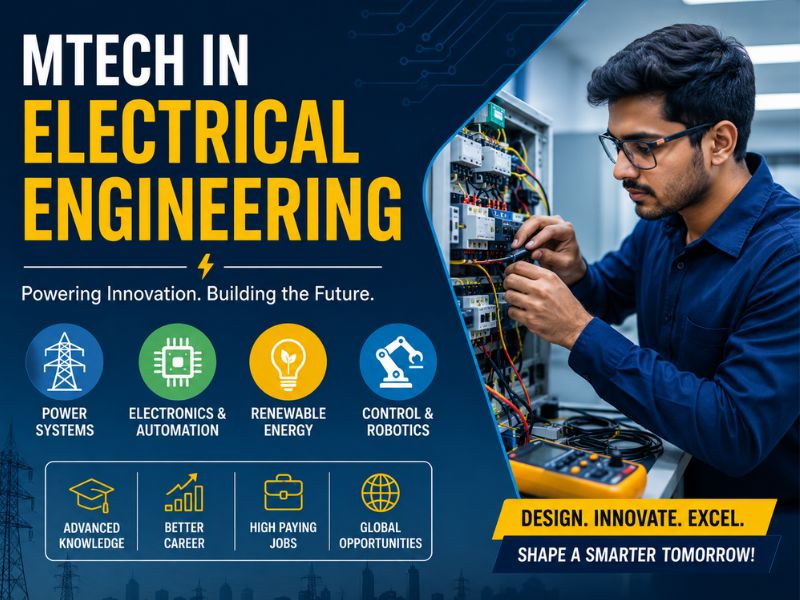
MTech in Electrical Engineering 2026: Admission, Fees, Top Colleges & Career Scope
MTech in Electrical Engineering 2026: Admission, Fees, Top Colleges & Career Scope
May 11, 2026
12 min read
In a world increasingly powered by smart grids, electric vehicles, renewable energy, industrial automation, and advanced electronics, electrical engineering remains one of the most essential and future-proof engineering disciplines.
If you want to move beyond basic engineering knowledge and build expertise in high-demand technical sectors, then an MTech in Electrical Engineering can be a powerful career accelerator.
From advanced power systems and robotics to AI-integrated control systems and green energy solutions, this postgraduate degree opens doors to leadership roles, research opportunities, and higher salary potential.
But is MTech in Electrical Engineering worth it in 2026? What are the fees, eligibility, salary prospects, and future scope?
This guide provides a complete, SEO-optimised breakdown in a simple, beginner-friendly format.
What is MTech in Electrical Engineering?
MTech in Electrical Engineering is a 2-year postgraduate technical degree focused on advanced electrical concepts, industrial systems, modern electronics, and specialised engineering applications.
It builds on undergraduate engineering fundamentals and prepares students for more advanced roles in design, innovation, research, and project management.
Why Choose MTech in Electrical Engineering?
Pursuing MTech in Electrical Engineering offers several strategic advantages for students seeking career advancement.
Key Benefits
Higher Salary Potential
Postgraduate specialisation often leads to better-paying roles.
Advanced Technical Expertise
Students gain deeper knowledge in specialised domains.
Government & PSU Opportunities
MTech graduates often have stronger profiles for public-sector technical jobs.
Research & Academic Careers
Ideal for PhD, teaching, and innovation-driven roles.
Growing Global Demand
Renewable energy, EVs, AI systems, and smart infrastructure are driving demand.
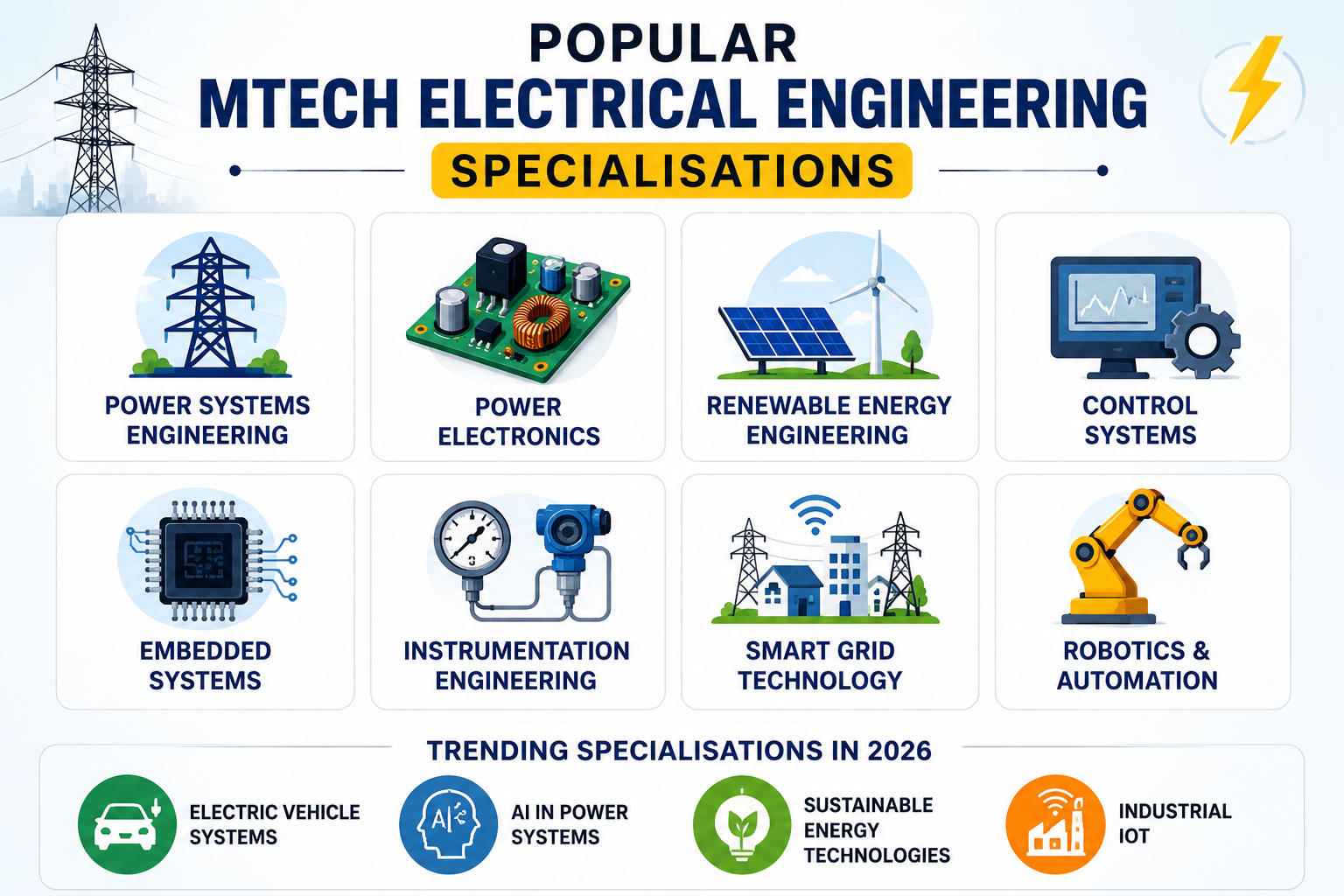
Popular MTech Electrical Engineering Specialisations
Choosing the right MTech Electrical Engineering specialisation can directly impact your career growth, salary potential, and future opportunities. The program offers several in-demand specialisations that cater to both traditional and emerging industries.
Popular Specialisations in MTech Electrical Engineering (2026 Edition)
Popular specialisations include:
Power Systems Engineering
Power Electronics
Renewable Energy Engineering
Control Systems
Embedded Systems
Instrumentation Engineering
Smart Grid Technology
Robotics & Automation
In 2026, industry demand is rapidly increasing for advanced domains like Electric Vehicle Systems, AI in Power Systems, Sustainable Energy Technologies, and Industrial IoT. These trending fields are shaping the future of electrical engineering and creating strong job prospects in research, manufacturing, automation, and clean energy sectors.
MTech Electrical Engineering Eligibility Criteria
To apply for MTech Electrical Engineering in India, candidates must meet certain academic and entrance requirements. Most colleges require a B.Tech. or BE degree in Electrical Engineering or a closely related discipline with a minimum of 50%–60% aggregate marks.
Key eligibility requirements include:
Bachelor’s degree in Electrical Engineering or equivalent
Minimum qualifying marks as per university standards
Valid GATE score for IITs, NITs, and top government institutes
Academic transcripts
Entrance exams for selected private universities
SOP or research proposal for some institutions
Students with strong analytical skills, mathematical understanding, technical problem-solving ability, and software simulation knowledge often perform better during admissions and academics.
MTech Electrical Engineering Admission Process
The admission process for MTech Electrical Engineering follows a structured path. Understanding each stage can improve your chances of securing admission to top institutions.
Step-by-step process:
Complete BTech/BE in Electrical Engineering
Prepare for and qualify for the GATE examination
Apply through COAP counselling or university admission portals
Participate in seat allocation and counselling rounds
Choose preferred colleges and specialisations
Complete document verification and final admission
Early preparation, exam strategy, and timely application submission are essential for maximising opportunities in competitive colleges.
MTech Electrical Engineering Fees in India (2026)
MTech Electrical Engineering course fees vary depending on whether you choose a government or private institution.
Government Colleges:
₹50,000 – ₹2 Lakhs total course fees
Private Colleges:
₹2 Lakhs – ₹8 Lakhs total course fees
Government colleges generally offer the best return on investment due to lower fees and higher placement opportunities. Additionally, GATE-qualified students can access scholarships, monthly stipends, and financial assistance programs.
Although private institutions may involve higher tuition costs, some offer specialised industry partnerships and advanced infrastructure that may justify the investment.
Top Colleges for M.Tech. Electrical Engineering in India
Selecting the right college plays a critical role in academic quality, placements, and long-term career growth. India’s top engineering institutes provide excellent MTech Electrical Engineering programs with advanced research opportunities and industry exposure.
Leading institutes include:
IIT Bombay
IIT Delhi
IIT Madras
IIT Kanpur
NIT Trichy
These institutions are known for:
High-quality faculty
Advanced laboratories
Strong placement records
Research-driven curriculum
Specialisations in future-focused engineering sectors
Graduating from one of these premier institutes can significantly improve career prospects in power systems, automation, renewable energy, electric vehicles, and smart technologies.
Career Scope After MTech in Electrical Engineering
An MTech in Electrical Engineering opens the door to a wide range of high-growth career opportunities across both traditional and emerging industries. As global demand for advanced energy systems, automation, and sustainable technologies rises, electrical engineering graduates are positioned for strong long-term career growth.
After completing MTech Electrical Engineering, graduates can build careers in:
Power generation companies
Renewable energy firms
Public Sector Undertakings (PSUs)
Indian Railways
Industrial automation companies
Electric vehicle (EV) industries
Semiconductor manufacturing
Research and development laboratories
Popular job roles include Electrical Design Engineer, Power Systems Engineer, Control Systems Engineer, Renewable Energy Engineer, Embedded Systems Engineer, Project Manager, and Research Scientist.
Power systems continue to offer stable and consistent demand, while sectors like EV technology, automation, and renewable energy are expanding rapidly due to global innovation trends. Government jobs in PSUs and railways remain attractive for job security, benefits, and long-term stability.
Bottom Line:
MTech in Electrical Engineering provides diverse, future-ready, and highly rewarding career opportunities across multiple industries.
Salary After MTech in Electrical Engineering
One of the biggest advantages of pursuing MTech in Electrical Engineering is the significant salary growth potential. Advanced specialisation, technical expertise, and industry demand can substantially increase earning opportunities compared to undergraduate qualifications alone.
Average Salary Range:
Freshers:
👉 ₹5 LPA – ₹10 LPA
Experienced Professionals:
👉 ₹12 LPA – ₹25 LPA+
International Salary Opportunities:
Professionals with advanced electrical engineering expertise can also secure premium-paying roles in countries such as:
USA
Germany
Canada
Australia
Gulf countries
Key salary factors include chosen specialisation, work experience, technical skills, and industry domain. High-demand sectors like renewable energy, automation, semiconductor technology, and EV systems often offer premium salary packages. PSU jobs provide stable income with excellent benefits, while private industries may offer faster salary progression.
Bottom Line:
MTech Electrical Engineering acts as a major salary booster, enhancing long-term earning potential, global career opportunities, and leadership prospects.
Master of Technology in Electrical Engineering Course Duration
The MTech in Electrical Engineering is typically a 2-year postgraduate program divided into four semesters. This duration is designed to provide students with advanced theoretical knowledge, practical exposure, research opportunities, and specialisation expertise in modern electrical engineering domains.
Distance education options for MTech Electrical Engineering are becoming increasingly relevant for working professionals seeking career advancement without leaving their jobs.
Admission Overview:
Bachelor’s degree in Electrical Engineering or related field
Minimum qualifying marks as per university criteria
Work experience may be preferred
Online or hybrid learning modes
Flexible academic schedules
Distance programs offer convenience, though students should carefully verify accreditation and industry recognition before enrolling.
Distance MTech programs provide flexibility while enabling technical upskilling.
Key Highlights:
Flexible learning for working professionals
Lower overall education costs
Online coursework and project submissions
Career advancement opportunities
Industry-relevant specialization options
However, practical lab exposure may be limited compared to regular full-time programs.
Fees Structure
The fee structure for MTech Electrical Engineering varies widely based on institution type and study mode.
Average Fee Range:
Government Colleges: ₹50,000 – ₹2 Lakhs
Private Colleges: ₹2 Lakhs – ₹8 Lakhs
Distance Education: ₹60,000 – ₹2.5 Lakhs
Government colleges generally provide the best return on investment due to lower tuition and strong placement outcomes.
Program Outcomes
An MTech Electrical Engineering program prepares graduates for advanced technical, managerial, and research-oriented careers.
Key Outcomes:
Advanced technical specialization
Improved analytical and design capabilities
Research proficiency
Leadership and project management skills
Better salary and promotion opportunities
Global employability
Graduates become equipped to solve complex engineering challenges in modern industries.
Skills Required for Success in Electrical Engineering
Success in MTech Electrical Engineering depends heavily on technical competence and problem-solving ability.
Essential Skills:
Strong mathematical foundation
Analytical thinking
Circuit and system design knowledge
Software proficiency (MATLAB, Simulink, AutoCAD)
Research aptitude
Programming and embedded systems understanding
Project management capabilities
Students with strong technical adaptability perform best in evolving industry environments.
Entrance Exams for MTech Electrical Engineering
Admission into top MTech programs often depends on competitive entrance examinations.
Major Entrance Exams:
GATE (Graduate Aptitude Test in Engineering)
BITS HD
VITMEE
SRMJEEE PG
Institution-specific entrance tests
GATE remains the most important and widely accepted exam for premier institutes like IITs and NITs.
Top Government Colleges for M.Tech. Electrical Engineering in India
India’s top government engineering institutions provide excellent academic quality, research opportunities, and placements.
Leading colleges include:
IIT Bombay
IIT Delhi
IIT Madras
IIT Kanpur
IIT Kharagpur
NIT Trichy
NIT Surathkal
Jadavpur University
These institutes are known for advanced laboratories, expert faculty, and industry collaborations.
Top Private Colleges for MTech Electrical Engineering in India
Several private institutions also offer quality MTech programs with strong infrastructure and industry exposure.
Top private colleges include:
VIT Vellore
SRM Institute of Science and Technology
Manipal Institute of Technology
BITS Pilani
Amity University
Thapar Institute of Engineering and Technology
Private colleges may offer advanced facilities, but they usually involve higher tuition fees.
Syllabus and Core Subjects in MTech Electrical Engineering
The syllabus is designed to provide advanced knowledge across specialised engineering disciplines.
Core Subjects:
Advanced Power Systems
Power Electronics
Control Systems
Electrical Machines
Renewable Energy Systems
Smart Grid Technology
Embedded Systems
High Voltage Engineering
Research Methodology
Students also complete dissertation work, internships, and technical projects.
Best Specialisations for High Salary in Electrical Engineering
Choosing the right specialisation can directly impact salary growth and career trajectory.
High-Salary Specialisations:
Electric Vehicle Systems
AI in Power Systems
Renewable Energy Engineering
Robotics and Automation
Semiconductor Technology
Smart Grid Systems
Industrial IoT
Power Electronics
These specialisations align closely with future industry demand, making them highly valuable for long-term career advancement.
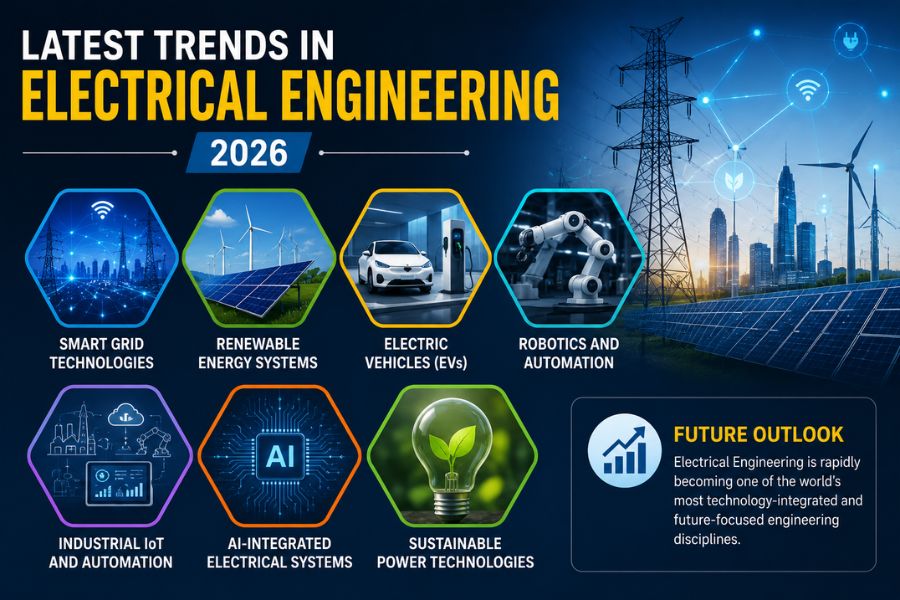
Latest Trends in Electrical Engineering (2026)
Electrical Engineering is evolving faster than ever, driven by technological innovation, sustainability goals, and global industrial transformation. In 2026, the field is no longer limited to traditional power systems—it now plays a central role in next-generation technologies.
Key emerging trends include:
Smart grid technologies
Renewable energy systems
Electric vehicles (EVs)
Robotics and automation
Industrial IoT and automation
AI-integrated electrical systems
Sustainable power technologies
These advancements are creating new career pathways in intelligent infrastructure, green energy, autonomous systems, and digital manufacturing. Electrical engineers with expertise in these domains are expected to remain in high demand across global markets.
Future Outlook:
Electrical Engineering is rapidly becoming one of the world’s most technology-integrated and future-focused engineering disciplines.
Pros and Cons of MTech in Electrical Engineering
Before pursuing MTech Electrical Engineering, students should carefully evaluate both the benefits and challenges.
Pros:
Strong industry demand
Higher salary potential
Government and private sector opportunities
International career scope
Evergreen and future-proof field
Cons:
Requires an additional 2 years of study
GATE preparation can be challenging
Admission to top colleges is highly competitive
While the degree requires commitment, the long-term career rewards often outweigh the short-term challenges.
Common Mistakes to Avoid
Many students make avoidable mistakes that can impact their career growth after MTech Electrical Engineering.
Common mistakes include:
Choosing the wrong specialisation
Ignoring GATE preparation
Failing to develop practical software skills
Selecting low-quality institutions
Overlooking industry trends
Avoiding these errors can significantly improve academic outcomes, employability, and long-term return on investment.
Expert Tips for Success
Success in MTech Electrical Engineering depends on strategic planning, skill development, and future-focused decision-making.
Top expert recommendations:
Start GATE preparation early
Master tools like MATLAB, Simulink, and AutoCAD
Choose future-ready specialisations
Gain internship experience
Build practical, technical, and research projects
Students who combine academic excellence with real-world technical skills often secure better placements and stronger career growth.
Is MTech in Electrical Engineering Worth It in 2026?
For most students, MTech Electrical Engineering continues to deliver strong ROI in 2026—especially when pursued from reputed government institutes or top-tier universities.
Worth It If:
✔ You want higher salary growth
✔ You seek PSU or advanced private sector roles
✔ You aim for technical specialisation
✔ You are interested in renewable energy, automation, or EV industries
Government institutes offer particularly strong ROI due to affordable fees, scholarships, and excellent placement outcomes.
Final Verdict:
Yes—MTech in Electrical Engineering remains one of the best postgraduate engineering options in 2026 for students seeking technical expertise, career stability, high earning potential, and future-proof opportunities.
Conclusion
MTech in Electrical Engineering is more than an academic upgrade—it’s a strategic investment in a future-driven career.
As industries shift toward electrification, automation, renewable systems, and advanced technology, skilled electrical engineers will continue to remain at the centre of global development.
👉 If you want higher salaries, technical authority, and future-ready engineering expertise, MTech in Electrical Engineering is one of the smartest educational choices you can make in 2026.
H2: FAQs
Q1: Is GATE mandatory?
For top colleges, yes.
Q2: Duration?
2 years.
Q3: Best specialisation?
Power systems, EV, renewable energy.
Q4: Salary after MTech?
₹5–25 LPA+.
Q5: Government jobs available?
Yes.
Q6: Worth it?
Highly, for specialisation.
Enter Your Details to Unlock Eligibility
Get personalized college recommendations and scholarship opportunities