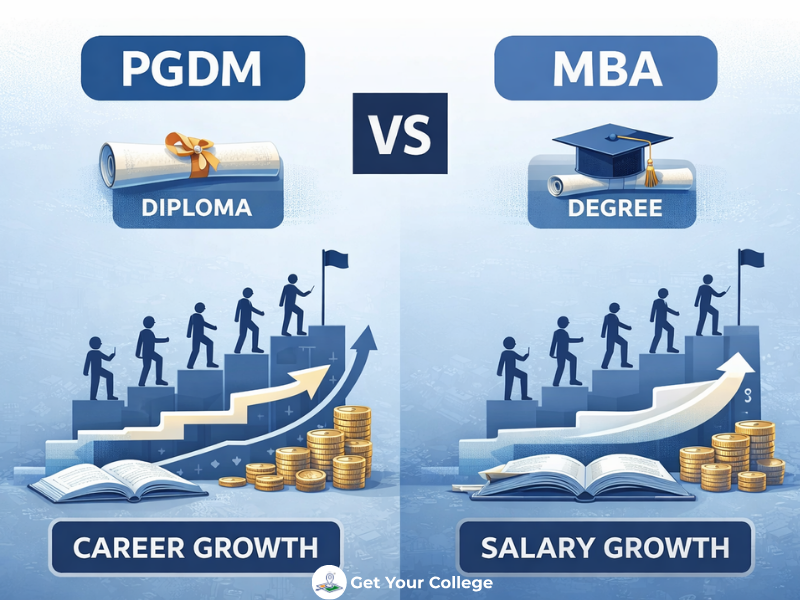
Every year, thousands of Indian students face the same dilemma after graduation:
Should I pursue an MBA or a PGDM?
At first glance, both programs appear similar. Both promise management education, corporate exposure, placements, and leadership careers. Yet, in reality, PGDM and MBA are not the same, and choosing the wrong option without understanding the difference can directly impact career growth, salary trajectory, and long-term opportunities.
As the management admissions 2026 approach, this confusion has become even more relevant due to:
Rapid expansion of private business schools
Growing importance of specialisation and industry exposure
Rising MBA and PGDM fees
Increased focus on ROI and employability
This detailed guide is written to help students and parents understand the real difference between PGDM and MBA, beyond marketing claims, and choose the option that offers better career growth and salary outcomes based on individual profiles.
Universities
Government institutions
UGC-recognised colleges
Degree program (not a diploma)
Curriculum approved by the university
Follows academic and regulatory frameworks
Less frequent curriculum updates
MBAs are typically offered by:
Central universities
State universities
Deemed universities
University-affiliated colleges
PGDM (Post Graduate Diploma in Management) is a diploma program, usually offered by:
Autonomous institutes
AICTE-approved private business schools
Diploma, not a degree
Approved by AICTE, not UGC
Curriculum is industry-driven and flexible
Regular updates based on market trends
PGDM programs are typically offered by top autonomous B-schools, including some of India’s most reputed management institutes.
One of the biggest myths is that a degree is always superior to a diploma. In management education, this assumption is incorrect.
Factor | MBA | PGDM |
|---|---|---|
Nature | Degree | Diploma |
Approval Body | UGC | AICTE |
Offered By | Universities | Autonomous institutes |
Curriculum Updates | Slower | Faster |
Industry Input | Limited | Strong |
In the corporate world, employability and skills matter more than degree labels.
From a recruiter’s perspective, companies do not shortlist candidates based on MBA or PGDM labels.
Quality of the institute
Curriculum relevance
Internships and live projects
Skillset and specialization
Communication and problem-solving ability
Top PGDM institutes often have better industry acceptance than average MBA colleges.
University-designed syllabus
More theoretical orientation
Less frequent revisions
Standardised across affiliated colleges
Designed by the institute
Strong industry involvement
Regular updates (AI, Analytics, FinTech, etc.)
More practical and case-study driven
Counsellor insight:
If your goal is corporate readiness, curriculum flexibility matters.
Both MBA and PGDM offer similar specialisations, but delivery differs.
Marketing
Finance
Human Resources
Operations
Business Analytics
AI & Digital Management
PGDM programs often introduce new-age specialisations faster than university MBAs.
Program Type | Fee Range |
|---|---|
Government MBA | ₹50,000 – ₹3 lakhs |
State University MBA | ₹2 – ₹6 lakhs |
Private University MBA | ₹6 – ₹15 lakhs |
Top PGDM Institutes | ₹15 – ₹25 lakhs |
High fees do not automatically mean better outcomes.
Institute Tier | MBA Avg CTC | PGDM Avg CTC |
|---|---|---|
Top Tier | ₹15–30 LPA | ₹18–35 LPA |
Mid Tier | ₹6–10 LPA | ₹7–12 LPA |
Average | ₹3–5 LPA | ₹4–6 LPA |
Key insight:
A good PGDM often outperforms an average MBA in salary outcomes.
Career growth depends on:
First job role
Skill acquisition
Specialization relevance
Individual performance
Stable, gradual growth
Preferred for government roles, academia, and PhD pathways
Faster early-career growth
Strong corporate exposure
Better suited for private sector leadership tracks
Goal | Better Option |
|---|---|
Government Jobs | MBA |
PhD & Academia | MBA |
Corporate Leadership | PGDM |
Consulting & Product Roles | PGDM |
The budget is limited
Government university options are available
Academic stability is preferred
Strong private institute available
Willing to invest in skill-driven education
Targeting corporate careers
Choosing MBA or PGDM based on name alone
Ignoring the institute's quality
Not evaluating specialisation strength
Believing marketing placement claims
Overlooking ROI
Identify career goals
Shortlist institutes, not program names
Compare placement data honestly
Evaluate curriculum relevance
Consider long-term growth, not first salary
Choosing between an MBA and PGDM requires a deep understanding of institutes, career outcomes, and individual profiles. At Get Your College, students receive experience-driven counselling that focuses on right-fit institute selection, realistic ROI evaluation, and long-term career planning, not generic advice. The emphasis is always on career sustainability and growth, not labels.
There is no universal winner.
A top PGDM is often better than an average MBA
A reputed university MBA can outperform a weak PGDM
The institute matters more than the program name
The right choice depends on:
Career goals
Budget
College quality
Specialization relevance
In management education, the right environment shapes the right leader.